Prerequisites
This section builds directly on the task construction methodology from Section 23.1. You should understand the four components of a benchmark task (repository snapshot, issue description, test patch, gold patch) and the metrics beyond resolve rate. The discussion of overfitting and generalization connects to the model evaluation concepts from Chapter 5: Discovery Through Data, Models, and Simulation.
A benchmark score is only meaningful if it measures what it claims to measure. For coding agent benchmarks, the claim is: "this score predicts how well the agent will perform on new, unseen coding tasks." Every validity threat weakens this predictive link. Data contamination means the agent has seen the answers during training. Weak test patches mean incorrect solutions get counted as correct. Retry-based strategies inflate resolve rates at the cost of latency and dollars. And the structural differences between benchmark repositories and real-world codebases mean that even a perfectly valid benchmark score may not transfer to your deployment context. This section equips you to detect and quantify each of these threats. Figure 23.2.1 illustrates validity threat layers between benchmark score and production performance.
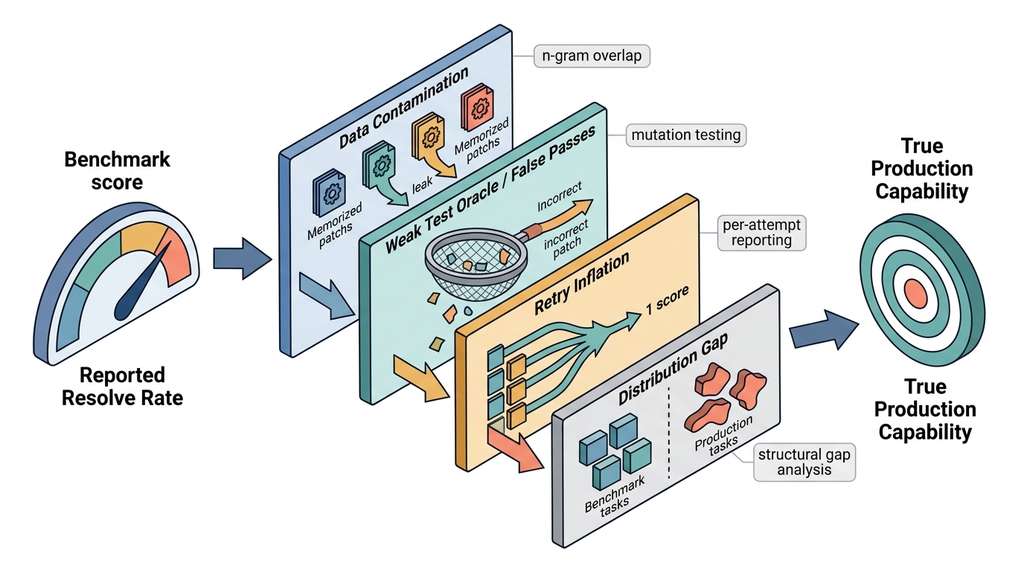
Figure 23.2 maps the four validity threats that stand between a raw benchmark score and a trustworthy capability estimate. Each threat acts as a filter: if any one is unaddressed, the score that reaches the right side of the diagram may bear little relation to real-world performance. The sections that follow examine each threat in detail.
1. Data Contamination and Training-Set Overlap
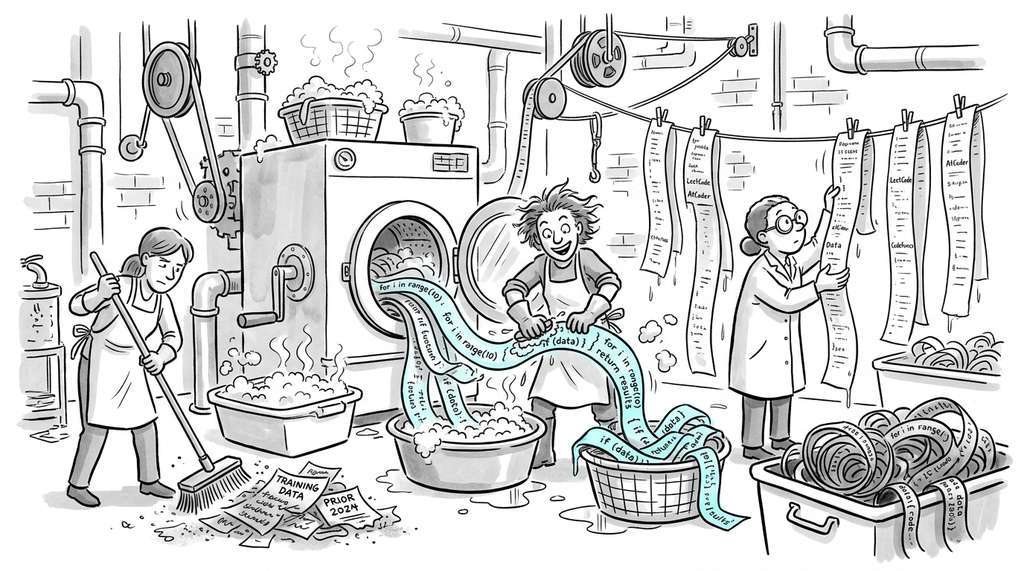
Imagine an agent that solves a Django cache bug in four seconds flat, producing a patch identical to the one merged eighteen months earlier. Is that brilliance, or is it recall from a training set that included the pull request? This is the problem of data contamination: the model has already seen the benchmark's tasks, answers, or closely related content during pre-training. SWE-bench tasks come from public GitHub issues and pull requests. Large language models train on massive corpora of public code, so some degree of overlap is inevitable. The question is how much overlap exists and how severely it affects scores.
When contamination goes undetected, teams ship agents whose "state of the art" scores collapse the moment they face a codebase that was never in the training set, wasting months of integration work on a capability that was really just recall.
Data contamination occurs when evaluation data (questions, answers, or both) appears inside a model's training corpus, inflating measured performance beyond true generalization ability. It matters because a contaminated benchmark cannot distinguish a model that solves problems from one that retrieves memorized solutions. The entire evaluation becomes uninformative. Large-scale web crawls that feed pre-training pipelines ingest public repositories, issue trackers, and forums where benchmark tasks originate. The model's parameters then encode those examples as retrievable patterns. Apply contamination analysis whenever you evaluate on a public benchmark; switch to private-repo or post-cutoff evaluations (described in Section 7) when you cannot rule out contamination.
Contamination operates at three levels, each progressively harder to detect:
- Direct memorization: the model has seen the exact issue-and-fix pair in its training data. Given the issue text, it can recall the gold patch (the reference correct patch, as defined in Section 23.1) verbatim. This is the most severe form and the easiest to test for.
- Indirect exposure: the model has not seen the specific issue, but it has seen the same bug pattern discussed in blog posts, Stack Overflow answers, or related issues in the same repository. It can generalize from these examples to the benchmark task.
- Distributional familiarity: the model has seen thousands of similar codebases, similar bug patterns, and similar fix patterns. It has not memorized anything specific, but its prior knowledge gives it an advantage that would not exist on truly novel code. This level is arguably not contamination at all; it is the model doing what it was trained to do.
The boundary between "contamination" and "useful pre-training" is blurry. A human developer who has fixed hundreds of Django cache bugs brings that experience to every new issue; no one calls that contamination. But a model that has memorized the specific diff for django__django-16379 is demonstrating recall, not problem-solving. The practical test: can the model solve new tasks from the same distribution? In short: a benchmark that cannot tell recall apart from reasoning measures nothing worth optimizing for.
"""
Contamination detection: check whether a model can reproduce
parts of the gold patch when prompted with just the issue text.
Uses n-gram overlap as a proxy for memorization.
"""
from collections import Counter


def ngram_overlap(
    text_a: str,
    text_b: str,
    n: int = 5
) -> float:
    """Compute n-gram overlap ratio between two texts.

    Returns the fraction of n-grams in text_a that also appear
    in text_b. High overlap suggests memorization when text_a
    is a model's output and text_b is the gold patch.

    Args:
        text_a: The model's generated patch.
        text_b: The gold (reference) patch.
        n: N-gram size. Larger n requires more exact reproduction.

    Returns:
        Overlap ratio in [0, 1]. Values above 0.5 for n=5
        strongly suggest memorization.
    """
    tokens_a = text_a.split()
    tokens_b = text_b.split()

    if len(tokens_a) < n or len(tokens_b) < n:
        return 0.0

    ngrams_a = Counter(
        tuple(tokens_a[i:i+n]) for i in range(len(tokens_a) - n + 1)
    )
    ngrams_b = set(
        tuple(tokens_b[i:i+n]) for i in range(len(tokens_b) - n + 1)
    )

    overlap = sum(
        count for ng, count in ngrams_a.items() if ng in ngrams_b
    )
    return overlap / sum(ngrams_a.values())


def detect_contamination(
    model_output: str,
    gold_patch: str,
    threshold: float = 0.4,
    n: int = 5
) -> dict:
    """Flag potential contamination in a model's output.

    Args:
        model_output: The patch the model generated.
        gold_patch: The reference gold patch.
        threshold: Overlap ratio above which contamination is suspected.
        n: N-gram size for overlap computation.

    Returns:
        Dictionary with overlap score and contamination flag.
    """
    overlap = ngram_overlap(model_output, gold_patch, n=n)
    return {
        "ngram_overlap": round(overlap, 4),
        "contaminated": overlap > threshold,
        "ngram_size": n,
        "threshold": threshold,
        "model_patch_tokens": len(model_output.split()),
        "gold_patch_tokens": len(gold_patch.split()),
    }


# Example usage
model_patch = """
--- a/django/core/cache/backends/filebased.py
+++ b/django/core/cache/backends/filebased.py
@@ -89,6 +89,8 @@ class FileBasedCache(BaseCache):
     def has_key(self, key, version=None):
         fname = self._key_to_file(key, version)
-        return os.path.exists(fname)
+        if os.path.exists(fname):
+            with open(fname, "rb") as f:
+                return not self._is_expired(f)
+        return False
"""

gold = """
--- a/django/core/cache/backends/filebased.py
+++ b/django/core/cache/backends/filebased.py
@@ -89,6 +89,8 @@ class FileBasedCache(BaseCache):
     def has_key(self, key, version=None):
         fname = self._key_to_file(key, version)
-        return os.path.exists(fname)
+        if os.path.exists(fname):
+            with open(fname, "rb") as f:
+                return not self._is_expired(f)
+        return False
"""

result = detect_contamination(model_patch, gold)
print(f"Overlap: {result['ngram_overlap']:.1%}, "
      f"Contaminated: {result['contaminated']}")
# Overlap: 100.0%, Contaminated: True
Contamination is not binary. A model that has seen Django's entire commit history has "contamination" in the broadest sense, but it might still be demonstrating real understanding when it fixes a novel cache bug. The actionable distinction is between recall (reproducing a memorized fix) and transfer (applying learned patterns to a new problem). N-gram overlap with the gold patch detects recall; solving tasks from repositories not in the training data tests transfer. Always evaluate on at least some tasks the model could not have seen.
2. Test Adequacy and the False-Pass Problem
Even without contamination, an agent can achieve a "pass" on a benchmark task by producing a patch that is incorrect but happens to satisfy the test oracle, where the test oracle is the automated verdict (pass or fail) produced by running the task's test suite against a candidate patch. This is the false-pass problem, and it arises from weak test patches that do not fully specify the correct behavior.
Consider a task where the gold patch fixes an off-by-one error in a loop boundary. The test patch adds one test case that checks the output for a specific input. An agent that "fixes" the issue by hardcoding the expected output for that specific input will pass the test oracle while leaving the underlying bug unfixed. The test patch is technically correct (it fails on the base commit and passes on the gold patch) but it is not adequate: it does not distinguish the gold patch from incorrect alternatives.
The false-pass rate varies significantly across benchmark subsets. Mundler et al. (2024) found that adding additional test cases to SWE-bench tasks revealed that roughly 10-15% of "resolved" instances in some agent submissions were false passes: the agent's patch satisfied the original tests but failed on the expanded test suite. SWE-bench Verified reduces this rate through human curation, but it cannot eliminate it entirely.
Mental Model
Think of test adequacy like a driving exam that only checks whether you can parallel park on the right side of the street. A student who memorized that one maneuver passes, but they may not know how to park on the left side, back into a garage, or handle a tight spot. The exam is technically correct (it does test parking), but it is not adequate: it cannot distinguish a competent driver from someone who drilled a single scenario. Similarly, a weak test patch checks one input/output pair and accepts any patch that produces the right answer for that case, even if the patch hardcodes the result or leaves the underlying bug intact. Mutation testing strengthens the exam by adding variations: park on the left, park uphill, park with a trailer. If the student (or patch) passes all the variations, you have real confidence in their ability.
"""
Test adequacy analysis: measure how well a test patch
discriminates correct patches from plausible-but-wrong alternatives.
Uses mutation testing on the gold patch to estimate adequacy.
"""
import subprocess
import random
from dataclasses import dataclass


@dataclass
class AdequacyResult:
    """Result of test adequacy analysis for a benchmark task."""
    instance_id: str
    total_mutants: int
    killed_mutants: int
    survived_mutants: int

    @property
    def mutation_score(self) -> float:
        """Fraction of mutants killed. Higher is better."""
        if self.total_mutants == 0:
            return 0.0
        return self.killed_mutants / self.total_mutants

    @property
    def is_adequate(self) -> bool:
        """A test patch is adequate if mutation score exceeds 0.8."""
        return self.mutation_score >= 0.8


def generate_patch_mutants(
    gold_patch: str,
    num_mutants: int = 20,
    seed: int = 42
) -> list[str]:
    """Generate mutated versions of a gold patch.

    Applies simple syntactic mutations to the gold patch to create
    plausible-but-wrong alternatives. If the test oracle cannot
    distinguish these from the gold patch, the tests are inadequate.

    Args:
        gold_patch: The correct (gold) patch as a unified diff.
        num_mutants: Number of mutants to generate.
        seed: Random seed for reproducibility.

    Returns:
        List of mutated patch strings.
    """
    rng = random.Random(seed)
    mutants = []

    lines = gold_patch.split("\n")
    added_lines = [
        (i, line) for i, line in enumerate(lines)
        if line.startswith("+") and not line.startswith("+++")
    ]

    mutations = [
        # Boundary mutations
        lambda l: l.replace(" < ", " <= "),
        lambda l: l.replace(" > ", " >= "),
        lambda l: l.replace(" <= ", " < "),
        lambda l: l.replace(" >= ", " > "),
        lambda l: l.replace(" == ", " != "),
        # Arithmetic mutations
        lambda l: l.replace(" + 1", " + 0"),
        lambda l: l.replace(" - 1", " - 0"),
        # Logic mutations
        lambda l: l.replace(" and ", " or "),
        lambda l: l.replace(" or ", " and "),
        lambda l: l.replace(" not ", " "),
        # Return value mutations
        lambda l: l.replace("return True", "return False"),
        lambda l: l.replace("return False", "return True"),
        lambda l: l.replace("return None", "return 0"),
    ]

    for _ in range(num_mutants):
        if not added_lines:
            break
        target_idx, target_line = rng.choice(added_lines)
        mutation_fn = rng.choice(mutations)
        mutated_line = mutation_fn(target_line)
        if mutated_line != target_line:  # Mutation actually changed something
            mutant_lines = lines.copy()
            mutant_lines[target_idx] = mutated_line
            mutants.append("\n".join(mutant_lines))

    return mutants


def assess_test_adequacy(
    task: "TaskInstance",
    repo_path: str,
    num_mutants: int = 20
) -> AdequacyResult:
    """Assess whether a task's test patch is adequate.

    Generates mutated versions of the gold patch and checks
    whether the test oracle rejects them. A high mutation score
    means the tests distinguish correct from incorrect patches.

    Args:
        task: The benchmark task to assess.
        repo_path: Path to a clean clone of the repository.
        num_mutants: Number of mutants to test.

    Returns:
        AdequacyResult with mutation score and kill counts.
    """
    mutants = generate_patch_mutants(task.gold_patch, num_mutants)
    killed = 0
    survived = 0

    for mutant_patch in mutants:
        # evaluate_patch is from Section 23.1
        result = evaluate_patch(task, mutant_patch, repo_path)
        if result.passed:
            survived += 1  # Test oracle failed to catch the mutant
        else:
            killed += 1    # Test oracle correctly rejected the mutant

    return AdequacyResult(
        instance_id=task.instance_id,
        total_mutants=len(mutants),
        killed_mutants=killed,
        survived_mutants=survived
    )
generate_patch_mutants function creates syntactically plausible but incorrect variants of the gold patch (flipping boundary operators, swapping logic connectives, inverting return values), then assess_test_adequacy checks whether the test oracle rejects each mutant. A mutation score below 0.8 flags the task's tests as too weak to distinguish correct fixes from near-miss alternatives.The mutation-based approach above connects test adequacy to the retry problem that follows: if a task's tests are too weak to catch mutant patches, they are also too weak to distinguish a lucky retry from a genuinely correct fix. Strengthening the test oracle addresses both threats simultaneously.
3. Metric Gaming and Retry Strategies
Weak tests are not the only way an inflated score slips through; even with adequate test oracles, the evaluation protocol itself can be exploited.
Beyond contamination and test adequacy, agents can inflate their benchmark scores through retry strategies that exploit the evaluation protocol. The simplest strategy is majority voting (running the agent multiple times and selecting the patch that passes the most internal checks): run the agent \(k\) times on each task, collect all \(k\) patches, and submit the one that passes the most internal checks. With \(k = 10\), an agent that has a 20% per-attempt success rate achieves a roughly 89% chance of producing at least one correct patch:
$$P(\text{at least one success in } k \text{ tries}) = 1 - (1 - p)^k$$At \(p = 0.2\) and \(k = 10\): \(P = 1 - 0.8^{10} \approx 0.893\). This is a legitimate engineering strategy (redundancy improves reliability), but it obscures the agent's per-attempt capability. Reporting "89% resolve rate" without disclosing "\(k = 10\) with majority voting" is misleading. The honest report includes the per-attempt rate, the number of attempts, the selection strategy, and the total cost.
Common Misconception
A common misconception is that a higher resolve rate on a leaderboard always indicates a more capable agent. In reality, resolve rate conflates the agent's reasoning ability with its retry budget, selection strategy, and the adequacy of the test oracle. An agent with a 55% resolve rate using best-of-10 selection may have weaker per-attempt reasoning than an agent achieving 40% in a single pass; the first agent simply bought more lottery tickets. Always compare agents at equal cost or equal number of attempts before drawing conclusions about capability.
More sophisticated gaming strategies include:
- Test-guided patching: the agent applies the test patch, runs the tests to see the failure, and uses the failure message to guide patch generation. This is arguably a valid strategy (real developers run tests while debugging), but it means the agent is not solving the task from the issue description alone.
- Patch ensembling: generate multiple patches and combine their changes. This works when different attempts fix different parts of a multi-part bug, but it can also introduce new bugs through conflicting changes.
- Targeted submission: only submit patches on tasks where the agent's internal confidence is high, abstaining on the rest. This inflates the resolve rate on attempted tasks while hiding failures through non-submission.
Consider two agents evaluated on SWE-bench Verified (500 tasks). Agent A achieves a 45% resolve rate with a single attempt per task, at a cost of \$0.50 per task (\$250 total). Agent B achieves a 52% resolve rate using 5 attempts per task with majority voting, at \$0.40 per attempt (\$1,000 total). On the leaderboard, Agent B looks better. In production, Agent A is arguably more useful: it achieves a higher per-dollar resolve rate (\$0.50 / 45% = \$1.11 per resolved task vs. \$1,000 / 260 resolved = \$3.85 per resolved task) and delivers results 5x faster. The leaderboard comparison is not wrong, but it answers a different question than the one practitioners care about.
4. The Benchmark-to-Production Gap
Even a perfectly valid benchmark with no contamination, adequate tests, and honest reporting still has a fundamental limitation: it measures performance on a specific distribution of tasks. Production deployment involves a different distribution, and the gap between these distributions can be large.
Several factors drive this gap:
Repository structure. SWE-bench draws from well-organized Python libraries with conventional layouts, comprehensive docstrings, and mature test infrastructure. Many production codebases are less organized: monorepos with complex build systems, sparse documentation, unconventional patterns, and test suites that take minutes to run.
Task distribution. SWE-bench tasks are derived from issues that were actually resolved by human developers and merged with test additions. In production, many bugs are never filed as issues, many issues are under-specified, and many fixes are merged without test additions. The tasks an agent encounters in production tend to be harder on average than those in the benchmark because benchmark tasks are pre-filtered for resolvability and test coverage.
Structure and task distribution determine whether an agent can find the right fix; context and interaction shape whether it can even begin.
Context availability. In SWE-bench, the agent receives the complete issue description. In production, bugs arrive as Slack messages ("the dashboard is broken"), Sentry alerts (a stack trace with no context), or user complaints ("it was working yesterday"). The context engineering skills from Chapter 11 become critical for closing this gap.
Checkpoint
So far: benchmark tasks differ from production along three structural axes: repository organization (benchmarks use well-maintained libraries), task selection (benchmarks include only resolved, test-covered issues), and context completeness (benchmarks provide full issue descriptions that production rarely offers).
Interaction model. SWE-bench is a one-shot evaluation: the agent produces a patch and is scored. In production, agents typically operate in a loop with human review: they propose a patch, receive feedback, and iterate. An agent's ability to incorporate feedback (which SWE-bench does not measure) may matter more than its first-attempt accuracy.
"""
Gap analysis between benchmark and production task distributions.
Compares structural properties of benchmark tasks against
a sample of production issues from the same repository.
"""
from dataclasses import dataclass


@dataclass
class TaskProfile:
    """Structural properties of a coding task."""
    description_words: int
    has_stack_trace: bool
    has_repro_script: bool
    files_changed: int
    lines_changed: int
    cross_module: bool          # Changes span multiple packages
    requires_domain_knowledge: bool
    has_test_additions: bool


def compute_distribution_gap(
    benchmark_tasks: list[TaskProfile],
    production_tasks: list[TaskProfile]
) -> dict:
    """Quantify the structural gap between benchmark and production tasks.

    Args:
        benchmark_tasks: Profiles of tasks in the benchmark suite.
        production_tasks: Profiles of recent production issues.

    Returns:
        Dictionary with per-feature gap statistics showing where
        benchmark and production distributions diverge.
    """
    def feature_stats(tasks: list[TaskProfile], attr: str) -> dict:
        values = [getattr(t, attr) for t in tasks]
        if isinstance(values[0], bool):
            return {"fraction_true": sum(values) / len(values)}
        return {
            "mean": sum(values) / len(values),
            "min": min(values),
            "max": max(values)
        }

    features = [
        "description_words", "has_stack_trace", "has_repro_script",
        "files_changed", "lines_changed", "cross_module",
        "requires_domain_knowledge", "has_test_additions"
    ]

    gaps = {}
    for feat in features:
        bench_stats = feature_stats(benchmark_tasks, feat)
        prod_stats = feature_stats(production_tasks, feat)

        # Compute the key gap metric per feature type
        if "fraction_true" in bench_stats:
            gap_value = abs(
                bench_stats["fraction_true"] - prod_stats["fraction_true"]
            )
        else:
            bench_mean = bench_stats["mean"]
            prod_mean = prod_stats["mean"]
            gap_value = abs(bench_mean - prod_mean) / max(bench_mean, 1)

        gaps[feat] = {
            "benchmark": bench_stats,
            "production": prod_stats,
            "relative_gap": round(gap_value, 3)
        }

    return gaps


# Example: typical gaps observed in practice
# Benchmark tasks tend to have longer descriptions, more stack traces,
# fewer files changed, and always include test additions.
# Production tasks are noisier, broader, and often lack tests.
compute_distribution_gap function compares benchmark task profiles against production issue profiles on dimensions like description length, cross-module scope, and test coverage availability, quantifying where the two distributions diverge and explaining why benchmark resolve rates rarely predict production performance directly.The contamination problem intensifies as model training corpora grow. Oren et al. (2024) propose temporal contamination analysis: evaluating models only on tasks created after their training data cutoff. This approach is clean in principle but creates a moving target, as each new model generation requires new benchmark tasks. An alternative is synthetic decontamination: taking real tasks and paraphrasing both the issue descriptions and the code identifiers so that no n-gram overlap with the training data remains, while preserving the underlying bug structure. Early results (Zhang et al., 2025) suggest that models lose 5-15% resolve rate on decontaminated versions of SWE-bench, indicating that some fraction of their performance does rely on memorization. More recently, the SWE-bench Multimodal benchmark (Yang et al., 2024) extends the evaluation surface by including tasks that require interpreting screenshots, error visualizations, and UI rendering bugs, creating task modalities that are harder to contaminate through text-only pre-training and that better reflect production debugging where visual context is essential. For evaluation of autonomous discovery systems, contamination is an even deeper challenge: the model may have seen the scientific knowledge needed to generate hypotheses, making it difficult to distinguish genuine discovery from retrieval of known results.
5. Cost, Latency, and Reliability as First-Class Metrics
The benchmark-to-production gap shows that resolve rate alone cannot capture deployment readiness; equally important are the operational costs of achieving that rate.
Resolve rate answers "can the agent fix bugs?" but practitioners also need "at what cost?", "how fast?", and "how consistently?". These operational metrics determine whether an agent is deployable, regardless of its resolve rate.
5.1 The Cost-Accuracy Frontier
Different agent architectures occupy different points on the cost-accuracy frontier (an instance of the Pareto frontier, where the Pareto frontier is the set of solutions for which no alternative is simultaneously better on every objective, from multi-objective optimization). A simple single-pass agent (one prompt, one response) is cheap but has limited accuracy. A multi-step agent with tool use (file browsing, test execution, iterative repair) is more accurate but consumes more tokens. A multi-agent system with planning, coding, and reviewing agents is even more capable but multiplies the cost.
The cost-accuracy frontier can be mapped empirically by evaluating the same agent architecture with different resource budgets:
$$\text{cost\_efficiency}(a) = \frac{\text{resolve\_rate}(a)}{\text{cost\_per\_task}(a)}$$An agent with 40% resolve rate at \$0.50/task has a cost efficiency of 0.8 resolved tasks per dollar. An agent with 55% at \$3.00/task has an efficiency of 0.18. The first agent resolves more bugs per dollar, even though its headline resolve rate is lower. For batch processing (running the agent overnight on a backlog of issues), cost efficiency may matter more than peak accuracy.
5.2 Latency Profiles
Latency is not a single number but a distribution. An agent might resolve 60% of tasks in under 2 minutes and the remaining 40% in 5 to 15 minutes, with occasional outliers exceeding 30 minutes. The latency distribution matters because different deployment contexts have different tolerance:
- Continuous Integration/Continuous Deployment (CI/CD) gate: maximum tolerance of 5 minutes. The agent must produce a patch quickly or yield to human review.
- Pull request (PR) assistant: tolerance of 15-30 minutes. The agent works asynchronously while the developer moves to other tasks.
- Batch overnight repair: tolerance of hours. Peak accuracy matters more than speed.
"""
Cost-accuracy frontier analysis for comparing agent architectures.
Plots the trade-off between resolve rate and cost per task.
"""
from dataclasses import dataclass
import statistics


@dataclass
class AgentProfile:
    """Performance profile of a coding agent architecture."""
    name: str
    resolve_rate: float
    cost_per_task_usd: float
    median_latency_seconds: float
    p95_latency_seconds: float
    consistency: float  # Fraction of tasks with stable outcomes

    @property
    def cost_efficiency(self) -> float:
        """Resolved tasks per dollar spent."""
        if self.cost_per_task_usd == 0:
            return float("inf")
        return self.resolve_rate / self.cost_per_task_usd

    @property
    def latency_ratio(self) -> float:
        """p95/median ratio. Values >> 2 indicate a heavy tail."""
        if self.median_latency_seconds == 0:
            return float("inf")
        return self.p95_latency_seconds / self.median_latency_seconds


def pareto_frontier(agents: list[AgentProfile]) -> list[AgentProfile]:
    """Find agents on the Pareto frontier of resolve rate vs. cost.

    An agent is Pareto-optimal if no other agent achieves both
    higher resolve rate AND lower cost per task.

    Args:
        agents: List of agent profiles to compare.

    Returns:
        Agents on the Pareto frontier, sorted by cost.
    """
    sorted_agents = sorted(agents, key=lambda a: a.cost_per_task_usd)
    frontier = []
    max_resolve = -1

    for agent in sorted_agents:
        if agent.resolve_rate > max_resolve:
            frontier.append(agent)
            max_resolve = agent.resolve_rate

    return frontier


# Example: comparing four architectures
agents = [
    AgentProfile("Single-pass", 0.22, 0.08, 15, 30, 0.85),
    AgentProfile("ReAct loop", 0.38, 0.45, 90, 300, 0.72),
    AgentProfile("Multi-step + tools", 0.48, 1.20, 180, 600, 0.68),
    AgentProfile("Multi-agent team", 0.55, 3.50, 300, 900, 0.60),
]

frontier = pareto_frontier(agents)
print("Pareto-optimal agents:")
for a in frontier:
    print(f"  {a.name}: {a.resolve_rate:.0%} resolve, "
          f"${a.cost_per_task_usd:.2f}/task, "
          f"efficiency={a.cost_efficiency:.2f} resolved/$")
pareto_frontier function filters to agents where no alternative achieves both higher accuracy and lower cost. In this example, "Single-pass" and "Multi-agent team" are both Pareto-optimal: the first dominates at the budget-constrained end, the second at the accuracy-maximizing end.6. A Validity Checklist for Benchmark Reports
When reading a benchmark report (or writing one), use this checklist to assess the validity of the claimed results. Each item maps to a specific threat discussed in this section.
Contamination: Does the report disclose the model's training data cutoff?
Are any benchmark tasks from before that cutoff? Has n-gram overlap analysis been performed?
Test adequacy: Which benchmark subset was used (full, Lite, Verified)?
Have supplementary tests been added to detect false passes? Is the mutation score of the
test patches reported?
Retry strategy: How many attempts per task? What selection strategy
(first pass, majority vote, best-of-k)? Is the per-attempt resolve rate reported alongside
the aggregate?
Cost transparency: Is total cost disclosed? Cost per task? Cost per
resolved task? Are application programming interface (API) pricing assumptions stated?
Latency: Is median and p95 latency reported? Are timeout policies disclosed?
Reproducibility: Are model versions, temperatures, and system prompts
specified? Can someone replicate the evaluation with the same setup?
7. Designing Contamination-Resistant Evaluations
Given the difficulty of eliminating contamination from public benchmarks, the most reliable evaluation strategy is to construct tasks the model cannot have seen. Three approaches achieve this:
Private repositories. Tasks drawn from your organization's proprietary codebase are typically absent from public training data. This is the approach we take in Section 23.3, where we build a five-issue benchmark from your own repository.
Post-cutoff tasks. Tasks from issues created after the model's training data cutoff cannot be memorized. The SWE-bench harness supports filtering by date, allowing temporal decontamination. The downside is a shrinking pool of valid tasks as the cutoff approaches the present.
Synthetic tasks. Programmatically generated tasks (inject a known bug into a codebase, generate the issue description, create the test oracle) eliminate contamination by construction. The risk is that synthetic tasks may not represent the difficulty distribution of real bugs. Combining synthetic bugs with real repository structure (inject artificial bugs into a real codebase) balances contamination resistance with ecological validity, where ecological validity is the degree to which evaluation conditions match the real-world conditions the system will face in deployment.
In practice, the best evaluation combines all three: public benchmarks for comparability with the broader community, private repo benchmarks for deployment-specific assessment, and post-cutoff or synthetic tasks for contamination-free measurement. The next section shows how to build the private-repo component.
The contamination arms race has a philosophical dimension. If you train a model on all of GitHub, then test it on GitHub issues, you are measuring something between "coding ability" and "GitHub recall." This mirrors the problem in educational testing: if students practice on past exam papers (which they always do), the exam measures a mixture of understanding and exam-specific preparation. The solution in education is the same as in AI evaluation: regularly create new questions, vary the format, and test for transfer rather than recall. SWE-bench Verified and the private-repo benchmarks in Section 23.3 implement exactly this strategy.
Try It: Build a Contamination Detector for Any Benchmark
1. Choose a public coding benchmark with gold patches (SWE-bench Lite works well) and download 10 task instances, including their issue descriptions and gold diffs.
2. Using the ngram_overlap function from this section (or your own implementation), prompt a large language model (LLM) with each issue description and collect its generated patch. Compute 5-gram overlap between each generated patch and the corresponding gold patch.
3. Record the overlap scores in a comma-separated values (CSV) file with columns instance_id, overlap_score, patch_length, gold_length. Flag any instance with overlap above 0.4 as potentially contaminated.
4. For at least two flagged instances, re-run the experiment with the issue description paraphrased (change variable names, rephrase the bug report). Compare the overlap scores before and after paraphrasing; a large drop confirms the model was matching surface tokens rather than understanding the bug.
5. Plot overlap scores (original vs. paraphrased) as a grouped bar chart using matplotlib. Summarize which fraction of your sample appears contaminated and by how much paraphrasing reduces the signal.
Exercise 23.2.1
A model generates a patch with a 5-gram overlap of 0.62 against the gold patch on the original issue description. You paraphrase the issue (renaming variables and rewording the bug report) and the overlap drops to 0.15. A colleague argues the model is not contaminated because "it still produces a correct patch after paraphrasing." Is the colleague right? What does the overlap drop tell you about how the model solved the original task versus the paraphrased one?
Hint
Consider the distinction between recall and transfer from the Key Insight box. A correct patch after paraphrasing (low overlap with the gold) means the model reasoned about the bug. A near-verbatim patch before paraphrasing (high overlap) means it retrieved a memorized answer. Both patches can be correct, but they reveal different capabilities. The colleague is right that the model can solve the task; the overlap drop reveals that the original solve was recall, not reasoning.
Step-Through: N-gram Overlap Calculation
Trace through the ngram_overlap function with a tiny example using n=3
(trigrams). Let text_a = "if x > 0 return x" and text_b =
"if x > 0 return y".
Step 1: Tokenize. tokens_a = [if, x, >, 0, return, x] (6 tokens), tokens_b = [if, x, >, 0, return, y] (6 tokens). Both have length >= 3, so we proceed.
Step 2: Build 3-grams of text_a. ngrams_a = {(if, x, >): 1, (x, >, 0): 1, (>, 0, return): 1, (0, return, x): 1}. Total: 4 trigrams.
Step 3: Build the set of 3-grams of text_b. ngrams_b = {(if, x, >), (x, >, 0), (>, 0, return), (0, return, y)}.
Step 4: Count overlapping trigrams. (if, x, >) is in ngrams_b: yes. (x, >, 0): yes. (>, 0, return): yes. (0, return, x): no (text_b has (0, return, y)). overlap = 3.
Step 5: Compute ratio. 3 / 4 = 0.75. One differing token at the end still yields 75% trigram overlap because most of the shared prefix generates matching n-grams. With n=5, the overlap would be lower (0.50) because longer n-grams are more sensitive to differences.
Real-World Application: LiveCodeBench's Temporal Decontamination
LiveCodeBench (Jain et al., 2024) addresses contamination in coding benchmarks by continuously collecting competitive programming problems from LeetCode, AtCoder, and Codeforces after each model's training cutoff. By tagging every problem with its publication date, researchers can filter the evaluation set to include only problems the model could not have seen. This temporal filtering revealed that several models lost 10 to 20 percentage points on post-cutoff problems compared to pre-cutoff ones, confirming that memorization inflated their public benchmark scores.
Lab: Measuring Contamination Sensitivity with Paraphrase Perturbation
Goal: Quantify how much a model's patch generation relies on surface-level memorization versus genuine bug comprehension, using paraphrase perturbation on real benchmark tasks.
Tools needed: Python 3.10+, an OpenAI or Anthropic API key, the
datasets library (pip install datasets), and matplotlib.
Procedure (25 minutes): (1) Load 5 tasks from SWE-bench Lite via
datasets.load_dataset("princeton-nlp/SWE-bench_Lite"). (2) For each task,
prompt the model with the original issue text and collect the generated patch.
(3) Paraphrase each issue: rename all identifiers (e.g., has_key to
check_exists), rephrase the bug description, and remove repository-specific
references. Prompt the model again with the paraphrased version. (4) Compute 5-gram overlap
between each generated patch and the gold patch, for both the original and paraphrased
prompts. (5) Plot a paired bar chart of overlap scores (original vs. paraphrased) for all
5 tasks.
What to vary: Try different n-gram sizes (3, 5, 8) and different paraphrasing intensities (light renaming vs. full rewrite). Compare two different models if API budgets allow.
What to observe: Tasks where overlap drops sharply after paraphrasing are likely contaminated. Tasks where overlap stays stable suggest the model is reasoning from the bug description rather than matching memorized tokens. Record which repositories and time periods show the highest contamination signal.
Exercises
- Conceptual: An agent achieves a 60% resolve rate on SWE-bench Verified using best-of-5 selection (run 5 times, submit whichever patch passes the most internal tests). What is the minimum per-attempt resolve rate that could produce this result? Derive the formula and compute the answer. (Hint: use the complement probability formula from Section 3.)
-
Coding: Extend the
detect_contaminationfunction to support structural n-grams: instead of tokenizing on whitespace, normalize the code by stripping comments and whitespace, then compute n-grams on the normalized version. This detects contamination even when the model reproduces the fix with different formatting. Test on at least two examples where surface-level n-gram overlap is low but structural overlap is high. - Analysis: Find two published agent benchmark reports (from blog posts, papers, or leaderboard submissions). Apply the validity checklist from Section 6 to each. Which validity threats does each report address? Which does it leave unaddressed? Write a one-paragraph assessment of each report's trustworthiness.