"She provided the intuition. I provided the exhaustive search. Together we found something neither of us would have found alone. She called it collaboration. I called it complementary optimization."
A Research Agent That Learned to Listen
Prerequisites
This section builds on the autonomous innovation concepts from
Section 58.1, where we established the spectrum of discovery
autonomy and the innovation scoring framework. The research agent architectures from
Chapter 53 provide the agent-side
foundations. The multi-agent coordination protocols from
Chapter 54 apply directly to
human-AI team structures. Familiarity with the responsible AI considerations from
Chapter 57 is important for the
trust calibration discussion.
The Big Picture
The debate between "AI as tool" and "AI as autonomous scientist" presents a false dichotomy.
The most productive mode of discovery is neither fully manual nor fully autonomous, but a
structured collaboration where human scientists and AI agents contribute distinct cognitive
capabilities. Humans excel at problem framing, analogical reasoning, aesthetic judgment, and
ethical evaluation. AI systems excel at exhaustive search, quantitative optimization, pattern
detection across massive datasets, and tireless iteration. Co-discovery is the practice of
designing research workflows that leverage both sets of strengths while compensating for each
side's weaknesses. This section provides both the conceptual framework and the practical
infrastructure for building co-discovery systems.
1. Cognitive Complementarity
A protein engineer notices a subtle pocket geometry that the docking simulation overlooked; in the same hour, the AI screens ten million candidate molecules and surfaces three the engineer would never have considered. This increasingly common scene in a modern drug-discovery lab illustrates the foundational principle of co-discovery: human and artificial intelligence have complementary failure modes, and understanding those complementarities is the basis for designing effective collaboration protocols.
Two intelligent systems whose strengths and weaknesses are anti-correlated (that is, where one system's reliable capabilities correspond to the other's known gaps) will, when paired, typically outperform either system alone. This principle matters because raw capability does not bottleneck scientific discovery; coverage of the full reasoning landscape does. The mechanism is straightforward: each partner catches the other's blind spots, so errors that would propagate unchecked in a solo workflow get corrected at their point of origin. Apply cognitive complementarity as the design basis whenever the research task spans multiple reasoning modes (creative generation, quantitative analysis, contextual judgment). Default to a single-agent approach only when the task falls entirely within one partner's zone of reliable competence.
Table 58.2 maps the cognitive strengths and weaknesses of each partner across the stages of
the scientific method. The pattern is striking: at every stage, the natural weakness of one
partner aligns with the natural strength of the other.
In short: The best discoveries will come not from humans or AI alone, but from partnerships designed so that every blind spot on one side faces a sharp eye on the other.
Table 58.2: Cognitive Complementarity in Scientific Discovery
Difficulty with truly novel concepts outside training
Experiment design
Practical constraints, feasibility judgment
Suboptimal designs, limited exploration
Optimal designs (Bayesian, adaptive)
Limited understanding of lab realities
Data analysis
Recognizing anomalies with narrative significance
Overwhelmed by dimensionality, p-hacking (where the analyst runs many statistical tests and selectively reports significant ones) risk
High-dimensional pattern detection
Spurious correlation, hallucinated patterns
Interpretation
Contextual reasoning, mechanistic insight
Confirmation bias, overconfidence
Systematic uncertainty quantification
Cannot ground findings in physical intuition
Communication
Narrative, persuasion, context for audience
Selective reporting, framing effects
Comprehensive, reproducible reporting
No sense of audience or rhetorical strategy
Table 58.2: Cognitive complementarity across the stages of scientific discovery. Each stage exhibits a natural alignment between one partner's weakness and the other's strength, motivating mixed-initiative collaboration rather than full delegation to either side.
Key Insight: Complementarity Is Not Hierarchy
Cognitive complementarity does not imply that the human is "in charge" and the AI is a "tool,"
nor that the AI should eventually replace the human. It means that the system of human + AI
has capabilities that neither component has alone. A chess analogy is instructive: in "Advanced
Chess" (Kasparov's term), a human-computer team consistently outperforms both the best humans
and the best computers playing alone, not because the human overrides the computer or vice
versa, but because each catches the other's blind spots. The same dynamic applies to
scientific discovery, with the additional complexity that discovery is open-ended rather
than constrained by fixed rules.
2. Mixed-Initiative Research Workflows
A mixed-initiative workflow (where both human and AI can propose actions, and research direction emerges from their interaction rather than from either party's unilateral decisions) requires solving one key design challenge: initiative allocation, which determines who should propose the next step at each point in the
research process.
Without a principled way to decide who leads each step, co-discovery teams fall into one of two traps: the human micromanages every decision, negating the AI's speed advantage, or the AI runs unchecked through high-stakes choices the human should have vetted. Getting initiative allocation wrong does not merely slow research down; it produces the same blind-spot failures that solo work does, erasing the whole point of collaboration.
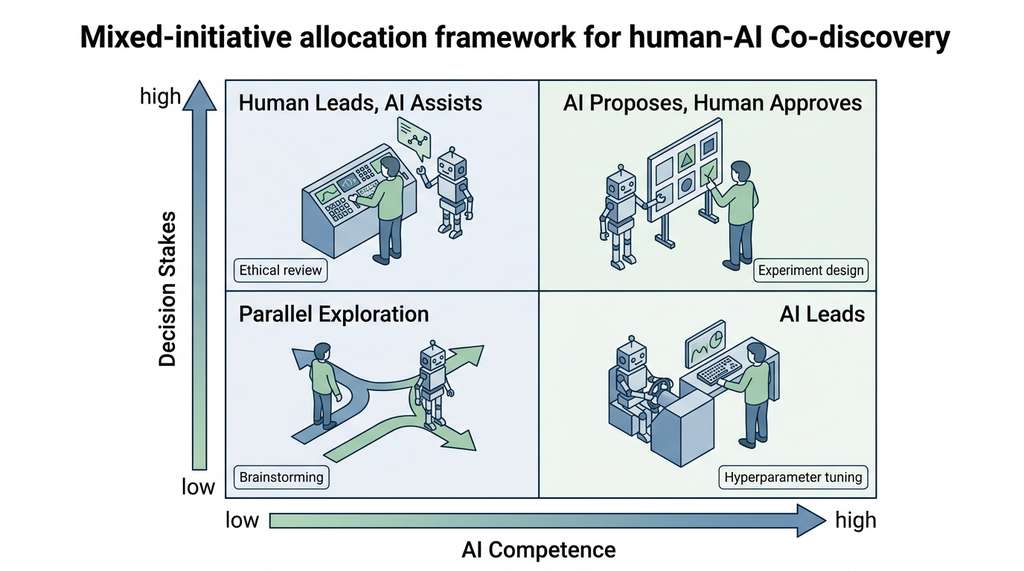
We formalize initiative allocation as a function of two variables: the AI's competence
on the current task (estimated from past performance) and the stakes of the decision
(how costly a mistake would be). Figure 58.3 visualizes this as a 2x2 framework: Figure 58.2.1 illustrates Mixed-initiative allocation framework.
Figure 58.2.1: The mixed-initiative allocation framework maps AI competence against decision stakes to determine which partner should lead each research task, enabling dynamic role-switching throughout the co-discovery process.Figure 58.3: The initiative allocation matrix. Two axes (AI competence on the current task and decision stakes) define four collaboration modes, each prescribing a different balance of human and AI leadership.
High competence, low stakes: AI leads. Examples: hyperparameter tuning,
routine data preprocessing, literature search expansion. The AI acts and reports results.
High competence, high stakes: AI proposes, human approves. Examples:
experimental design for expensive runs, selection of publication-worthy results. The AI
generates a ranked set of options with justifications; the human makes the final call.
Low competence, low stakes: Parallel exploration. Both human and AI
independently explore, then compare notes. Useful for early-stage brainstorming where
diversity of approach matters more than efficiency.
Low competence, high stakes: Human leads, AI assists. Examples: defining
research questions, evaluating ethical implications, making career decisions based on
results. The human drives; the AI provides data, analysis, and alternative perspectives
on request.
Mental Model
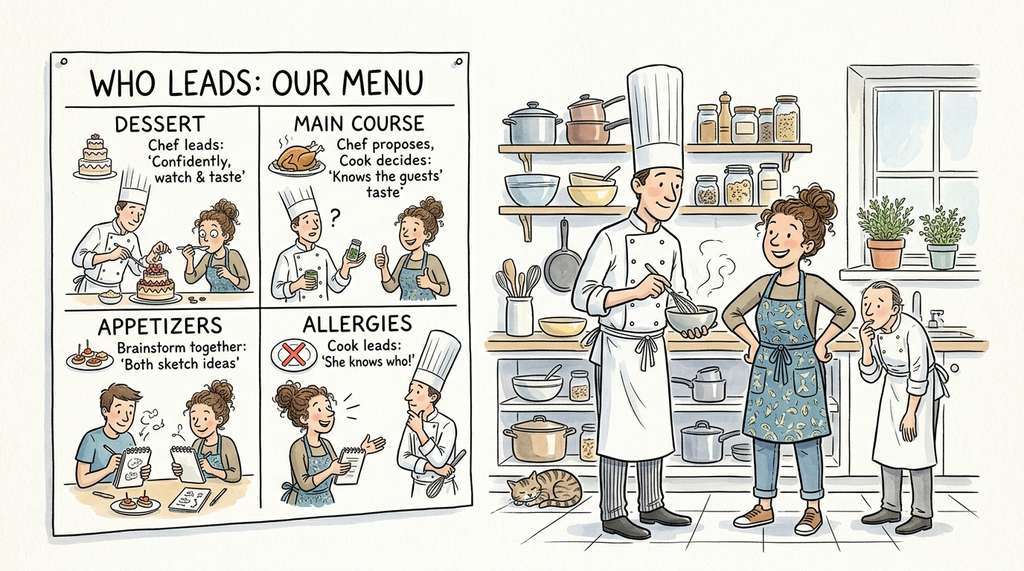
Think of initiative allocation like a kitchen where a home cook and a professional pastry chef are preparing a multi-course meal together. For dessert (high competence, low stakes for the pastry chef), the chef leads and the cook tastes. For the main course seasoning (high competence, high stakes), the chef proposes a flavor profile but the cook, who knows the guests' preferences, gives final approval. For appetizer brainstorming (low competence for both, low stakes), they each sketch ideas independently and then compare. For the menu's dietary accommodations (low competence for the chef, high stakes), the cook leads because she knows which guest has the allergy. The point is not who has more skill overall, but who has the right skill for each specific subtask, and how much damage a mistake would cause.
The following implementation provides an initiative allocator that dynamically assigns roles
based on competence estimation and stakes assessment.
"""
Mixed-initiative research workflow manager.

Dynamically allocates initiative between human and AI based
on estimated competence and decision stakes, implementing the
2x2 framework for co-discovery collaboration.
"""

from dataclasses import dataclass, field
from enum import Enum
from datetime import datetime
from typing import Optional


class InitiativeMode(Enum):
    AI_LEADS = "ai_leads"           # High competence, low stakes
    AI_PROPOSES = "ai_proposes"     # High competence, high stakes
    PARALLEL = "parallel"           # Low competence, low stakes
    HUMAN_LEADS = "human_leads"     # Low competence, high stakes


class TaskType(Enum):
    PROBLEM_FRAMING = "problem_framing"
    HYPOTHESIS_GENERATION = "hypothesis_generation"
    LITERATURE_SEARCH = "literature_search"
    EXPERIMENT_DESIGN = "experiment_design"
    DATA_COLLECTION = "data_collection"
    ANALYSIS = "analysis"
    INTERPRETATION = "interpretation"
    WRITING = "writing"
    ETHICAL_REVIEW = "ethical_review"


@dataclass
class CompetenceEstimate:
    """Tracks AI competence on a task type over time."""
    task_type: TaskType
    successes: int = 0
    attempts: int = 0
    human_overrides: int = 0  # Times human rejected AI proposal

    @property
    def competence(self) -> float:
        """
        Bayesian estimate of competence with a Beta(1,1) prior.
        Starts at 0.5 (maximum uncertainty), converges toward
        empirical success rate with experience.
        """
        alpha = 1 + self.successes
        beta = 1 + (self.attempts - self.successes)
        return alpha / (alpha + beta)

    @property
    def confidence(self) -> float:
        """How confident we are in the competence estimate."""
        if self.attempts == 0:
            return 0.0
        return min(1.0, self.attempts / 20.0)  # Saturates at 20


@dataclass
class StakesAssessment:
    """Assesses the stakes of a decision in the research process."""
    reversibility: float = 0.5    # 0 = fully reversible, 1 = irreversible
    resource_cost: float = 0.0    # Normalized cost of acting
    reputation_risk: float = 0.0  # Risk to scientific reputation
    ethical_weight: float = 0.0   # Ethical sensitivity

    @property
    def stakes(self) -> float:
        """Composite stakes score in [0, 1]."""
        return min(1.0, (
            0.3 * self.reversibility
            + 0.3 * self.resource_cost
            + 0.2 * self.reputation_risk
            + 0.2 * self.ethical_weight
        ))


@dataclass
class CoDiscoveryAction:
    """A single action in the co-discovery workflow."""
    task_type: TaskType
    description: str
    initiative: InitiativeMode
    proposed_by: str  # "human" or "ai"
    approved_by: Optional[str] = None
    outcome: Optional[str] = None
    timestamp: datetime = field(default_factory=datetime.now)


class InitiativeAllocator:
    """
    Dynamically allocates initiative between human and AI
    based on competence history and stakes assessment.

    The allocator learns from interaction: when a human overrides
    an AI proposal, competence for that task type decreases.
    When an AI-led action succeeds, competence increases.
    """

    # Default stakes for each task type (can be overridden)
    DEFAULT_STAKES = {
        TaskType.PROBLEM_FRAMING: StakesAssessment(
            reversibility=0.8, resource_cost=0.1,
            reputation_risk=0.3, ethical_weight=0.5
        ),
        TaskType.HYPOTHESIS_GENERATION: StakesAssessment(
            reversibility=0.9, resource_cost=0.0,
            reputation_risk=0.1, ethical_weight=0.1
        ),
        TaskType.LITERATURE_SEARCH: StakesAssessment(
            reversibility=1.0, resource_cost=0.0,
            reputation_risk=0.0, ethical_weight=0.0
        ),
        TaskType.EXPERIMENT_DESIGN: StakesAssessment(
            reversibility=0.3, resource_cost=0.6,
            reputation_risk=0.2, ethical_weight=0.3
        ),
        TaskType.DATA_COLLECTION: StakesAssessment(
            reversibility=0.2, resource_cost=0.7,
            reputation_risk=0.1, ethical_weight=0.2
        ),
        TaskType.ANALYSIS: StakesAssessment(
            reversibility=0.9, resource_cost=0.1,
            reputation_risk=0.1, ethical_weight=0.1
        ),
        TaskType.INTERPRETATION: StakesAssessment(
            reversibility=0.7, resource_cost=0.0,
            reputation_risk=0.5, ethical_weight=0.3
        ),
        TaskType.WRITING: StakesAssessment(
            reversibility=0.8, resource_cost=0.1,
            reputation_risk=0.6, ethical_weight=0.2
        ),
        TaskType.ETHICAL_REVIEW: StakesAssessment(
            reversibility=0.1, resource_cost=0.0,
            reputation_risk=0.9, ethical_weight=1.0
        ),
    }

    COMPETENCE_THRESHOLD = 0.6
    STAKES_THRESHOLD = 0.4

    def __init__(self):
        self.competence_tracker: dict[TaskType, CompetenceEstimate] = {
            tt: CompetenceEstimate(task_type=tt)
            for tt in TaskType
        }
        self.action_history: list[CoDiscoveryAction] = []

    def allocate(
        self,
        task_type: TaskType,
        stakes_override: Optional[StakesAssessment] = None,
    ) -> InitiativeMode:
        """
        Determine who should lead this task based on current
        competence estimates and stakes assessment.
        """
        competence = self.competence_tracker[task_type].competence
        stakes_assessment = stakes_override or self.DEFAULT_STAKES.get(
            task_type,
            StakesAssessment()
        )
        stakes = stakes_assessment.stakes

        high_competence = competence >= self.COMPETENCE_THRESHOLD
        high_stakes = stakes >= self.STAKES_THRESHOLD

        if high_competence and not high_stakes:
            return InitiativeMode.AI_LEADS
        elif high_competence and high_stakes:
            return InitiativeMode.AI_PROPOSES
        elif not high_competence and not high_stakes:
            return InitiativeMode.PARALLEL
        else:
            return InitiativeMode.HUMAN_LEADS

    def record_outcome(
        self,
        task_type: TaskType,
        success: bool,
        human_override: bool = False,
    ) -> None:
        """Update competence estimates based on task outcome."""
        tracker = self.competence_tracker[task_type]
        tracker.attempts += 1
        if success:
            tracker.successes += 1
        if human_override:
            tracker.human_overrides += 1

    def get_competence_report(self) -> dict[str, dict[str, float]]:
        """Summarize current competence estimates across task types."""
        return {
            tt.value: {
                "competence": est.competence,
                "confidence": est.confidence,
                "attempts": est.attempts,
                "override_rate": (
                    est.human_overrides / max(est.attempts, 1)
                ),
            }
            for tt, est in self.competence_tracker.items()
        }
Listing 58.4: A mixed-initiative allocator that dynamically assigns leadership roles (AI leads, AI proposes, parallel exploration, human leads) based on Bayesian competence estimation and multi-factor stakes assessment. Competence updates as the system accumulates interaction history, so the collaboration adapts over time.
Knowing who should lead each task is necessary but not sufficient; the human partner also needs a reliable way to judge how much to rely on the AI's contributions, which brings us to the problem of trust calibration.
3. Trust Calibration
Effective co-discovery requires calibrated trust: the human must trust the AI system
exactly as much as it deserves. Overtrust leads to automation complacency (where the human accepts AI outputs without critical examination because past outputs were correct). Undertrust leads to automation aversion (where the human ignores valuable AI contributions, often triggered by a single memorable AI failure). Both failure modes degrade
discovery quality.
Common Misconception
A common misconception is that trust calibration means increasing trust over time as the AI "proves itself." In reality, calibrated trust can go in either direction: it should increase when the AI demonstrates reliable competence and decrease when the AI encounters task domains outside its training distribution, even if it performed well on previous, unrelated tasks. Trust that only ratchets upward is not calibration; it is automation complacency with a delay.
Scientific contexts make trust calibration especially challenging because researchers rarely know the ground truth (that is the whole point of doing research). Unlike a self-driving car, where accident rates provide a clear metric, no one can immediately verify a discovery system's outputs against a known correct answer. Teams must instead rely on process-based trust signals (indicators derived from how the AI reached its conclusion, rather than from comparing the conclusion against a known correct answer): indicators that the AI's reasoning process is sound, even when the conclusion resists independent verification.
Four process-based trust signals anchor a co-discovery system:
Epistemic transparency. The system distinguishes between what it knows
from data, what it infers from models, and what it assumes. Each claim carries a provenance
tag indicating its evidential basis. This connects to the provenance tracking infrastructure
from Chapter 47.
Uncertainty quantification. Every prediction, hypothesis, or recommendation
comes with calibrated confidence intervals (ranges whose stated coverage probability matches their actual empirical coverage). The Bayesian methods from
Chapter 32
provide the technical substrate. A system that says "I am 90% confident" should be correct
90% of the time it says that.
Disagreement flagging. When the AI's analysis contradicts the human's
expectations, or when multiple AI components disagree with each other, the system explicitly
flags the disagreement rather than silently averaging or arbitrarily choosing. Disagreements
are often the most scientifically interesting moments in a collaboration.
Competence boundaries. The system knows (and communicates) the limits
of its competence. It can say: "This question requires expertise in synthetic organic
chemistry, which is outside my training domain. I can assist with the computational modeling
aspects, but the synthesis feasibility assessment should come from a domain expert."
Practical Example: Trust Calibration in Drug Discovery
A pharmaceutical company uses a co-discovery system for lead compound optimization. The AI
proposes modifications to a drug candidate's molecular structure to improve binding affinity.
A well-calibrated system presents the proposal as: "Modifying position R3 from methyl to
ethyl is predicted to improve binding by 1.4 kcal/mol (95% confidence interval (CI): 0.8 to 2.1) based on the
molecular dynamics ensemble from 50 ns simulation. However, the synthetic accessibility score
drops from 0.85 to 0.62, and my confidence in the absorption, distribution, metabolism, excretion, and toxicity (ADMET) prediction for the modified compound
is low (the nearest training example is 0.4 Tanimoto distance away, where Tanimoto distance measures the structural dissimilarity between two molecules as 1 minus the ratio of their shared chemical features to their combined features). I recommend consulting
a medicinal chemist about the synthetic route before committing to this modification." This
response demonstrates all four trust signals: it separates data from inference, provides
confidence intervals, flags the potential disagreement between binding improvement and
synthetic difficulty, and acknowledges its competence boundary on synthesis planning.
4. The Co-Discovery Session Manager
With the conceptual framework in place, we can build the practical infrastructure for
co-discovery: a session manager that structures the interaction between human scientist and
AI agent around the hypothesis-experiment-interpretation loop. The session manager implements
the initiative allocation logic from Section 2, surfaces the trust signals from Section 3,
and maintains a persistent record of the collaboration for reproducibility.
"""
Co-Discovery Session Manager for the Discovery Workbench.

Structures human-AI scientific collaboration around the
hypothesis-experiment-interpretation loop with dynamic
initiative allocation and trust signal surfacing.
"""

import json
import uuid
from dataclasses import dataclass, field, asdict
from datetime import datetime
from pathlib import Path
from typing import Any, Optional
from enum import Enum


class SessionPhase(Enum):
    """Phases of the hypothesis-experiment-interpretation loop."""
    FRAMING = "framing"
    HYPOTHESIS = "hypothesis"
    DESIGN = "design"
    EXECUTION = "execution"
    ANALYSIS = "analysis"
    INTERPRETATION = "interpretation"
    SYNTHESIS = "synthesis"


@dataclass


  Real-World Application: Materials Science

class TrustSignal:
    """A trust signal surfaced during co-discovery."""
    signal_type: str  # "transparency", "uncertainty", "disagreement", "boundary"
    message: str
    severity: str = "info"  # "info", "warning", "critical"
    evidence: Optional[dict] = None


@dataclass
class CoDiscoveryEvent:
    """An event in the co-discovery session log."""
    event_id: str = field(default_factory=lambda: str(uuid.uuid4())[:8])
    timestamp: str = field(
        default_factory=lambda: datetime.now().isoformat()
    )
    phase: str = ""
    actor: str = ""  # "human", "ai", "system"
    action: str = ""
    content: dict = field(default_factory=dict)
    trust_signals: list[dict] = field(default_factory=list)
    initiative_mode: str = ""


class CoDiscoverySession:
    """
    Manages a single co-discovery session, tracking the
    progression through research phases, recording all
    decisions and their rationale, and surfacing trust
    signals at appropriate moments.

    Usage:
        session = CoDiscoverySession(
            research_question="Does compound X inhibit enzyme Y?",
            domain="biochemistry",
        )
        session.start_phase(SessionPhase.FRAMING)
        session.record_human_input(
            "I suspect the binding pocket has an allosteric site"
        )
        initiative = session.get_initiative()
        # ... AI generates hypotheses ...
        session.record_ai_output(
            hypotheses, trust_signals=[...]
        )
        session.save("sessions/session_001.json")
    """

    def __init__(
        self,
        research_question: str,
        domain: str,
        allocator: Optional["InitiativeAllocator"] = None,
        session_id: Optional[str] = None,
    ):
        self.session_id = session_id or str(uuid.uuid4())[:12]
        self.research_question = research_question
        self.domain = domain
        self.allocator = allocator or InitiativeAllocator()

        self.current_phase = SessionPhase.FRAMING
        self.events: list[CoDiscoveryEvent] = []
        self.hypotheses: list[dict] = []
        self.experiments: list[dict] = []
        self.findings: list[dict] = []

        # Session-level metadata
        self.created_at = datetime.now().isoformat()
        self.status = "active"

        # Record session creation
        self._log_event(
            actor="system",
            action="session_created",
            content={
                "research_question": research_question,
                "domain": domain,
            },
        )

    def start_phase(self, phase: SessionPhase) -> InitiativeMode:
        """
        Transition to a new research phase. Returns the
        recommended initiative mode for this phase.
        """
        self.current_phase = phase

        # Map session phases to task types for initiative allocation
        phase_to_task = {
            SessionPhase.FRAMING: TaskType.PROBLEM_FRAMING,
            SessionPhase.HYPOTHESIS: TaskType.HYPOTHESIS_GENERATION,
            SessionPhase.DESIGN: TaskType.EXPERIMENT_DESIGN,
            SessionPhase.EXECUTION: TaskType.DATA_COLLECTION,
            SessionPhase.ANALYSIS: TaskType.ANALYSIS,
            SessionPhase.INTERPRETATION: TaskType.INTERPRETATION,
            SessionPhase.SYNTHESIS: TaskType.WRITING,
        }

        task_type = phase_to_task.get(
            phase, TaskType.PROBLEM_FRAMING
        )
        initiative = self.allocator.allocate(task_type)

        self._log_event(
            actor="system",
            action="phase_transition",
            content={
                "new_phase": phase.value,
                "initiative_mode": initiative.value,
            },
        )
        return initiative

    def record_human_input(
        self,
        content: str,
        metadata: Optional[dict] = None,
    ) -> None:
        """Record a human scientist's input to the session."""
        self._log_event(
            actor="human",
            action="input",
            content={"text": content, **(metadata or {})},
        )

    def record_ai_output(
        self,
        content: Any,
        trust_signals: Optional[list[TrustSignal]] = None,
        rationale: str = "",
    ) -> None:
        """
        Record an AI output along with trust signals.
        Trust signals are surfaced to the human partner
        for calibrated trust assessment.
        """
        signals = trust_signals or []
        self._log_event(
            actor="ai",
            action="output",
            content={
                "result": content if isinstance(content, dict) else str(content),
                "rationale": rationale,
            },
            trust_signals=[
                {
                    "type": s.signal_type,
                    "message": s.message,
                    "severity": s.severity,
                }
                for s in signals
            ],
        )

    def record_decision(
        self,
        decision: str,
        decided_by: str,
        alternatives_considered: Optional[list[str]] = None,
        rationale: str = "",
    ) -> None:
        """
        Record a research decision with full provenance.
        Every decision in the co-discovery process is logged
        with who made it, what alternatives were considered,
        and why this option was chosen.
        """
        self._log_event(
            actor=decided_by,
            action="decision",
            content={
                "decision": decision,
                "alternatives": alternatives_considered or [],
                "rationale": rationale,
            },
        )

    def flag_disagreement(
        self,
        human_position: str,
        ai_position: str,
        resolution: Optional[str] = None,
    ) -> TrustSignal:
        """
        Explicitly flag a disagreement between human and AI.
        Disagreements are among the most valuable events in
        co-discovery: they mark points where one partner's
        assumptions may need revision.
        """
        signal = TrustSignal(
            signal_type="disagreement",
            message=f"Human: {human_position} | AI: {ai_position}",
            severity="warning",
            evidence={"resolution": resolution},
        )

        self._log_event(
            actor="system",
            action="disagreement_flagged",
            content={
                "human_position": human_position,
                "ai_position": ai_position,
                "resolution": resolution,
            },
            trust_signals=[{
                "type": signal.signal_type,
                "message": signal.message,
                "severity": signal.severity,
            }],
        )
        return signal

    def get_session_summary(self) -> dict:
        """
        Generate a summary of the session for reporting
        and reproducibility.
        """
        phase_counts = {}
        for event in self.events:
            phase = event.phase
            phase_counts[phase] = phase_counts.get(phase, 0) + 1

        disagreements = [
            e for e in self.events
            if e.action == "disagreement_flagged"
        ]

        return {
            "session_id": self.session_id,
            "research_question": self.research_question,
            "domain": self.domain,
            "created_at": self.created_at,
            "current_phase": self.current_phase.value,
            "total_events": len(self.events),
            "events_per_phase": phase_counts,
            "n_disagreements": len(disagreements),
            "n_hypotheses": len(self.hypotheses),
            "n_experiments": len(self.experiments),
            "n_findings": len(self.findings),
            "competence_report": self.allocator.get_competence_report(),
        }

    def save(self, path: str) -> None:
        """Persist session to JSON for reproducibility."""
        session_data = {
            "session_id": self.session_id,
            "research_question": self.research_question,
            "domain": self.domain,
            "created_at": self.created_at,
            "current_phase": self.current_phase.value,
            "events": [asdict(e) for e in self.events],
            "hypotheses": self.hypotheses,
            "experiments": self.experiments,
            "findings": self.findings,
        }
        Path(path).parent.mkdir(parents=True, exist_ok=True)
        with open(path, "w") as f:
            json.dump(session_data, f, indent=2, default=str)

    @classmethod
    def load(cls, path: str) -> "CoDiscoverySession":
        """Restore a session from JSON."""
        with open(path) as f:
            data = json.load(f)
        session = cls(
            research_question=data["research_question"],
            domain=data["domain"],
            session_id=data["session_id"],
        )
        session.created_at = data["created_at"]
        session.current_phase = SessionPhase(data["current_phase"])
        session.hypotheses = data.get("hypotheses", [])
        session.experiments = data.get("experiments", [])
        session.findings = data.get("findings", [])
        # Reconstruct events
        for e_data in data.get("events", []):
            session.events.append(CoDiscoveryEvent(**e_data))
        return session

    def _log_event(
        self,
        actor: str,
        action: str,
        content: dict,
        trust_signals: Optional[list[dict]] = None,
    ) -> None:
        """Internal: append an event to the session log."""
        event = CoDiscoveryEvent(
            phase=self.current_phase.value,
            actor=actor,
            action=action,
            content=content,
            trust_signals=trust_signals or [],
            initiative_mode=self.allocator.allocate(
                TaskType.PROBLEM_FRAMING  # Default
            ).value,
        )
        self.events.append(event)
Listing 58.5: The Co-Discovery Session Manager structures human-AI scientific collaboration around seven phases (framing through synthesis), with dynamic initiative allocation via the InitiativeAllocator, trust signal surfacing through TrustSignal objects, disagreement tracking, and full session persistence to JSON for reproducibility audits.
Library Shortcut: Human-AI Interaction with Gradio and Chainlit
Building a co-discovery interface from scratch requires significant frontend effort.
Gradio provides chat-style interfaces
with file upload, visualization, and component composition in approximately 30 lines of
Python. Chainlit offers a more structured
conversation interface with step tracking, session persistence, and multi-user support.
For the trust signal display and initiative mode indicators, both frameworks support
custom components. The session manager in Listing 58.5 provides the backend logic; Gradio
or Chainlit provides the frontend. Wrapping the CoDiscoverySession in a
Chainlit app takes roughly 100 lines and yields a deployable co-discovery interface.
As of 2025, Gradio 5 has added native multi-turn agent support and built-in streaming, making it even more suitable for co-discovery interfaces; Chainlit remains actively maintained with comparable features.
5. Patterns for Effective Co-Discovery
Effective co-discovery also depends on interaction patterns that have emerged from early human-AI research deployments. Five patterns stand out.
Pattern 1: Diverge-Then-Converge
In the hypothesis generation phase, have both human and AI independently generate hypotheses
before sharing them. This prevents anchoring bias (the tendency to fixate on the first piece of information encountered, which then skews all subsequent judgments) and automation bias (the tendency to defer to automated system outputs even when they conflict with one's own correct reasoning). After
independent generation, compare the two sets. Hypotheses that appear in both sets have
high convergent validity (where independent methods arriving at the same conclusion strengthen confidence that the conclusion is correct). Hypotheses that appear in only one set are the most interesting:
they represent the cognitive blind spots that co-discovery is designed to illuminate.
Pattern 2: Adversarial Interpretation
After the AI produces an analysis, the human's first task is not to accept or reject it
but to construct the strongest possible counter-interpretation. What alternative
explanation could account for the same data? What confounders might the AI have missed?
Conversely, when the human proposes an interpretation, the AI should systematically
generate adversarial critiques. This mirrors the peer review process but happens in
real time within the research team.
Pattern 3: Structured Handoffs
When initiative passes from one partner to the other, the handoff should include three
elements: (1) a summary of what was done and why, (2) the key uncertainties that remain,
and (3) the specific question that the next partner should address. Unstructured handoffs
("here are the results, what do you think?") waste the receiving partner's cognitive
resources on context reconstruction.
Checkpoint
So far: effective co-discovery rests on three interaction patterns: generating ideas independently before comparing them (diverge-then-converge), stress-testing each other's interpretations (adversarial interpretation), and passing initiative with explicit context (structured handoffs).
Pattern 4: Periodic Recalibration
At a regular interval (in practice, every 5 to 10 research cycles, though the right cadence depends on how quickly the domain shifts), the team should pause for a calibration check. The human
reviews the AI's predictions from previous cycles against outcomes: was the AI's confidence
well-calibrated? Were its uncertainty estimates accurate? Did it flag the right
disagreements? This empirical calibration prevents trust drift (gradual over- or
under-trust that accumulates without explicit correction).
Pattern 5: Provenance-First Documentation
Every finding should carry a provenance chain: which data fed the analysis, which methods were applied, who (human or AI) proposed the interpretation, and what alternatives were considered. Beyond reproducibility, provenance is essential for understanding why a collaboration produced its results, for debugging partnerships that stall, and for replicating conditions that led to a breakthrough.
Practical Example: Co-Discovery in Climate Science
A climate research team uses the co-discovery framework to investigate a newly observed
atmospheric pattern. The session proceeds through phases: Framing
(human leads; defines the pattern as a potential new mode of variability in the Southern
Hemisphere). Hypothesis (parallel; both independently generate explanations;
the human proposes a connection to sea surface temperature anomalies; the AI proposes a
connection to stratospheric aerosol loading; neither had considered the other's hypothesis).
Design (AI proposes; suggests a paired sensitivity experiment using the
climate simulation framework from
Chapter 43;
human approves but adds a control run). Analysis (AI leads; runs the
simulations, detects a statistically significant interaction between both proposed mechanisms).
Interpretation (human leads; the interaction effect was not anticipated by
either partner independently, representing a genuinely novel finding that emerged from the
complementarity of the collaboration).
Research Frontier
The COSCIENTIST system (Boiko et al., "Autonomous chemical research with large language models," Nature, 2023) demonstrated an LLM-driven agent that autonomously plans, executes, and analyzes chemical experiments by coordinating web search, documentation lookup, code execution, and robotic lab hardware. While COSCIENTIST operated largely autonomously, its architecture reveals exactly where human-AI co-discovery adds value: the system excelled at routine synthesis optimization but required human intervention for novel reaction classes outside its training data. More recent work on "mixed-autonomy" laboratory platforms (2024) extends this model by letting the human scientist dynamically adjust the agent's autonomy level mid-experiment, effectively implementing the initiative allocation framework described in this section at the wet-lab bench.
These five patterns assume that the human and AI are working as genuine colleagues, but not every research context calls for that depth of integration; some tasks need only a lightweight tool relationship, while others benefit from full delegation.
6. The Spectrum of Human-AI Research Partnerships
Not every research collaboration needs the full co-discovery framework. The appropriate
level of integration depends on the research context. We map five partnership modes along a
spectrum from loose coupling to deep integration:
Tool mode. The AI is a sophisticated instrument. The human formulates
questions, the AI computes answers, the human interprets results. Most current LLM-assisted
research operates here. Appropriate for well-understood domains with clear metrics.
Assistant mode. The AI proactively suggests analyses, flags anomalies,
and drafts interpretations, but the human retains all decision authority. The research
agents from Chapter 40
operate at this level.
Colleague mode. Both partners contribute ideas, critique each other's
proposals, and jointly decide on research directions. This is the mode that the co-discovery
session manager supports. Appropriate for exploratory research where neither partner has a
clear advantage.
Delegation mode. The human sets high-level goals and constraints; the AI
executes entire research sub-programs autonomously, reporting back for review at milestones.
The AI scientist architectures from
Chapter 53 operate here.
Orchestration mode. The human manages a portfolio of AI-driven research
programs, allocating resources, resolving conflicts between programs, and synthesizing
cross-program insights. This is the organizational level discussed in
Section 58.1.
A mature research group will operate across multiple modes simultaneously: using tool mode
for routine analyses, colleague mode for frontier questions, and delegation mode for
well-defined sub-problems. The co-discovery session manager adapts its initiative allocation
based on which mode the current interaction requires.
Discovery Workbench Connection
The CoDiscoverySession becomes a first-class object in the Discovery Workbench,
alongside the experiment registry (Chapter 47) and the knowledge graph (Chapter 38). Each
session links to the hypotheses it generated, the experiments it designed, and the findings
it produced, creating a complete provenance chain from research question to conclusion. The
Workbench UI displays the current initiative mode, surfaces trust signals in real time, and
provides a timeline view of the session history. Sessions can be exported as structured
JSON for reproducibility audits or as narrative reports for publication supplements.
Try It: Build a Diverge-Then-Converge Hypothesis Generator
Implement a minimal co-discovery loop using only Python and an LLM API to experience the diverge-then-converge pattern firsthand.
Step 1: Choose a simple scientific question you find interesting (e.g., "Why do some houseplants thrive under fluorescent light while others do not?"). Write down three hypotheses of your own before touching any code.
Step 2: Write a Python script that sends the same question to an LLM (using openai or anthropic client libraries) with the prompt: "Generate exactly three distinct, testable hypotheses for the following question. For each, state the proposed mechanism in one sentence." Collect the AI's three hypotheses.
Step 3: Write a comparison function that takes your list and the AI's list, computes pairwise cosine similarity between each hypothesis pair using scikit-learn's TfidfVectorizer and cosine_similarity, and flags pairs above 0.5 similarity as "convergent" and all others as "unique to human" or "unique to AI."
Step 4: Print a summary table showing convergent hypotheses (high mutual validity) and unique hypotheses (potential blind-spot discoveries). Note which unique hypotheses surprise you.
Step 5: Repeat the experiment with a different question and compare whether the same partner (you or the AI) consistently produces the unique hypotheses, or whether the blind-spot coverage shifts by domain.
Exercise 58.2.1
A co-discovery system has accumulated the following competence history for experiment design:
12 attempts, 9 successes, 3 human overrides. The stakes assessment for the next experiment
design task yields reversibility = 0.3, resource_cost = 0.7, reputation_risk = 0.2,
ethical_weight = 0.3. Using the InitiativeAllocator from Listing 58.4 (with
COMPETENCE_THRESHOLD = 0.6 and STAKES_THRESHOLD = 0.4), determine: (a) the Bayesian competence estimate (using a Beta(1,1) prior, where the uniform Beta prior encodes maximum initial uncertainty and is updated by observed successes and failures), (b) the composite stakes score, and
(c) the resulting initiative mode. Then explain in one sentence why this mode is appropriate
given the specific combination of competence and stakes.
Hint
For part (a), recall the Beta posterior formula: competence = (1 + successes) / (1 + successes + 1 + failures),
where failures = attempts minus successes. For part (b), apply the weighted sum:
0.3 * reversibility + 0.3 * resource_cost + 0.2 * reputation_risk + 0.2 * ethical_weight.
Compare both values to their respective thresholds to land in one of the four quadrants.
Step-Through: Initiative Allocation Over Three Research Cycles
Trace the InitiativeAllocator through three cycles on the ANALYSIS task type,
starting from zero history. Use the default stakes for ANALYSIS (reversibility=0.9,
resource_cost=0.1, reputation_risk=0.1, ethical_weight=0.1).
Cycle 2 (1 more attempt, but a failure): competence = (1+1)/(1+1+1+1) =
2/4 = 0.5. Stakes unchanged. Competence 0.5 < 0.6 (low), stakes 0.34 < 0.4 (low).
Mode: PARALLEL. One failure drops the system back to shared exploration, demonstrating the
allocator's responsiveness to performance.
Real-World Application: Materials Science
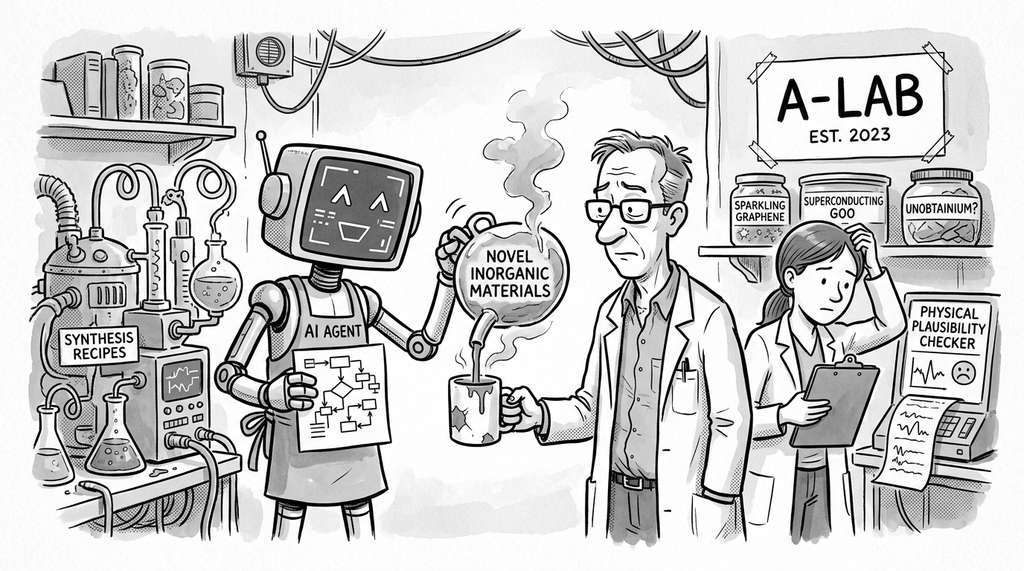
The A-Lab at Lawrence Berkeley National Laboratory uses a mixed-initiative system where an
AI agent proposes novel inorganic material compositions and synthesis recipes, while human
scientists review proposals for physical plausibility and override the robotic synthesis
queue when the agent's suggested precursors are unavailable or hazardous. In its first 17
days of operation (2023), the system autonomously synthesized 41 of 58 target compounds,
with human interventions concentrated at the interpretation and safety review stages,
precisely matching the initiative allocation pattern this section prescribes.
The Centaur Paradox
In 2005, a "freestyle" chess tournament on Playchess.com produced a surprising winner: not a
grandmaster with a supercomputer, but two amateur players using three ordinary laptops. Their
edge was not chess strength or hardware power but a superior process for deciding when to
trust the engine and when to override it. Garry Kasparov, who originated the human-plus-machine
concept after his 1997 loss to Deep Blue, called this result evidence that "a weak human plus
machine plus a better process" beats "a strong human plus machine plus an inferior process."
The lesson for co-discovery: the collaboration protocol matters more than the raw capability
of either partner.
Lab: Measuring Cognitive Complementarity with a Toy Discovery Task
Goal: Empirically measure whether a human-AI team outperforms either partner
alone on a small pattern-discovery task. Tools: Python 3.10+, an LLM API
(OpenAI or Anthropic), scikit-learn, and matplotlib.
Setup (5 min): Generate a synthetic dataset with sklearn.datasets.make_classification
using 10 features, 2 informative, 3 redundant, and a hidden interaction term (multiply two
features, add noise, append as feature 11). Solo-human trial (5 min):
Inspect pairwise scatter plots and write down which features you believe are informative.
Solo-AI trial (5 min): Send the feature correlation matrix and summary
statistics to an LLM, ask it to identify the informative features. Co-discovery trial
(10 min): Share the AI's answer with yourself, re-examine any features it flagged
that you missed, and produce a joint answer. What to observe: Score each
trial by precision and recall against the true informative set (features 0, 1, and the
interaction feature 11). Vary the noise level and the number of redundant features across
runs. In most configurations, the joint answer will match or exceed both solo answers,
illustrating cognitive complementarity in miniature.
What's Next
Autonomous innovation and human-AI co-discovery are aspirational directions. Realizing them
requires solving concrete open problems in benchmarking, theory, infrastructure, and
governance. Section 58.3: Open Problems and What the Field
Needs maps these gaps systematically and proposes a research agenda for the next decade
of Discovery AI.