"You gave me a JSON schema and suddenly I stopped hallucinating field names. Coincidence? I think not."
A Language Model That Finally Passed Validation
A language model that returns free-form text is a conversational partner. A language model that returns validated, typed data structures is a software component. This section teaches you to cross that boundary. You will learn how JSON Schema constrains model outputs at the token level, how function calling turns models into tool-using agents, and how Pydantic provides the Python type system that ties everything together. By the end, you will be able to call any large language model (LLM) and guarantee that the response conforms to a contract your code can consume without parsing heuristics or prayer.
1. The Problem with Unstructured Outputs
You ask a language model to extract five fields from a paper abstract. It returns a bulleted list. You repeat the identical prompt and get a markdown table. A third time, you get a JSON blob whose keys bear no resemblance to the ones you requested. Each format requires different parsing logic. The format can shift between calls to the same model with the same prompt, because the model's output distribution includes many plausible continuations.
This instability is a fundamental obstacle to reliable systems. The Discovery Workbench from Chapter 6 routes typed artifacts through a provenance graph. Every node expects data in a specific shape; a response that violates the expected schema breaks the entire pipeline.
From Instability to Guarantees
When an automated pipeline silently drops records because the model returned a markdown table instead of JSON, no error is raised, no exception is logged; the data simply vanishes. That invisible data loss is why format reliability is not a convenience feature but a correctness requirement.
The solution is constrained generation: mechanisms that force the model to produce outputs conforming to a predefined schema. There are three levels of constraint, each progressively stronger:
Constrained generation restricts a language model's token sampling so that every possible output satisfies a formal specification such as a JSON Schema or a context-free grammar. Unconstrained models produce structurally unpredictable outputs that break downstream code. Even a 1% malformation rate means a pipeline processing thousands of requests encounters dozens of failures per day. (That 1% is not a rounding error; at 10,000 calls per day it produces 100 silent breakages, each one a potential data-loss event.) At each decoding step, the mechanism computes a mask over the model's vocabulary, zeroing out any token that would violate the specification. Only valid continuations survive. Use constrained generation whenever your application consumes model output programmatically. Reserve free-form text generation for conversational or creative tasks where rigid structure would be counterproductive.
- Prompt-level: instruct the model in the system prompt to output JSON with specific fields. This is a request, not a guarantee. The model may comply 95% of the time, which means it fails at scale.
- API-level: use the provider's structured output mode, which constrains the token sampling process itself. The model literally cannot produce tokens that would violate the schema.
- Validation-level: parse and validate the response against a Pydantic model after generation, raising typed errors on violations. This catches semantic issues (wrong value ranges, missing cross-field constraints) that schema-level constraints cannot express.
Production systems combine all three layers. In short: a schema turns a language model from a conversational partner into a software component whose outputs your code can trust without parsing heroics.
2. JSON Schema as a Contract Language
JSON Schema is a vocabulary for annotating and validating JSON documents. Every major LLM API (Anthropic, OpenAI, Google) uses JSON Schema as the contract language for structured outputs. Understanding its core constructs is essential.
A schema defines the shape of valid data: which fields exist, what types they carry, which are required, and what constraints apply. Here is a schema for a paper metadata record:
{
  "$schema": "https://json-schema.org/draft/2020-12/schema",
  "type": "object",
  "properties": {
    "title": {
      "type": "string",
      "description": "Full title of the paper"
    },
    "authors": {
      "type": "array",
      "items": {
        "type": "object",
        "properties": {
          "name": {"type": "string"},
          "affiliation": {"type": "string"}
        },
        "required": ["name"]
      },
      "minItems": 1
    },
    "year": {
      "type": "integer",
      "minimum": 1900,
      "maximum": 2030
    },
    "keywords": {
      "type": "array",
      "items": {"type": "string"},
      "maxItems": 10
    },
    "methodology": {
      "type": "string",
      "enum": ["experimental", "computational", "theoretical", "review", "meta-analysis"]
    }
  },
  "required": ["title", "authors", "year", "methodology"]
}enum constraint on methodology limits the model to exactly five valid values; minItems guarantees at least one author.When you pass this schema to a structured output API, the provider's decoding engine uses it to mask invalid tokens at each generation step. If the model has just produced "year":, only integer tokens are allowed next. If the integer so far is 18, only digits that keep the value between 1900 and 2030 are permitted. This is not post-hoc validation; it is constrained decoding that makes invalid outputs impossible.
Mental Model

Think of constrained decoding like a custom keyboard that changes its keys after every keystroke. When you fill out a paper tax form, you can write anything in any box. But imagine a digital form where the "Year" field physically removes all letter keys from the keyboard and only shows digit keys, and after you type "19," it removes the keys for digits that would produce a number outside the valid range. The model still chooses which valid key to press (it retains its judgment about the most likely year), but the form makes it structurally impossible to type something invalid. That is exactly what a JSON Schema does to the model's token vocabulary at each generation step: it reshapes the set of available next tokens so that only schema-compliant continuations remain.
Constrained decoding does not reduce model quality. Research from Willard and Louf (2023) indicates that grammar-constrained generation with finite-state machines produces outputs that are both schema-valid and, in their benchmarks, semantically comparable to unconstrained generation. The model already assigns high probability to valid JSON tokens; the constraint simply prevents the rare cases where sampling would produce an invalid continuation.
Common Misconception
A common misconception is that structured outputs guarantee semantic correctness: that if the model returns valid JSON matching your schema, the content must be factually accurate. This is false. Constrained decoding ensures syntactic conformance (correct types, required fields present, enum values from the allowed set), but the model can still hallucinate a paper title, invent a Digital Object Identifier (DOI) that does not exist, or assign the wrong methodology category with perfect structural validity. Always pair schema constraints with downstream validation, fact-checking, or human review for any field whose value (not just its type) matters to your application.
3. Pydantic: Schemas from Python Types
Writing JSON Schema by hand is tedious and error-prone. Pydantic (a Python library for data validation using type annotations) lets you define schemas as Python classes, with full IDE support, autocomplete, and type checking. The library generates the JSON Schema automatically, validates data at runtime, and provides clear error messages when validation fails.
from pydantic import BaseModel, Field
from enum import Enum
from typing import Optional


class Methodology(str, Enum):
    """Controlled vocabulary for research methodology types."""
    EXPERIMENTAL = "experimental"
    COMPUTATIONAL = "computational"
    THEORETICAL = "theoretical"
    REVIEW = "review"
    META_ANALYSIS = "meta-analysis"


class Author(BaseModel):
    """A paper author with name and optional affiliation."""
    name: str = Field(description="Full name of the author")
    affiliation: Optional[str] = Field(
        default=None,
        description="Primary institutional affiliation"
    )


class PaperMetadata(BaseModel):
    """Structured metadata extracted from a paper abstract."""
    title: str = Field(description="Full title of the paper")
    authors: list[Author] = Field(
        min_length=1,
        description="List of authors, at least one required"
    )
    year: int = Field(ge=1900, le=2030, description="Publication year")
    keywords: list[str] = Field(
        default_factory=list,
        max_length=10,
        description="Up to 10 topic keywords"
    )
    methodology: Methodology = Field(
        description="Primary research methodology"
    )


# Generate JSON Schema from the Pydantic model
schema = PaperMetadata.model_json_schema()
print(schema)
# Output matches the hand-written schema above, plus $defs for nested modelsThe key advantage is that the same class serves three roles: (1) schema definition for the LLM API, (2) runtime validation for the response, and (3) typed data object for downstream code. There is no impedance mismatch (where the schema says one thing and the code expects another) between the contract and the code.
A single Pydantic model defines, validates, and represents the data, so the remaining piece is connecting it to an LLM API that returns a guaranteed-valid instance.
4. Structured Outputs with the Anthropic SDK
The Anthropic software development kit (SDK) supports structured outputs through tool use. You define a tool whose input schema matches your desired output shape, then instruct the model to "use" that tool. The model's tool-use response is guaranteed to conform to the schema.
import anthropic
import json

client = anthropic.Anthropic()


def extract_metadata(abstract: str) -> PaperMetadata:
    """Extract structured metadata from a paper abstract.

    Uses Claude's tool-use mode to guarantee schema compliance.
    """
    # Define the extraction tool with our Pydantic schema
    tools = [
        {
            "name": "record_metadata",
            "description": (
                "Record the structured metadata extracted from a "
                "scientific paper abstract."
            ),
            "input_schema": PaperMetadata.model_json_schema(),
        }
    ]

    response = client.messages.create(
        model="claude-sonnet-4-20250514",
        max_tokens=1024,
        tools=tools,
        tool_choice={"type": "tool", "name": "record_metadata"},
        messages=[
            {
                "role": "user",
                "content": (
                    f"Extract metadata from this abstract:\n\n{abstract}"
                ),
            }
        ],
    )

    # The response is guaranteed to contain a tool_use block
    tool_block = next(
        block for block in response.content
        if block.type == "tool_use"
    )

    # Validate with Pydantic (catches semantic issues beyond schema)
    return PaperMetadata.model_validate(tool_block.input)


# Example usage
abstract = """
We present a graph neural network approach to predicting
protein-ligand binding affinity. Our model achieves state-of-the-art
performance on the PDBbind benchmark, with a Pearson correlation of
0.87 on the core set. We train on 16,000 complexes and validate on
1,000 held-out structures.
"""
metadata = extract_metadata(abstract)
print(f"Title: {metadata.title}")
print(f"Method: {metadata.methodology.value}")
print(f"Year: {metadata.year}")
# Title: Graph Neural Network Approach to Predicting ...
# Method: computational
# Year: 2024tool_choice parameter forces the model to call the specified tool, guaranteeing a schema-valid response.Notice the two-layer validation strategy. The API's constrained decoding guarantees that the JSON conforms to the schema (correct types, required fields present, enum values valid). The Pydantic model_validate call then applies Python-level constraints (field ranges, cross-field logic, custom validators) that JSON Schema cannot express.
5. Function Calling and Tool Use
Structured outputs are one direction: model to code. Function calling (also called tool use) adds the reverse direction: the model can invoke your code and receive results. This creates a bidirectional interface where the model reasons about when to call tools, what arguments to pass, and how to interpret the results.
The pattern, introduced conceptually in Chapter 4 as part of ReAct-style reasoning (where the model alternates between reasoning about what to do and acting by calling a tool), works as follows. Figure 10.1 illustrates this cycle.
- You define a set of tools, each with a name, description, and input schema.
- The model receives a user query plus the tool definitions.
- The model decides whether to answer directly or call a tool (or multiple tools).
- If it calls a tool, your code executes the function and returns the result.
- The model incorporates the result and either answers or calls another tool.
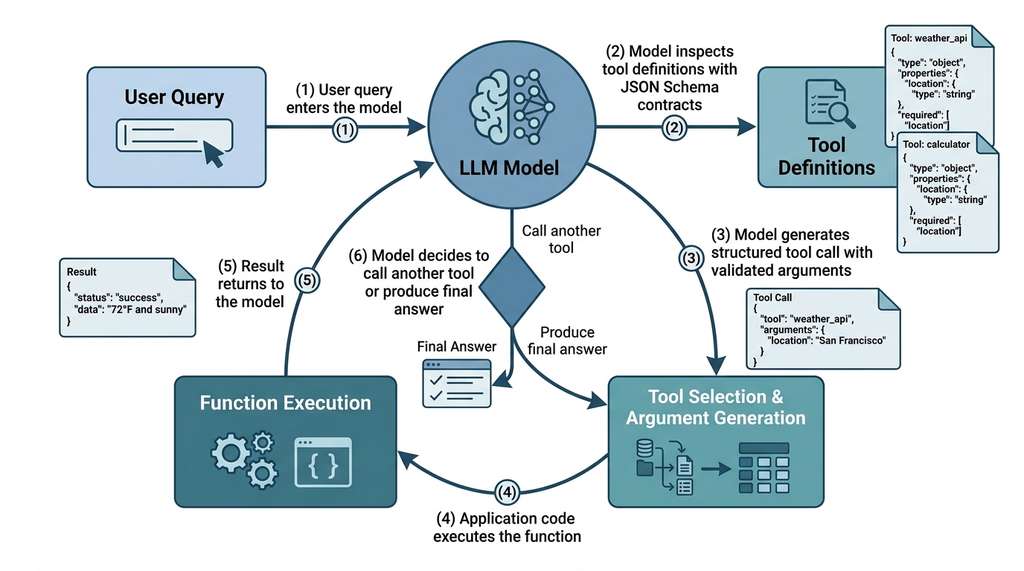
Figure 10.1.1 illustrates the tool-use agent loop. Here is a complete example that gives Claude access to a literature search tool:
import anthropic
from pydantic import BaseModel, Field


class SearchQuery(BaseModel):
    """Input schema for literature search."""
    query: str = Field(description="Search query for paper titles/abstracts")
    max_results: int = Field(default=5, ge=1, le=20)
    year_min: int = Field(default=2020, ge=1900)


class SearchResult(BaseModel):
    """A single search result."""
    title: str
    authors: list[str]
    year: int
    abstract: str
    doi: str


def search_literature(params: SearchQuery) -> list[dict]:
    """Search a paper database. In production, this calls
    Semantic Scholar, OpenAlex, or a local index."""
    # Simplified: in practice, call an API
    return [
        {
            "title": "Graph Neural Networks for Molecular Property Prediction",
            "authors": ["Alice Chen", "Bob Kumar"],
            "year": 2023,
            "abstract": "We propose a message-passing neural network...",
            "doi": "10.1234/example.2023.001",
        }
    ]


def run_agent_loop(user_query: str) -> str:
    """Run a tool-use agent loop until the model produces a final answer."""
    client = anthropic.Anthropic()

    tools = [
        {
            "name": "search_literature",
            "description": (
                "Search the scientific literature database. "
                "Returns papers matching the query with titles, "
                "authors, years, abstracts, and DOIs."
            ),
            "input_schema": SearchQuery.model_json_schema(),
        }
    ]

    messages = [{"role": "user", "content": user_query}]

    while True:
        response = client.messages.create(
            model="claude-sonnet-4-20250514",
            max_tokens=2048,
            tools=tools,
            messages=messages,
        )

        # Check if the model wants to use a tool
        if response.stop_reason == "tool_use":
            # Process each tool call
            tool_results = []
            for block in response.content:
                if block.type == "tool_use":
                    # Validate input, execute function
                    params = SearchQuery.model_validate(block.input)
                    results = search_literature(params)
                    tool_results.append({
                        "type": "tool_result",
                        "tool_use_id": block.id,
                        "content": str(results),
                    })

            # Feed results back to the model
            messages.append({"role": "assistant", "content": response.content})
            messages.append({"role": "user", "content": tool_results})
        else:
            # Model produced a final text response
            return response.content[0].text


answer = run_agent_loop(
    "Find recent papers on graph neural networks for drug discovery"
)
print(answer)In a real Discovery Workbench integration, you would register multiple tools: search_literature, fetch_paper_details, extract_figures, query_knowledge_graph. The model orchestrates these tools in whatever order makes sense for the user's question. A query like "What methods have been used to predict binding affinity since 2022?" might trigger a search, fetch full texts for the top results, extract methodology sections, and summarize the findings. The typed interfaces guarantee that each step produces data the next step can consume. Chapter 12 builds exactly this kind of multi-tool server using the Model Context Protocol.
6. The Model Context Protocol (MCP)
Individual tool definitions work well for a single application, but they do not scale. If every team defines its own tool schemas, its own serialization, and its own execution protocol, interoperability is impossible. The Model Context Protocol (MCP), introduced by Anthropic in 2024, solves this by defining a standard protocol for connecting LLMs to external tools and data sources.
MCP defines three primitives:
- Tools: functions the model can call, with JSON Schema input/output contracts.
- Resources: data sources the model can read (files, database tables, API endpoints).
- Prompts: reusable prompt templates that tools can expose to the model.
An MCP server exposes these primitives over a standard transport (stdio or HTTP with server-sent events). Any MCP client (Claude Desktop, an IDE plugin, a custom agent) can discover and use the server's capabilities without custom integration code.
Checkpoint
So far: unstructured model outputs break pipelines, so we constrain generation with JSON Schema (the contract language), validate with Pydantic (the Python type layer), and call tools through typed interfaces; MCP standardizes this pattern into a reusable protocol with three primitives (Tools, Resources, Prompts) that any client can discover.
from mcp.server.fastmcp import FastMCP
from pydantic import BaseModel, Field

# Create an MCP server for literature search
mcp = FastMCP("literature-search")


class PaperSearchInput(BaseModel):
    """Schema for the search tool's input."""
    query: str = Field(description="Search terms")
    max_results: int = Field(default=10, ge=1, le=50)
    year_range: tuple[int, int] = Field(
        default=(2020, 2026),
        description="(start_year, end_year) inclusive"
    )


class PaperRecord(BaseModel):
    """Schema for a returned paper record."""
    title: str
    authors: list[str]
    year: int
    doi: str
    abstract: str
    citation_count: int


@mcp.tool()
def search_papers(input: PaperSearchInput) -> list[PaperRecord]:
    """Search the scientific literature and return matching papers.

    Queries Semantic Scholar and OpenAlex, deduplicates by DOI,
    and ranks by relevance score.
    """
    # Implementation calls external APIs
    # Returns validated PaperRecord objects
    ...


@mcp.resource("papers://{doi}")
def get_paper(doi: str) -> str:
    """Retrieve the full text of a paper by DOI."""
    ...


if __name__ == "__main__":
mcp.run()search_papers without custom integration. Chapter 12 builds a complete MCP server for scientific workflows.The critical insight is that MCP tool schemas are just JSON Schema, the same contract language used for structured outputs. This means the type system is consistent from end to end: Pydantic defines the schema, the LLM API enforces it during generation, MCP transmits it between processes, and Pydantic validates it again on receipt. One type definition flows through the entire stack.
Because every major provider has converged on JSON Schema as its contract language, switching between SDKs becomes a matter of surface syntax rather than conceptual redesign.
7. Cross-SDK Comparison: Anthropic, OpenAI, and Beyond
The structured output and tool-use patterns differ in surface syntax across providers, but the underlying model is the same: define a schema, pass it to the API, get back validated data. Here is a side-by-side comparison for the paper metadata extraction task:
# --- Anthropic SDK ---
import anthropic

def extract_anthropic(abstract: str) -> PaperMetadata:
    client = anthropic.Anthropic()
    response = client.messages.create(
        model="claude-sonnet-4-20250514",
        max_tokens=1024,
        tools=[{
            "name": "record_metadata",
            "description": "Record extracted paper metadata.",
            "input_schema": PaperMetadata.model_json_schema(),
        }],
        tool_choice={"type": "tool", "name": "record_metadata"},
        messages=[{"role": "user", "content": f"Extract: {abstract}"}],
    )
    tool_block = next(b for b in response.content if b.type == "tool_use")
    return PaperMetadata.model_validate(tool_block.input)


# --- OpenAI SDK (Responses API, 2025) ---
from openai import OpenAI

def extract_openai(abstract: str) -> PaperMetadata:
    client = OpenAI()
    response = client.responses.create(
        model="gpt-4o",
        input=[{"role": "user", "content": f"Extract: {abstract}"}],
        text={"format": {
            "type": "json_schema",
            "name": "paper_metadata",
            "schema": PaperMetadata.model_json_schema(),
            "strict": True,  # enables constrained decoding
        }},
    )
return PaperMetadata.model_validate_json(response.output_text)json_schema response format. Both consume the same Pydantic-generated JSON Schema.The Pydantic model is the common denominator. Write it once, and it works with any provider that accepts JSON Schema. This is why Pydantic has become the de facto standard for typed LLM interfaces in Python.
The Instructor library (by Jason Liu) wraps the Anthropic and OpenAI SDKs with a single client.chat.completions.create(response_model=PaperMetadata) call. It handles schema generation, API dispatch, response parsing, and retry logic in about 3 lines instead of the 20+ shown above. Instructor also supports streaming partial objects, validation retries with error feedback, and multi-provider routing. For production code where you need structured outputs without the boilerplate, Instructor is the right tool. Internally, it does exactly what our examples do: generate JSON Schema from Pydantic, pass it to the provider's structured output mode, and validate the response.
8. Designing Typed Agent Interfaces
With structured outputs and tool use in hand, you can design complete agent interfaces as type hierarchies. The pattern draws on the interface design principles from Chapter 3 (knowledge representation) and the architecture patterns from Chapter 6 (Discovery Workbench).
from pydantic import BaseModel, Field
from typing import Literal, Union
from enum import Enum
from datetime import datetime


# --- Domain types ---
class Confidence(str, Enum):
    HIGH = "high"
    MEDIUM = "medium"
    LOW = "low"


class Citation(BaseModel):
    """A reference to a specific paper."""
    doi: str
    title: str
    relevance: str = Field(description="Why this paper is relevant")


class Claim(BaseModel):
    """A scientific claim extracted from literature."""
    statement: str = Field(description="The claim in one sentence")
    evidence: list[Citation] = Field(min_length=1)
    confidence: Confidence
    methodology: str = Field(description="How the claim was established")


# --- Agent interface ---
class AnalysisRequest(BaseModel):
    """Input contract for the literature analysis agent."""
    research_question: str
    scope: Literal["narrow", "broad"] = "narrow"
    max_papers: int = Field(default=20, ge=5, le=100)
    year_range: tuple[int, int] = Field(default=(2020, 2026))


class AnalysisResult(BaseModel):
    """Output contract for the literature analysis agent."""
    question: str
    claims: list[Claim] = Field(min_length=1)
    gaps: list[str] = Field(
        description="Identified gaps in the literature"
    )
    suggested_experiments: list[str]
    papers_reviewed: int
    timestamp: datetime


# The agent function has a clear typed signature
def analyze_literature(request: AnalysisRequest) -> AnalysisResult:
    """Run the literature analysis agent.

    This function orchestrates multiple LLM calls and tool uses,
    but its interface is a simple typed function.
    """
    # Implementation uses the tool-use patterns from above
...AnalysisRequest and AnalysisResult models define a contract that is enforceable, testable, and self-documenting. This is the interface pattern used throughout the Discovery Workbench from Chapter 6 onward.This design has three properties that matter for discovery systems:
- Testability: you can write unit tests that construct an
AnalysisRequest, call the function, and assert properties of theAnalysisResult. No parsing, no regex, no "did the model say something that looks right." - Composability: the output of one agent becomes the input of another. An
AnalysisResultcan feed directly into a hypothesis generation agent (see Chapter 39) because both share theClaimandCitationtypes. - Observability: every request and result can be serialized to JSON and logged to the Discovery Workbench's provenance system, creating an auditable trace of what the agent did, what it found, and what it concluded.
Willard and Louf (2023) formalized constrained decoding using finite-state machines (FSMs) (computational models that transition between a fixed set of states based on input, used here to track which tokens keep the output schema-valid) that mask the token vocabulary at each generation step. Their library, Outlines, compiles JSON Schema into an FSM that runs alongside the model's sampling loop. More recent work by Geng et al. (2025) extends this to context-free grammars (a class of formal grammars more expressive than regular expressions, capable of describing nested and recursive structures), enabling constraints beyond what JSON Schema can express (for example, syntactically valid Python code or balanced chemical equations). In a parallel development, the XGrammar system (2024) from the MLCEngine team achieves near-zero overhead constrained decoding by precompiling grammar automata into GPU-friendly lookup tables, making structured generation as fast as unconstrained generation even for complex grammars. XGrammar has been integrated into vLLM and SGLang (two widely used open-source LLM serving frameworks), bringing grammar-constrained decoding to production serving stacks. The LMQL project takes yet another approach, embedding constraints as a query language that interleaves with generation. These techniques appear to be converging toward a standard where every LLM call can be constrained by a formal grammar, not just a JSON Schema, with negligible performance cost.
Try It: Build a Schema-Validated Extraction Pipeline
Put structured outputs into practice by building a small pipeline that extracts and validates structured data from unstructured text. You need Python 3.10+, the pydantic library, and an API key for Anthropic or OpenAI.
- Define your schema. Create a Pydantic model called
ExperimentSummarywith fields fortitle(str),organism(str),sample_size(int, ge=1),technique(an Enum with values "PCR", "Western blot", "CRISPR", "RNA-seq", "other"), andfinding(str, max 200 characters). Print the generated JSON Schema withExperimentSummary.model_json_schema()and inspect it. - Write the extraction function. Using the Anthropic SDK (or OpenAI), create a function
extract_experiment(text: str) -> ExperimentSummarythat passes your schema as a tool definition withtool_choiceforcing the tool call, then validates the response withmodel_validate. - Test with real abstracts. Copy three short experiment descriptions from PubMed abstracts. Run your function on each and print the validated results. Confirm that the
techniquefield always contains one of your enum values and thatsample_sizeis always a positive integer. - Add a custom validator. Add a Pydantic
@field_validatortoExperimentSummarythat rejects anyfindingcontaining the phrase "not statistically significant" (to filter out negative results). Test that the validator raises aValidationErrorwhen the model extracts such a finding. - Batch and collect. Wrap your function in a loop that processes a list of 5+ abstracts, collects results into a list, and serializes them to a JSON file using
[e.model_dump() for e in results]. Open the JSON file and verify that every record conforms to your schema.
Exercise 10.1.1
You are given the following Pydantic model for a chemistry experiment result:
class ReactionResult(BaseModel):
    reagents: list[str] = Field(min_length=1)
    product: str
    yield_percent: float = Field(ge=0, le=100)
    temperature_c: float
catalyst: Optional[str] = NoneA collaborator proposes using this model as a tool schema with tool_choice={"type": "any"} instead of forcing the specific tool. Under what circumstances could the model return a valid response that does not contain a ReactionResult? What change to the API call would guarantee you always get one?
Hint
With "type": "any", the model may choose to respond with plain text instead of calling the tool, or it may call a different tool if multiple are defined. To guarantee a ReactionResult, set tool_choice={"type": "tool", "name": "your_tool_name"}, which forces the model to call that specific tool and produce schema-valid output.
Step-Through: Constrained Token Masking
Trace through constrained decoding for a tiny schema {"type": "object", "properties": {"score": {"type": "integer", "minimum": 1, "maximum": 5}}, "required": ["score"]} with a vocabulary of tokens: {, }, "score", :, 0, 1, 2, 3, 4, 5, 6, 7, 8, 9, "hello".
Step 1: Position 0. Only { is valid. Mask = {{}. Model emits {.
Step 2: After {. The required key must appear. Mask = {"score"}. Model emits "score".
Step 3: After {"score". Must produce colon. Mask = {:}. Model emits :.
Step 4: After {"score":. Value must be integer 1 through 5. Mask = {1, 2, 3, 4, 5}. Tokens 0, 6 through 9, and "hello" are all masked out. Suppose the model's softmax (the probability distribution the model computes over its vocabulary at each step) assigns highest probability to 4. Model emits 4.
Step 5: After {"score":4. No more properties, so must close. Mask = {}}. Model emits }.
Final output: {"score":4}. At every step, the mask eliminated structurally or semantically invalid tokens while preserving the model's freedom to choose among valid options.
Real-World Application: GitHub Copilot's Structured Tool Calls
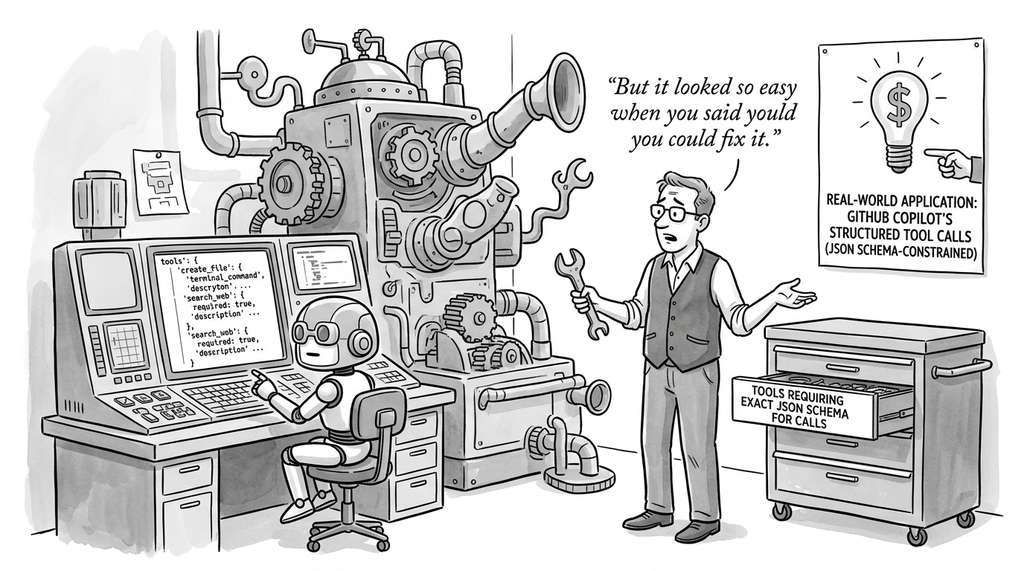
GitHub Copilot (in its agent mode, shipped 2025) uses JSON Schema-constrained tool calling to let the model invoke workspace actions such as file edits, terminal commands, and web searches. Each tool has a Pydantic-style schema defining required parameters (file path, line range, replacement text), and the model's output is constrained to match that schema before any file system operation executes. This prevents a class of bugs where a malformed tool call could silently corrupt source files or run unintended shell commands.
The 15-Million-Dollar Parse Error
In 2023, according to an account that circulated widely in the structured-output community, a financial technology startup reported that a production outage costing an estimated \$15 million in failed transactions traced back to an LLM returning a JSON response with a trailing comma, which their parser rejected. The model had been instructed via prompt to "always return valid JSON," and it did so 99.97% of the time. The remaining 0.03% struck during a peak trading window. The fix was switching from prompt-based JSON formatting to the provider's constrained decoding mode, which reduced malformed outputs to exactly zero. Whether or not the dollar figure is precise, the lesson stands: "almost always valid" is not the same as "guaranteed valid."
Lab: Schema Strictness vs. Model Creativity
Goal: Measure how tightly constraining a schema affects the semantic quality (not just validity) of LLM-extracted data.
Tools needed: Python 3.10+, pydantic, anthropic (or openai), and 10 PubMed abstracts describing experiments (copy them manually or use the Entrez API).
Procedure:
- Define three versions of a
PaperSummaryPydantic model: (a) loose, with onlytitle: strandsummary: str; (b) moderate, addingmethodology: Methodology(5-value enum),sample_size: int, andkeywords: list[str]; (c) strict, addingorganism: strwith a 10-value enum,p_value: float = Field(ge=0, le=1), andeffect_direction: Literal["positive", "negative", "null"]. - Run each schema on all 10 abstracts. Record (i) whether the call succeeds, (ii) wall-clock latency, and (iii) your subjective accuracy rating (1 to 5) for each extracted field.
- What to vary: the schema strictness level. What to observe: whether the strict schema forces the model to hallucinate values for fields not present in the abstract (for example, a p-value when none is reported), and whether latency increases with schema complexity.
Expect to find that moderate schemas hit a sweet spot: they constrain enough to be machine-readable but leave room for the model to express "not reported" via optional fields, while overly strict schemas push the model toward confident fabrication.
Exercises
- Conceptual: Explain why prompt-level instructions ("Please respond in JSON") are insufficient for production systems. What failure modes does constrained decoding eliminate that prompt instructions cannot?
- Coding: Define a Pydantic model for a
ExperimentRecordthat captures: hypothesis (string), independent variables (list of named variables with types and ranges), dependent variables (list), methodology (enum: "in_vitro", "in_vivo", "in_silico", "observational"), sample size (positive integer), and statistical test used (string). Generate the JSON Schema and use it with the Anthropic SDK to extract experiment records from a paragraph describing a drug trial. - Analysis: Compare the structured output APIs of Anthropic (tool-use mode) and OpenAI (json_schema response format). What are the trade-offs in terms of (a) schema expressiveness, (b) streaming support, and (c) error recovery when the model struggles with a constraint? Write a wrapper function that provides a unified interface across both providers.