"I decomposed your question into seven sub-questions, retrieved forty-three passages, reranked them twice, verified every citation, and scored my own faithfulness. The answer is: we need more data."
A Research Copilot Who Understands Science All Too Well
A postdoc joins a computational biology lab with 2,400 papers accumulated over a decade, and her advisor asks, "What experimental evidence exists for the interaction between BRCA1 and PALB2?" She could spend two weeks reading, or she could type the question into a system that decomposes it into retrieval sub-queries, searches the lab's entire paper corpus with bi-encoder retrieval (where a single neural network encodes queries and passages independently into vectors for fast similarity search) and cross-encoder reranking, generates a cited answer, and evaluates its own faithfulness before delivering results. This section builds that system from scratch: first the corpus ingestion pipeline, then the multi-hop retrieval engine, then the faithful generation stage, and finally the end-to-end evaluation harness.
1. Corpus Ingestion: From PDFs to Searchable Chunks
What. Before a research copilot can answer questions, it must ingest a corpus of scientific papers: parse PDFs, split them into overlapping chunks, compute embeddings, and store everything in a vector database.
Why. The ingestion pipeline sets the quality ceiling. Chunk too aggressively and you lose context (a result separated from its method section). Chunk too conservatively and you dilute relevance with surrounding noise, making cross-section questions harder to answer.
How. We use a sliding-window chunker with section-aware boundaries. Instead of splitting at fixed token counts, we split at paragraph and section boundaries, with overlap to preserve context at chunk edges. In short: the quality ceiling of every answer your copilot will ever produce is set the moment you decide how to slice the corpus.
import hashlib
from dataclasses import dataclass, field
from pathlib import Path

@dataclass
class PaperChunk:
    """A chunk of text from a scientific paper with metadata."""
    chunk_id: str
    text: str
    paper_id: str
    paper_title: str
    section: str           # e.g., "Methods", "Results", "Discussion"
    page_numbers: list[int]
    char_start: int
    char_end: int
    embedding: list[float] = field(default_factory=list)

    def to_payload(self) -> dict:
        """Convert to Qdrant payload format."""
        return {
            "text": self.text,
            "paper_id": self.paper_id,
            "paper_title": self.paper_title,
            "section": self.section,
            "page_numbers": self.page_numbers,
        }


def chunk_paper(
    text: str,
    paper_id: str,
    paper_title: str,
    chunk_size: int = 512,
    chunk_overlap: int = 64,
) -> list[PaperChunk]:
    """Split a paper into overlapping chunks with metadata.

    Uses word-level tokenization with paragraph-boundary awareness.
    Chunks prefer to break at paragraph boundaries (double newlines)
    rather than mid-sentence.
    """
    words = text.split()
    chunks = []
    start_idx = 0

    while start_idx < len(words):
        end_idx = min(start_idx + chunk_size, len(words))

        # Try to break at a paragraph boundary
        chunk_words = words[start_idx:end_idx]
        chunk_text = " ".join(chunk_words)

        # Look for the last paragraph break within the chunk
        last_para = chunk_text.rfind("\n\n")
        if last_para > len(chunk_text) * 0.5:
            # Break at paragraph boundary if it is in the second half
            chunk_text = chunk_text[:last_para].strip()
            # Recalculate end_idx based on actual words used
            actual_words = len(chunk_text.split())
            end_idx = start_idx + actual_words

        # Detect section from common headings
        section = detect_section(chunk_text)

        # Generate deterministic chunk ID
        chunk_hash = hashlib.sha256(
            f"{paper_id}:{start_idx}".encode()
        ).hexdigest()[:12]

        chunks.append(PaperChunk(
            chunk_id=f"{paper_id}_chunk_{chunk_hash}",
            text=chunk_text.strip(),
            paper_id=paper_id,
            paper_title=paper_title,
            section=section,
            page_numbers=[],  # Populated by PDF parser
            char_start=start_idx,
            char_end=end_idx,
        ))

        # Advance with overlap
        start_idx = end_idx - chunk_overlap

    return chunks


def detect_section(text: str) -> str:
    """Heuristic section detection from chunk text."""
    text_lower = text[:200].lower()
    sections = {
        "abstract": ["abstract"],
        "introduction": ["introduction", "1. introduction", "1 introduction"],
        "methods": ["methods", "materials and methods", "experimental",
                     "methodology", "2. methods"],
        "results": ["results", "3. results", "findings"],
        "discussion": ["discussion", "4. discussion"],
        "conclusion": ["conclusion", "conclusions", "summary"],
        "references": ["references", "bibliography"],
    }
    for section_name, markers in sections.items():
        if any(marker in text_lower for marker in markers):
            return section_name
return "body"PaperChunk carries metadata about its source paper, section label, and character offset. The chunker prefers paragraph boundaries over fixed-size splits, and the overlap parameter ensures context is not lost at chunk edges. The deterministic chunk ID (derived from paper ID and start offset) enables idempotent re-ingestion (re-running the pipeline produces the same result without creating duplicates).2. The Ingestion Pipeline
With chunking defined, the ingestion pipeline parses PDFs, chunks them, computes embeddings, and indexes everything in Qdrant (an open-source vector database optimized for nearest-neighbor search over high-dimensional embeddings). This pipeline typically runs once per corpus update (when new papers are added) and is the most time-consuming part of the system.
from sentence_transformers import SentenceTransformer
from qdrant_client import QdrantClient
from qdrant_client.models import (
    Distance, VectorParams, PointStruct,
)
import fitz  # PyMuPDF for PDF parsing


class CorpusIndex:
    """Manages paper ingestion, embedding, and vector search."""

    def __init__(
        self,
        collection_name: str = "research_papers",
        embedding_model: str = "BAAI/bge-large-en-v1.5",
        qdrant_url: str = ":memory:",
    ):
        self.collection_name = collection_name
        self.embedder = SentenceTransformer(embedding_model)
        self.embedding_dim = self.embedder.get_sentence_embedding_dimension()
        self.client = QdrantClient(qdrant_url)

        # Create collection if it does not exist
        collections = [
            c.name for c in self.client.get_collections().collections
        ]
        if collection_name not in collections:
            self.client.create_collection(
                collection_name=collection_name,
                vectors_config=VectorParams(
                    size=self.embedding_dim,
                    distance=Distance.COSINE,
                ),
            )

    def ingest_pdf(self, pdf_path: str, paper_id: str = None) -> int:
        """Parse a PDF, chunk it, embed chunks, and index them."""
        path = Path(pdf_path)
        if paper_id is None:
            paper_id = path.stem

        # Extract text with PyMuPDF
        doc = fitz.open(pdf_path)
        full_text = ""
        page_breaks = []
        for page_num, page in enumerate(doc):
            page_breaks.append(len(full_text))
            full_text += page.get_text() + "\n\n"
        doc.close()

        # Extract title from first line (heuristic)
        first_line = full_text.split("\n")[0].strip()
        paper_title = first_line if len(first_line) < 200 else paper_id

        # Chunk the paper
        chunks = chunk_paper(
            text=full_text,
            paper_id=paper_id,
            paper_title=paper_title,
            chunk_size=512,
            chunk_overlap=64,
        )

        if not chunks:
            return 0

        # Compute embeddings in batch
        texts = [c.text for c in chunks]
        embeddings = self.embedder.encode(
            texts,
            normalize_embeddings=True,
            show_progress_bar=True,
            batch_size=32,
        )

        # Index in Qdrant
        points = [
            PointStruct(
                id=abs(hash(chunk.chunk_id)) % (2**63),
                vector=embedding.tolist(),
                payload=chunk.to_payload(),
            )
            for chunk, embedding in zip(chunks, embeddings)
        ]
        self.client.upsert(
            collection_name=self.collection_name,
            points=points,
        )

        return len(chunks)

    def ingest_directory(self, directory: str) -> dict:
        """Ingest all PDFs in a directory."""
        pdf_dir = Path(directory)
        results = {}
        for pdf_path in sorted(pdf_dir.glob("*.pdf")):
            n_chunks = self.ingest_pdf(str(pdf_path))
            results[pdf_path.name] = n_chunks
            print(f"  Indexed {pdf_path.name}: {n_chunks} chunks")
        return results

    def search(
        self,
        query: str,
        k: int = 20,
        section_filter: str = None,
    ) -> list[dict]:
        """Search the corpus for passages relevant to a query."""
        query_embedding = self.embedder.encode(
            [query], normalize_embeddings=True
        )[0]

        # Build optional filter
        query_filter = None
        if section_filter:
            from qdrant_client.models import Filter, FieldCondition, MatchValue
            query_filter = Filter(
                must=[FieldCondition(
                    key="section",
                    match=MatchValue(value=section_filter),
                )]
            )

        results = self.client.query_points(
            collection_name=self.collection_name,
            query=query_embedding.tolist(),
            query_filter=query_filter,
            limit=k,
        )

        return [
            {
                "doc_id": f"{r.payload['paper_id']}",
                "passage": r.payload["text"],
                "paper_title": r.payload["paper_title"],
                "section": r.payload["section"],
                "score": r.score,
            }
            for r in results.points
]CorpusIndex class handles PDF extraction (via PyMuPDF), section-aware chunking, embedding (via sentence-transformers with BGE), and vector storage. The search method supports optional section filtering, allowing queries like "find methods sections relevant to CRISPR delivery." As of 2025, the BGE model family has continued to evolve; BAAI/bge-m3 supports multilingual and multi-granularity retrieval (dense, sparse, and ColBERT in a single model), and newer entries on the MTEB leaderboard such as nvidia/NV-Embed-v2 offer improved retrieval quality, though bge-large-en-v1.5 remains a solid and widely deployed baseline for English corpora.A computational biology lab has 2,400 PDFs collected over a decade of research on protein-protein interactions. The ingestion pipeline processes them in 45 minutes on a machine with a mid-range GPU (for embedding computation). The result: approximately 180,000 chunks indexed in Qdrant, consuming about 1.5 GB of disk space for vectors and payloads. Queries typically return in under 50 milliseconds, depending on index size and hardware. A new postdoc can now ask questions like "What experimental evidence exists for the interaction between BRCA1 and PALB2?" and receive cited answers drawing on the lab's entire publication history, not just the papers they happened to read during their first week.
3. The Multi-Hop Research Engine
Ingesting and indexing a corpus gives us fast retrieval of individual passages, but scientific questions rarely map to a single passage in a single paper; answering them requires combining evidence from multiple retrieval passes.
Without multi-hop decomposition, a copilot that retrieves against a single query will miss half the evidence for any question spanning two distinct concepts, leaving researchers with answers that look complete but silently omit entire lines of relevant work.
With the corpus indexed, we build the research engine that processes complex questions. This engine combines the query decomposition from Section 37.1 with the faithfulness evaluation from Section 37.2 into a single, coherent pipeline. Figure 37.6 illustrates the five stages of this pipeline, from question decomposition through faithfulness evaluation.
How Multi-Hop Retrieval Works
Multi-hop retrieval breaks a complex question into simpler sub-queries, retrieves evidence for each one independently, and merges the results before generating an answer. Real scientific questions almost never map to a single passage in a single paper. A question like "How does drug X overcome resistance mechanism Y?" requires passages about the drug's pharmacology, the molecular basis of the resistance mechanism, and any clinical trials testing the combination. Figure 37.3.1 illustrates the multi-hop research copilot pipeline.
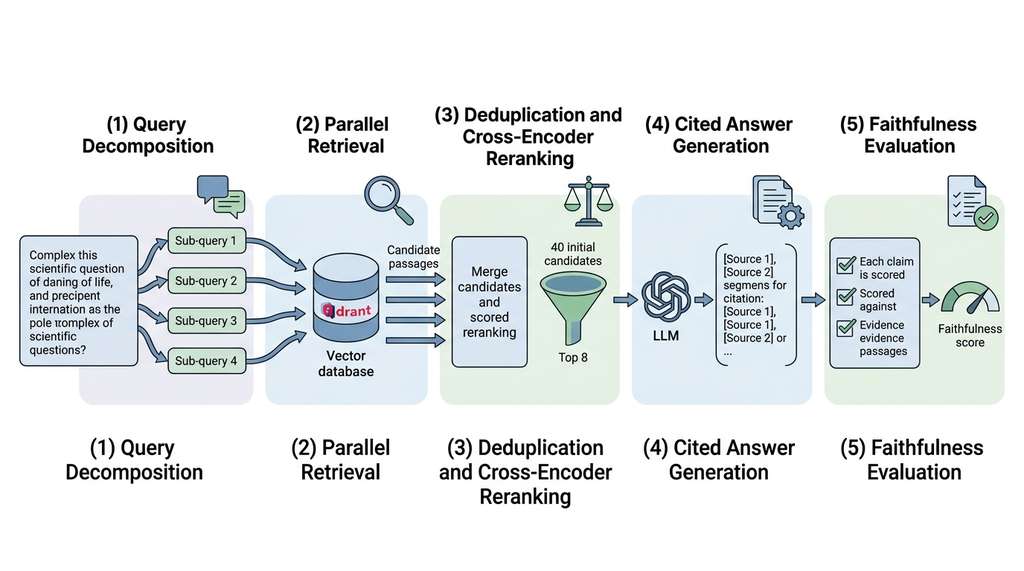
The large language model (LLM) decomposes the original question into self-contained retrieval queries and runs each query against the vector index in parallel. The engine then deduplicates and reranks the pooled candidates with cross-encoder reranking (where a single model jointly encodes the query and each candidate passage to produce a fine-grained relevance score, as shown in stage 3 of Figure 37.6) against the original question, passing only the top-scoring passages to the generator. Use multi-hop retrieval whenever a question involves two or more distinct concepts unlikely to co-occur in a single chunk. For factual lookups ("What was the sample size in the FLAURA trial?"), a single query with reranking is faster and sufficient.
Checkpoint
So far: the corpus is parsed, chunked, embedded, and indexed in a vector store; a complex question will be decomposed into sub-queries, each sub-query will retrieve candidates independently, and a cross-encoder will rescore the pooled candidates before generation.
The implementation below also calls compute_faithfulness, the claim-level verification function built in Section 37.2. If you have not read that section yet, the key idea is straightforward: the function decomposes an answer into individual claims, checks whether each claim is entailed by the retrieved passages, and returns the fraction of supported claims as a score between 0 and 1.
import anthropic
import json
from sentence_transformers import CrossEncoder
from dataclasses import dataclass

@dataclass
class ResearchResult:
    """Complete result from the research copilot."""
    question: str
    sub_queries: list[str]
    evidence: list[dict]
    answer: str
    citations: list[dict]
    faithfulness_score: float
    faithfulness_details: list[dict]
    evaluation: dict


class ResearchCopilot:
    """Multi-hop research copilot with faithfulness evaluation."""

    def __init__(
        self,
        corpus_index: CorpusIndex,
        reranker_model: str = "cross-encoder/ms-marco-MiniLM-L-12-v2",
        generator_model: str = "claude-sonnet-4-20250514",
        k_retrieve: int = 20,
        k_rerank: int = 8,
        min_rerank_score: float = 0.3,
    ):
        self.corpus = corpus_index
        self.reranker = CrossEncoder(reranker_model)
        self.client = anthropic.Anthropic()
        self.generator_model = generator_model
        self.k_retrieve = k_retrieve
        self.k_rerank = k_rerank
        self.min_rerank_score = min_rerank_score

    def decompose_question(self, question: str) -> list[str]:
        """Break a complex question into retrieval sub-queries."""
        response = self.client.messages.create(
            model=self.generator_model,
            max_tokens=1024,
            messages=[{
                "role": "user",
                "content": f"""Decompose this scientific research question
into 2-5 simpler sub-queries. Each sub-query should target a distinct
aspect that can be answered by searching a scientific paper database.

Question: {question}

Return ONLY a JSON array of sub-query strings.""",
            }],
        )
        return json.loads(response.content[0].text)

    def retrieve_and_rerank(
        self,
        question: str,
        sub_queries: list[str],
    ) -> list[dict]:
        """Multi-hop retrieve and rerank evidence."""
        # Retrieve candidates from all sub-queries
        all_candidates = {}
        for sq in sub_queries:
            results = self.corpus.search(sq, k=self.k_retrieve)
            for r in results:
                key = r["doc_id"] + ":" + r["passage"][:100]
                if key not in all_candidates:
                    all_candidates[key] = {
                        **r,
                        "sub_queries_matched": [],
                    }
                all_candidates[key]["sub_queries_matched"].append(sq)

        if not all_candidates:
            return []

        # Rerank all unique candidates against the original question
        candidate_list = list(all_candidates.values())
        pairs = [(question, c["passage"]) for c in candidate_list]
        rerank_scores = self.reranker.predict(pairs)

        for candidate, score in zip(candidate_list, rerank_scores):
            candidate["rerank_score"] = float(score)

        # Filter by minimum score and take top-k
        filtered = [
            c for c in candidate_list
            if c["rerank_score"] >= self.min_rerank_score
        ]
        filtered.sort(key=lambda x: x["rerank_score"], reverse=True)

        return filtered[:self.k_rerank]

    def generate_answer(
        self,
        question: str,
        evidence: list[dict],
    ) -> tuple[str, list[dict]]:
        """Generate a cited answer from evidence passages."""
        if not evidence:
            return (
                "I could not find sufficient evidence in the corpus "
                "to answer this question. Consider refining the query "
                "or adding relevant papers to the corpus.",
                [],
            )

        context_parts = []
        for i, ev in enumerate(evidence):
            context_parts.append(
                f"[Source {i+1}] (Paper: {ev['paper_title']}, "
                f"Section: {ev['section']}):\n{ev['passage']}"
            )
        context = "\n\n".join(context_parts)

        response = self.client.messages.create(
            model=self.generator_model,
            max_tokens=3072,
            system="""You are a scientific research assistant. Answer
questions based ONLY on the provided source passages.

Rules:
1. Every factual claim must cite its source as [Source N].
2. If multiple sources support a claim, cite all of them.
3. If the sources do not contain enough information, say so.
4. Do not add information from your training data.
5. Distinguish direct evidence from inferences across sources.
6. Note any contradictions between sources explicitly.
7. Report specific numbers, methods, and findings precisely
   as stated in the sources.""",
            messages=[{
                "role": "user",
                "content": f"""Answer this research question using the
provided sources.

Question: {question}

Sources:
{context}

Provide a detailed, well-organized, cited answer.""",
            }],
        )

        answer = response.content[0].text

        # Extract citation mapping
        import re
        citations = []
        for i, ev in enumerate(evidence):
            source_tag = f"Source {i+1}"
            if source_tag in answer:
                citations.append({
                    "source_id": source_tag,
                    "paper_id": ev["doc_id"],
                    "paper_title": ev["paper_title"],
                    "section": ev["section"],
                    "rerank_score": ev["rerank_score"],
                })

        return answer, citations

    def evaluate_faithfulness(
        self,
        answer: str,
        evidence: list[dict],
    ) -> tuple[float, list[dict]]:
        """Evaluate faithfulness of the generated answer.

        Uses compute_faithfulness from Section 37.2.
        """
        evidence_passages = [e["passage"] for e in evidence]
        result = compute_faithfulness(answer, evidence_passages)  # Section 37.2
        return result["faithfulness_score"], result["details"]

    def ask(self, question: str) -> ResearchResult:
        """Full pipeline: decompose, retrieve, generate, evaluate."""
        # Step 1: Decompose the question
        sub_queries = self.decompose_question(question)

        # Step 2: Multi-hop retrieve and rerank
        evidence = self.retrieve_and_rerank(question, sub_queries)

        # Step 3: Generate cited answer
        answer, citations = self.generate_answer(question, evidence)

        # Step 4: Evaluate faithfulness
        faith_score, faith_details = self.evaluate_faithfulness(
            answer, evidence
        )

        # Step 5: Compute retrieval metrics
        evaluation = {
            "num_sub_queries": len(sub_queries),
            "num_candidates_retrieved": len(evidence),
            "num_sources_cited": len(citations),
            "mean_rerank_score": (
                sum(e["rerank_score"] for e in evidence) / len(evidence)
                if evidence else 0.0
            ),
            "faithfulness": faith_score,
        }

        return ResearchResult(
            question=question,
            sub_queries=sub_queries,
            evidence=evidence,
            answer=answer,
            citations=citations,
            faithfulness_score=faith_score,
            faithfulness_details=faith_details,
            evaluation=evaluation,
)ResearchCopilot class implementing the five-stage pipeline from Figure 37.6. The ask method orchestrates question decomposition, multi-hop retrieval with cross-encoder reranking, cited answer generation, and faithfulness evaluation. Each stage is independently testable and replaceable, following the modular architecture from Chapter 6.Mental Model
Think of faithfulness evaluation the way a newspaper editor fact-checks a journalist's article before publication. The journalist (the generator) writes a story based on interview transcripts and documents (the retrieved evidence). The editor does not verify whether the underlying sources are correct; the editor verifies that every claim in the article actually appears in those transcripts rather than being invented or embellished by the journalist. A claim that rephrases a source is fine. A claim that extrapolates beyond what any source says gets flagged, even if it happens to be true, because the article's credibility rests on its grounding in cited material. The faithfulness score is the fraction of claims that survive the editor's check.
4. Running the Copilot End to End
The following demonstration exercises the full pipeline on a realistic scientific question. It ingests a small corpus, then poses a multi-hop question that requires synthesizing information from multiple papers.
# Initialize the corpus and copilot
corpus = CorpusIndex(
    collection_name="oncology_papers",
    embedding_model="BAAI/bge-large-en-v1.5",
    qdrant_url=":memory:",  # Use a Qdrant server URL in production
)

# Ingest papers (in production, point to your PDF directory)
# corpus.ingest_directory("./papers/oncology/")

# For demonstration, we manually add pre-chunked passages
from qdrant_client.models import PointStruct
demo_passages = [
    {
        "text": "Osimertinib is a third-generation EGFR TKI that "
                "selectively targets the T790M resistance mutation. "
                "In the FLAURA trial, osimertinib demonstrated a median "
                "progression-free survival of 18.9 months compared to "
                "10.2 months for standard EGFR TKIs (HR 0.46, p<0.001).",
        "paper_id": "soria_2018",
        "paper_title": "Osimertinib in EGFR-Mutated NSCLC (FLAURA)",
        "section": "results",
    },
    {
        "text": "The T790M mutation in EGFR exon 20 is the most common "
                "mechanism of acquired resistance to first-generation "
                "EGFR TKIs, accounting for approximately 50-60% of "
                "resistance cases. The mutation alters the ATP-binding "
                "pocket, reducing drug binding affinity.",
        "paper_id": "yu_2014",
        "paper_title": "Analysis of EGFR Resistance Mechanisms",
        "section": "results",
    },
    {
        "text": "Combination therapy of osimertinib with chemotherapy "
                "(platinum/pemetrexed) in the FLAURA2 trial showed a "
                "median PFS of 25.5 months versus 16.7 months for "
                "osimertinib monotherapy (HR 0.62, p<0.001) in "
                "first-line EGFR-mutant NSCLC.",
        "paper_id": "planchard_2023",
        "paper_title": "FLAURA2: Osimertinib Plus Chemotherapy",
        "section": "results",
    },
    {
        "text": "MET amplification and C797S mutations are emerging "
                "resistance mechanisms to osimertinib. MET amplification "
                "is detected in 15-20% of patients progressing on "
                "osimertinib, while C797S mutations occur in approximately "
                "10-15% of cases.",
        "paper_id": "leonetti_2019",
        "paper_title": "Resistance to Osimertinib in EGFR-Mutant NSCLC",
        "section": "discussion",
    },
    {
        "text": "Liquid biopsy using circulating tumor DNA (ctDNA) enables "
                "non-invasive monitoring of EGFR mutation status and "
                "resistance mechanism emergence. Serial ctDNA analysis "
                "can detect T790M and C797S mutations 2-4 months before "
                "radiographic progression.",
        "paper_id": "oxnard_2016",
        "paper_title": "ctDNA Monitoring in EGFR-Mutant Lung Cancer",
        "section": "results",
    },
]

# Embed and index demo passages
embeddings = corpus.embedder.encode(
    [p["text"] for p in demo_passages],
    normalize_embeddings=True,
)
points = [
    PointStruct(
        id=i,
        vector=emb.tolist(),
        payload=p,
    )
    for i, (p, emb) in enumerate(zip(demo_passages, embeddings))
]
corpus.client.upsert(
    collection_name="oncology_papers",
    points=points,
)

# Initialize the copilot
copilot = ResearchCopilot(
    corpus_index=corpus,
    k_retrieve=10,
    k_rerank=5,
    min_rerank_score=0.1,
)

# Ask a multi-hop question
result = copilot.ask(
    "What are the resistance mechanisms to EGFR inhibitors in lung "
    "cancer, and what monitoring strategies can detect resistance early?"
)

# Display results
print(f"Question: {result.question}\n")
print(f"Sub-queries:")
for i, sq in enumerate(result.sub_queries, 1):
    print(f"  {i}. {sq}")

print(f"\nAnswer:\n{result.answer}\n")

print(f"Citations ({len(result.citations)}):")
for c in result.citations:
    print(f"  {c['source_id']}: {c['paper_title']} "
          f"(rerank={c['rerank_score']:.3f})")

print(f"\nFaithfulness: {result.faithfulness_score:.2f}")
print(f"Evaluation: {json.dumps(result.evaluation, indent=2)}")5. Evaluation Harness: Benchmarking the Copilot
The end-to-end demonstration confirms that the pipeline produces cited answers, but a single worked example cannot reveal whether the copilot handles the full range of questions your researchers will ask.
A research copilot must be evaluated systematically, not just on individual questions. We build an evaluation harness that runs the copilot against a benchmark dataset and computes aggregate metrics across all questions.
from dataclasses import dataclass
import time

@dataclass
class BenchmarkQuestion:
    """A question in the evaluation benchmark."""
    question: str
    ground_truth_answer: str
    relevant_paper_ids: list[str]  # Papers that should be retrieved
    difficulty: str  # "single_hop", "multi_hop", "comparison"


def create_benchmark() -> list[BenchmarkQuestion]:
    """Create an evaluation benchmark for the copilot."""
    return [
        BenchmarkQuestion(
            question="What was the progression-free survival "
                     "benefit of osimertinib in the FLAURA trial?",
            ground_truth_answer="Osimertinib demonstrated a median "
                "PFS of 18.9 months compared to 10.2 months for "
                "standard EGFR TKIs (HR 0.46, p<0.001).",
            relevant_paper_ids=["soria_2018"],
            difficulty="single_hop",
        ),
        BenchmarkQuestion(
            question="What are the resistance mechanisms to "
                     "osimertinib and how can they be detected?",
            ground_truth_answer="MET amplification (15-20%) and "
                "C797S mutations (10-15%) are the main resistance "
                "mechanisms. ctDNA liquid biopsy can detect these "
                "mutations 2-4 months before radiographic progression.",
            relevant_paper_ids=["leonetti_2019", "oxnard_2016"],
            difficulty="multi_hop",
        ),
        BenchmarkQuestion(
            question="How does osimertinib plus chemotherapy compare "
                     "to osimertinib monotherapy in first-line NSCLC?",
            ground_truth_answer="FLAURA2 showed combination therapy "
                "achieved median PFS of 25.5 months versus 16.7 months "
                "for monotherapy (HR 0.62, p<0.001).",
            relevant_paper_ids=["planchard_2023"],
            difficulty="comparison",
        ),
    ]


def run_benchmark(
    copilot: ResearchCopilot,
    benchmark: list[BenchmarkQuestion],
) -> dict:
    """Run the copilot against a benchmark and compute metrics."""
    results = []

    for bq in benchmark:
        start_time = time.time()
        result = copilot.ask(bq.question)
        elapsed = time.time() - start_time

        # Check retrieval: did we find the right papers?
        retrieved_paper_ids = {
            e["doc_id"] for e in result.evidence
        }
        relevant_retrieved = (
            set(bq.relevant_paper_ids) & retrieved_paper_ids
        )
        retrieval_recall = (
            len(relevant_retrieved) / len(bq.relevant_paper_ids)
            if bq.relevant_paper_ids else 0.0
        )

        results.append({
            "question": bq.question,
            "difficulty": bq.difficulty,
            "faithfulness": result.faithfulness_score,
            "retrieval_recall": retrieval_recall,
            "num_sources_cited": len(result.citations),
            "num_sub_queries": len(result.sub_queries),
            "latency_seconds": elapsed,
        })

    # Aggregate metrics
    import numpy as np
    faith_scores = [r["faithfulness"] for r in results]
    recall_scores = [r["retrieval_recall"] for r in results]
    latencies = [r["latency_seconds"] for r in results]

    aggregate = {
        "num_questions": len(results),
        "mean_faithfulness": float(np.mean(faith_scores)),
        "mean_retrieval_recall": float(np.mean(recall_scores)),
        "mean_latency_seconds": float(np.mean(latencies)),
        "faithfulness_by_difficulty": {},
        "per_question": results,
    }

    for difficulty in ["single_hop", "multi_hop", "comparison"]:
        diff_scores = [
            r["faithfulness"] for r in results
            if r["difficulty"] == difficulty
        ]
        if diff_scores:
            aggregate["faithfulness_by_difficulty"][difficulty] = (
                float(np.mean(diff_scores))
            )

    return aggregate


# Run the benchmark
benchmark = create_benchmark()
bench_results = run_benchmark(copilot, benchmark)

print("Benchmark Results:")
print(f"  Questions: {bench_results['num_questions']}")
print(f"  Mean Faithfulness: {bench_results['mean_faithfulness']:.3f}")
print(f"  Mean Retrieval Recall: "
      f"{bench_results['mean_retrieval_recall']:.3f}")
print(f"  Mean Latency: {bench_results['mean_latency_seconds']:.1f}s")
print(f"\n  Faithfulness by difficulty:")
for diff, score in bench_results["faithfulness_by_difficulty"].items():
print(f" {diff}: {score:.3f}")BenchmarkQuestion through the full pipeline, measures faithfulness and retrieval recall (did the correct paper IDs appear in the evidence?), records latency, and computes aggregate metrics grouped by question difficulty. Multi-hop questions typically show lower faithfulness than single-hop ones because they require more synthesis across sources.Generic Retrieval Augmented Generation (RAG) benchmarks (Natural Questions, TriviaQA, HotpotQA) measure general knowledge retrieval, not scientific domain performance. The evaluation harness above is designed to be filled with questions from your corpus about your domain. Invest the time to create 20 to 50 benchmark questions with ground truth answers and relevant paper IDs. This corpus-specific benchmark is worth more than any generic leaderboard score because it measures exactly the performance your users will experience. Update the benchmark as the corpus grows and as users report failure cases.
Common Misconception
A high faithfulness score does not mean the answer is correct. Faithfulness measures whether the generated answer is supported by the retrieved passages, not whether those passages themselves are accurate or complete. If the retrieval stage misses the most relevant paper, the generator can produce a perfectly faithful answer to the wrong evidence: every claim traces back to a source, yet the answer is incomplete or misleading because the critical source was never retrieved. Always evaluate retrieval recall (the fraction of known-relevant papers that actually appear in the retrieved set) alongside faithfulness (did we stay true to what we found?). A copilot with 0.95 faithfulness but 0.40 retrieval recall is confidently summarizing the wrong slice of the literature.
6. Production Considerations
The copilot we have built works, but deploying it for a research team requires additional engineering. The key considerations below each link back to architectural principles from Chapter 6.
6.1 Incremental Ingestion
Scientific corpora grow continuously. The ingestion pipeline must support incremental updates: ingest new papers without re-processing the entire corpus. Our CorpusIndex already supports this (call ingest_pdf for each new paper), but production systems should also detect and handle paper retractions, version updates, and duplicate detection.
6.2 Caching and Cost Management
Each query involves multiple LLM calls: decomposition, generation, and faithfulness evaluation. For a team of 20 researchers each asking 10 questions per day, that is 600+ LLM calls daily. Cache at two levels: (1) cache embedding computations (the same passage always produces the same vector), and (2) cache complete answers for repeated or near-duplicate questions using semantic similarity thresholds.
class QueryCache:
    """Semantic cache for research copilot queries."""

    def __init__(self, embedder, similarity_threshold: float = 0.95):
        self.embedder = embedder
        self.threshold = similarity_threshold
        self.cache: list[dict] = []  # In production, use Redis or similar

    def get(self, question: str) -> ResearchResult | None:
        """Return cached result if a semantically similar query exists."""
        if not self.cache:
            return None

        q_emb = self.embedder.encode(
            [question], normalize_embeddings=True
        )[0]

        for entry in self.cache:
            sim = float(q_emb @ entry["embedding"])
            if sim >= self.threshold:
                return entry["result"]
        return None

    def put(self, question: str, result: ResearchResult):
        """Cache a query result."""
        q_emb = self.embedder.encode(
            [question], normalize_embeddings=True
        )[0]
        self.cache.append({
            "question": question,
            "embedding": q_emb,
            "result": result,
})6.3 User Feedback Loop
The most valuable signal for improving a research copilot comes from user feedback. When a researcher flags an answer as inaccurate, incorrect, or missing key information, that feedback should flow into the evaluation benchmark and, over time, guide improvements to the retrieval and generation stages.
@dataclass
class UserFeedback:
    """Feedback on a copilot response from a researcher."""
    question: str
    answer: str
    rating: int              # 1-5 scale
    issues: list[str]        # ["missing_citation", "wrong_fact", ...]
    correct_answer: str | None = None
    missing_papers: list[str] | None = None  # Papers that should
                                              # have been retrieved

def feedback_to_benchmark(
    feedbacks: list[UserFeedback],
    min_rating_for_positive: int = 4,
) -> list[BenchmarkQuestion]:
    """Convert user feedback into benchmark questions."""
    benchmarks = []
    for fb in feedbacks:
        if fb.rating < min_rating_for_positive and fb.correct_answer:
            benchmarks.append(BenchmarkQuestion(
                question=fb.question,
                ground_truth_answer=fb.correct_answer,
                relevant_paper_ids=fb.missing_papers or [],
                difficulty="user_reported",
            ))
return benchmarksBenchmarkQuestion with difficulty "user_reported," ensuring that identified failure cases are caught by future benchmark runs. This creates a virtuous cycle: user feedback improves the benchmark, which drives improvements to the system, which reduces negative feedback.6.4 Connecting to Research Agents
The research copilot we built answers questions from a static corpus. In Chapter 40 (Research Agents), we will extend this into an agent that can actively search the literature, retrieve new papers, and update its corpus in real time. The copilot's modular architecture makes this extension straightforward: the CorpusIndex.ingest_pdf method becomes a tool that the agent can call during a conversation, and the ResearchCopilot.ask method becomes one step in a larger agentic workflow that includes literature search, experimental design, and hypothesis generation.
A materials science group uses the research copilot to accelerate literature reviews. After three months, they notice a pattern: researchers frequently ask questions like "What synthesis conditions produce phase-pure perovskites with bandgap below 1.5 eV?" The copilot answers well when the information exists in a single paper, but struggles when the answer requires combining synthesis conditions from one paper with bandgap measurements from another. This observation leads them to extend the copilot into a structured extraction pipeline: for each paper, extract synthesis conditions, material properties, and characterization methods into a structured database (the knowledge graph approach from Chapter 38). The copilot's retrieval still finds relevant passages, but the generator now also queries the structured database for precise numerical comparisons. The lesson: a research copilot is not the end state; it is the foundation for more sophisticated discovery systems.
The complete pipeline we built across Listings 37.17 through 37.23 (chunking, embedding, indexing, multi-hop retrieval, reranking, generation, evaluation, caching) spans approximately 400 lines of Python. LlamaIndex provides all of these components as pre-built modules: SimpleDirectoryReader for ingestion, VectorStoreIndex with QdrantVectorStore for indexing, SubQuestionQueryEngine for multi-hop decomposition, SentenceTransformerRerank for reranking, and FaithfulnessEvaluator for evaluation. The equivalent LlamaIndex implementation is roughly 60 lines. The tradeoff: LlamaIndex's abstractions save development time but make debugging harder. When your copilot produces a wrong answer, our from-scratch implementation lets you inspect every stage independently. LlamaIndex requires understanding its callback and event system to achieve the same visibility. Our recommendation: build from scratch for your first RAG system (to learn the failure modes), then migrate to LlamaIndex for subsequent projects. Note that LlamaIndex underwent a major restructuring in 2024, splitting into a core package (llama-index-core) with separate integration packages (e.g., llama-index-vector-stores-qdrant); import paths and class names changed significantly from the pre-0.10 API, so consult the current documentation when adopting it.
Research Frontier
The CRAG (Corrective Retrieval Augmented Generation) framework, introduced by Yan et al. in 2024, adds a lightweight retrieval evaluator between the retrieval and generation stages. Before passing evidence to the generator, CRAG scores each retrieved document's relevance and triggers one of three actions: if the documents are confidently relevant, proceed normally; if they are ambiguous, refine the query and re-retrieve; if they are confidently irrelevant, fall back to web search. This corrective loop addresses a blind spot in the pipeline we built: our copilot reranks but never reconsiders whether retrieval failed entirely. CRAG's self-correcting retrieval improved performance on PopQA and Biography benchmarks by 5 to 15 percentage points over standard RAG, with especially large gains on questions where initial retrieval returned off-topic passages. Integrating a similar retrieval confidence gate between our retrieve_and_rerank and generate_answer stages (the dashed feedback arrow in Figure 37.6) would let the copilot detect and recover from retrieval failures rather than faithfully summarizing irrelevant evidence.
Try It: Build a Mini Research Copilot Over arXiv Abstracts
You can build a stripped-down version of the copilot in this section using only free tools and a laptop. (1) Download 50 to 100 arXiv abstracts in a single topic (e.g., "retrieval augmented generation") using the arXiv API: import urllib.request; urllib.request.urlretrieve("http://export.arxiv.org/api/query?search_query=all:retrieval+augmented+generation&max_results=100", "arxiv.xml"), then parse the XML to extract title and abstract fields. (2) Chunk each abstract as a single passage (abstracts are short enough to serve as their own chunks) and compute embeddings using sentence-transformers with the model all-MiniLM-L6-v2. (3) Store the embeddings in a NumPy matrix and implement cosine-similarity search: given a query embedding, compute dot products against all passage embeddings and return the top 5. (4) Write a generate_answer function that formats the top 5 abstracts as numbered sources, sends them along with the question to any LLM API (or a local model via ollama), and instructs the model to cite sources by number. (5) Test with a multi-hop question such as "What chunking strategies improve faithfulness in RAG systems?" and manually verify that each citation in the generated answer actually appears in the corresponding source abstract. This exercise reproduces the full retrieve-generate-verify loop without requiring Qdrant, a GPU, or a large PDF corpus.
7. The Discovery Workbench Connection
The research copilot integrates naturally into the Discovery Workbench introduced in Chapter 6. The copilot serves as the workbench's knowledge retrieval layer. Other components query it to ground their reasoning in published evidence: hypothesis generators from Chapter 39, research agents from Chapter 40, and claim validators from Chapter 41. The faithfulness guarantees from this chapter let downstream components trust the copilot's evidence, preventing hallucination from propagating through the discovery pipeline.
Exercise 37.3.1
The research copilot's retrieve_and_rerank method deduplicates candidates using the key doc_id + ":" + passage[:100]. Suppose two chunks from the same paper share the same first 100 characters but differ afterward (for example, overlapping chunks created by the sliding-window chunker). What happens to the second chunk? Propose a better deduplication key and explain why it avoids this failure mode.
Hint
ThePaperChunk dataclass already contains a deterministic, unique chunk_id derived from the paper ID and character offset. Using that as the deduplication key guarantees that overlapping chunks with shared prefixes are both retained, while true duplicates (same paper, same offset) are still collapsed.Step-Through: Multi-Hop Retrieval Pipeline
Trace through the ask method with the question "Does osimertinib overcome T790M resistance, and can liquid biopsy detect it early?"
Step 1 (Decompose): The LLM splits this into two sub-queries: SQ1 = "osimertinib activity against T790M resistance mutation" and SQ2 = "liquid biopsy detection of EGFR resistance mutations."
Step 2 (Retrieve): SQ1 retrieves 3 candidates with bi-encoder scores (cosine similarity between the query embedding and each passage embedding): soria_2018 (0.87), yu_2014 (0.82), leonetti_2019 (0.71). SQ2 retrieves: oxnard_2016 (0.91), leonetti_2019 (0.68). After deduplication, there are 4 unique candidates. The leonetti_2019 entry records both sub-queries in its sub_queries_matched list.
Step 3 (Rerank): The cross-encoder rescores all 4 candidates against the original question. New scores: oxnard_2016 = 0.93, soria_2018 = 0.88, yu_2014 = 0.74, leonetti_2019 = 0.61. All pass the 0.3 threshold. Top k_rerank = 5 keeps all four.
Step 4 (Generate): The four passages are formatted as [Source 1] through [Source 4] and sent to the LLM with citation instructions. The generated answer cites Sources 1, 2, and 3.
Step 5 (Evaluate): Faithfulness check decomposes the answer into 5 claims, verifies each against the source passages, and returns a score of 0.80 (4 of 5 claims supported; one inference combining data across two sources is flagged as unsupported).
Real-World Application: Biomedical Literature at Elicit
Elicit (elicit.com), an AI research assistant for scientists, uses a multi-hop RAG pipeline structurally similar to the copilot in this section. Given a research question, it decomposes it into sub-queries, retrieves relevant paper abstracts from a corpus of over 200 million papers via Semantic Scholar, reranks candidates with a learned relevance model, and generates cited summaries with per-claim source attribution. Their production system reportedly processes millions of queries per month and uses faithfulness evaluation to flag answers where citation support is weak, demonstrating that the retrieve-rerank-generate-evaluate architecture scales from a lab prototype to a commercial product.
The Chunking Wars
In 2023 and 2024, the RAG community experimented with dozens of chunking strategies, from fixed-size windows to recursive character splitting to "semantic chunking" that places boundaries where embedding similarity between adjacent sentences drops below a threshold. After extensive benchmarking, multiple teams (including LlamaIndex's own evaluation suite and the Massive Text Embedding Benchmark (MTEB) retrieval leaderboard contributors) have generally converged on a finding: simple overlapping fixed-size chunks of 256 to 512 tokens, combined with a strong reranker, match or outperform sophisticated semantic chunking on most retrieval benchmarks. The reranker compensates for imperfect chunk boundaries by scoring full question-passage relevance, making the exact chunking strategy less critical than most practitioners assume. The lesson: invest your engineering budget in the reranker, not the chunker.
Lab: Measuring How Chunk Size Affects Faithfulness
Goal: Determine empirically how chunk size and overlap parameters affect retrieval recall and answer faithfulness in a research copilot.
Tools needed: Python 3.10+, sentence-transformers, qdrant-client, and access to any LLM API (or a local model via ollama). Use 20 to 30 arXiv abstracts as your test corpus (download via the arXiv API as shown in the "Try It" callout above).
What to vary: Run the ingestion and query pipeline three times with different chunk sizes: 128, 256, and 512 tokens, each with overlap set to 25% of the chunk size. Keep the same 5 benchmark questions across all runs.
What to observe: For each configuration, record (1) the number of chunks produced, (2) retrieval recall (did the top-5 results include the correct source abstract?), (3) the rerank score distribution, and (4) the faithfulness score of the generated answer. Plot chunk size on the x-axis against faithfulness and recall on the y-axis. You should observe that very small chunks improve recall (more fine-grained matching) but can reduce faithfulness (the generator lacks enough context per passage to avoid hallucinating connections), while very large chunks preserve context but dilute relevance scores.
Section Summary
We built a complete multi-hop research copilot from components: a corpus ingestion pipeline that parses PDFs into searchable chunks (Listing 37.17-37.18), a multi-hop retrieval engine with query decomposition and cross-encoder reranking (Listing 37.19, illustrated in Figure 37.6), a cited answer generator with faithfulness evaluation (Listing 37.20), and a benchmark harness for systematic evaluation (Listing 37.21). Production considerations include incremental ingestion, semantic query caching, and user feedback loops that convert failure cases into regression tests. The copilot's modular architecture positions it as the knowledge retrieval layer in the Discovery Workbench, supporting the research agents and hypothesis generators we will build in the chapters ahead.