Prerequisites
This section builds on the claim extraction and evidence mapping pipeline from Section 41.1. You should be familiar with MLflow experiment tracking and Data Version Control (DVC) data versioning from Chapter 22. Knowledge of pytest for writing test suites, basic statistics (mean, standard deviation, hypothesis testing), and the concept of data leakage from machine learning practice is assumed. Familiarity with Chapter 25: Exploratory Discovery will help with understanding how leakage distorts evaluation metrics.
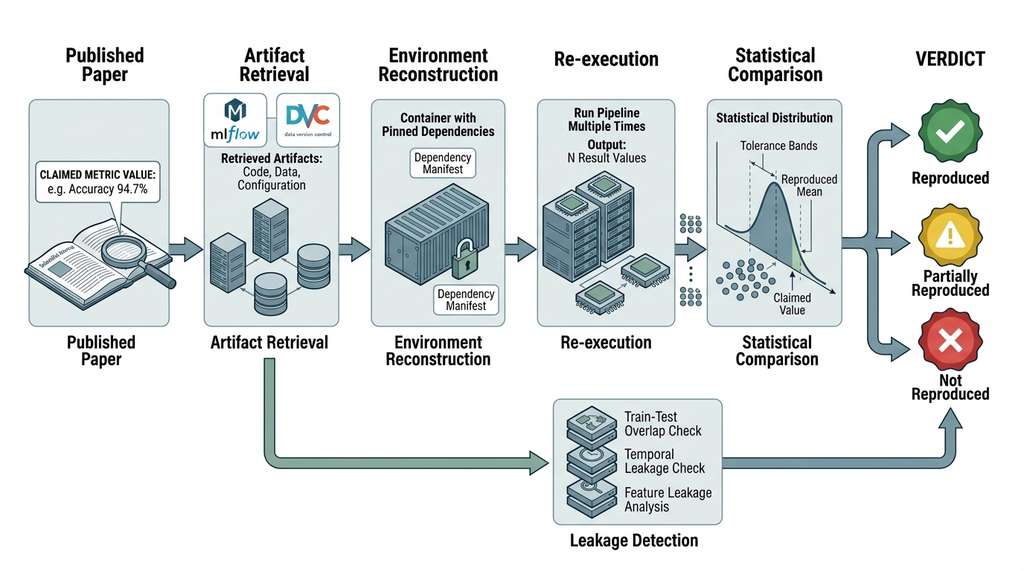
Evidence mapping tells you what artifacts should support a claim. Reproducibility auditing tells you whether they actually do. The gap between "the code exists" and "the code produces the claimed result" is where most scientific claims break down. A reproducibility audit re-executes the experimental pipeline, compares the output to the reported values, and quantifies the discrepancy. When the discrepancy exceeds a statistical tolerance, the claim fails the audit. When the pipeline cannot even be re-executed (missing dependencies, undocumented preprocessing, hardware-specific code), the claim is flagged as unverifiable. Both outcomes are informative: a failed audit narrows the search for errors, and an unverifiable claim identifies exactly what documentation is missing. Figure 41.2.1 illustrates the reproducibility audit pipeline.
1. Re-Executing Experimental Pipelines
When a pharmaceutical company cannot reproduce a published drug-target result, it burns millions of dollars and years of pipeline development chasing a phantom. When a climate policy rests on model projections that no independent group can replicate, the cost is measured in misallocated resources across entire economies. The technique that catches these failures before they compound is systematic pipeline re-execution.
The gold standard for reproducibility is simple in concept and fiendish in practice: take the authors' code and data, run it, and check whether the output matches the reported results. In practice, "take the code and run it" requires resolving dozens of undocumented dependencies, obtaining restricted datasets, provisioning specific hardware, and interpreting ambiguous configuration files. Our approach automates this process using MLflow for experiment artifact retrieval and DVC for dataset versioning.
Figure 41.2 illustrates how these components connect. The audit pipeline flows from artifact retrieval through dataset verification, pipeline re-execution, reproducibility scoring, and finally verdict assignment, with each stage feeding its output to the next and any failure at an early stage short-circuiting the rest.
A reproducibility audit retrieves the exact code, data, and configuration from a logged experiment. It re-executes the computational pipeline in a controlled environment and compares the resulting metrics against the values the publication claims. The mere existence of source code and data files tells you nothing about whether those artifacts produce the reported numbers; only re-execution closes that gap. The auditor hashes every input artifact, replays each pipeline stage, and applies statistical tolerance tests (covered in Section 2) to the output metrics. Use a reproducibility audit when you need quantitative confidence that a claimed result holds. Use a lighter evidence map (Section 41.1) when you only need to verify that supporting artifacts exist, or a manual code review when you suspect logical errors that would survive a successful re-run. In short: a claim without a re-execution is just a story with footnotes.
1.1 Retrieving Artifacts from MLflow
MLflow stores experiment runs as structured records: parameters, metrics, artifacts (model files, evaluation outputs), and tags. (As of 2024, MLflow 2.x introduced MLflow Deployments, a unified gateway for LLM providers, and expanded its artifact store to support large language model evaluation natively; the core tracking API shown here remains stable.) When a paper's results are logged in MLflow, we can retrieve the exact artifacts that produced a claimed metric value and attempt to reproduce the evaluation step.
"""
Retrieve and re-execute experimental artifacts from MLflow.
Connects claimed metrics to logged runs and verifies that
artifacts can reproduce the reported values.
"""
import mlflow
from mlflow.tracking import MlflowClient
from dataclasses import dataclass, field
from pathlib import Path
import json
import subprocess
import tempfile


@dataclass
class RunArtifacts:
    """Artifacts retrieved from an MLflow run."""
    run_id: str
    experiment_name: str
    params: dict
    metrics: dict                  # metric_name -> value
    artifact_paths: list[str]      # Local paths to downloaded artifacts
    tags: dict
    start_time: int
    status: str                    # FINISHED, FAILED, etc.


class MLflowAuditor:
    """Retrieve and verify MLflow experiment artifacts."""

    def __init__(self, tracking_uri: str):
        """Connect to an MLflow tracking server.

        Args:
            tracking_uri: MLflow server URI or local file path.
                          Example: "http://localhost:5000" or
                          "file:///path/to/mlruns"
        """
        mlflow.set_tracking_uri(tracking_uri)
        self.client = MlflowClient(tracking_uri)

    def find_runs_for_claim(
        self, claim, experiment_name: str = None
    ) -> list[RunArtifacts]:
        """Find MLflow runs that match a claim's context.

        Searches for runs with metrics matching the claim's
        predicate and values close to the claimed magnitude.

        Args:
            claim: A Claim object from the extraction pipeline.
            experiment_name: Optional experiment name to narrow search.

        Returns:
            List of matching RunArtifacts, sorted by metric proximity.
        """
        # Build search filter
        if experiment_name:
            experiments = [
                e for e in self.client.search_experiments()
                if e.name == experiment_name
            ]
        else:
            experiments = self.client.search_experiments()

        matching_runs = []

        for exp in experiments:
            runs = self.client.search_runs(
                experiment_ids=[exp.experiment_id],
                filter_string=f"status = 'FINISHED'",
                max_results=100,
                order_by=["start_time DESC"]
            )

            for run in runs:
                # Check if run logged the claimed metric
                metric_name = self._normalize_metric(
                    claim.predicate
                )
                if metric_name in run.data.metrics:
                    logged_value = run.data.metrics[metric_name]

                    # Include if within 10% of claimed value
                    if claim.value.magnitude is not None:
                        relative_diff = abs(
                            logged_value - claim.value.magnitude
                        ) / max(abs(claim.value.magnitude), 1e-8)
                        if relative_diff < 0.10:
                            artifacts = self._download_artifacts(
                                run.info.run_id
                            )
                            matching_runs.append(RunArtifacts(
                                run_id=run.info.run_id,
                                experiment_name=exp.name,
                                params=dict(run.data.params),
                                metrics=dict(run.data.metrics),
                                artifact_paths=artifacts,
                                tags=dict(run.data.tags),
                                start_time=run.info.start_time,
                                status=run.info.status,
                            ))

        # Sort by proximity to claimed value
        if claim.value.magnitude is not None:
            matching_runs.sort(key=lambda r: abs(
                r.metrics.get(
                    self._normalize_metric(claim.predicate), 0
                ) - claim.value.magnitude
            ))

        return matching_runs

    def _download_artifacts(self, run_id: str) -> list[str]:
        """Download all artifacts from an MLflow run."""
        local_dir = Path(tempfile.mkdtemp()) / run_id
        try:
            path = self.client.download_artifacts(
                run_id, "", str(local_dir)
            )
            return [
                str(p) for p in Path(path).rglob("*")
                if p.is_file()
            ]
        except Exception:
            return []

    def _normalize_metric(self, predicate: str) -> str:
        """Normalize metric names for matching.
        Maps common aliases to canonical forms."""
        aliases = {
            "accuracy": "accuracy",
            "acc": "accuracy",
            "f1 score": "f1",
            "f1": "f1",
            "precision": "precision",
            "recall": "recall",
            "auc-roc": "auc_roc",
            "auc": "auc_roc",
            "rmse": "rmse",
            "mae": "mae",
            "loss": "loss",
            "perplexity": "perplexity",
        }
        return aliases.get(predicate.lower(), predicate.lower())

    def compare_claim_to_run(
        self, claim, run: RunArtifacts
    ) -> dict:
        """Compare a claim's value to an MLflow run's metrics.

        Returns:
            Dictionary with match status, delta, and details.
        """
        metric_name = self._normalize_metric(claim.predicate)
        if metric_name not in run.metrics:
            return {
                "match": False,
                "reason": f"Metric '{metric_name}' not in run",
                "run_id": run.run_id,
            }

        logged_value = run.metrics[metric_name]
        claimed_value = claim.value.magnitude

        if claimed_value is None:
            return {
                "match": False,
                "reason": "Claim has no numerical value",
                "run_id": run.run_id,
            }

        delta = logged_value - claimed_value
        relative_delta = delta / max(abs(claimed_value), 1e-8)

        return {
            "match": abs(relative_delta) < 0.01,  # 1% tolerance
            "claimed_value": claimed_value,
            "logged_value": logged_value,
            "delta": delta,
            "relative_delta": relative_delta,
            "run_id": run.run_id,
            "experiment": run.experiment_name,
        }
1.2 Dataset Verification with DVC
Even when the code is available and executable, reproducibility fails if the dataset has changed since the original experiment. DVC addresses this by tracking datasets alongside code in Git, storing file hashes that pin each dataset version to a specific commit. Our auditor verifies that the dataset used in a re-execution matches the dataset recorded in the original experiment.
"""
Dataset verification using DVC checksums.
Ensures that the data used in a reproduction matches
the data used in the original experiment.
"""
import hashlib
import subprocess
import yaml
from pathlib import Path


@dataclass
class DatasetIntegrity:
    """Result of a dataset integrity check."""
    dataset_path: str
    expected_hash: str     # From DVC lock file or MLflow artifact
    actual_hash: str       # Computed from current file
    matches: bool
    file_size_bytes: int
    row_count: int | None  # For tabular data


class DVCVerifier:
    """Verify dataset integrity using DVC checksums."""

    def __init__(self, repo_path: str):
        """Initialize with path to a Git/DVC repository.

        Args:
            repo_path: Path to the repository root containing
                       .dvc files and dvc.lock.
        """
        self.repo_path = Path(repo_path)

    def get_tracked_files(self) -> dict[str, str]:
        """Parse DVC lock file to get tracked file hashes.

        Returns:
            Dictionary mapping file paths to their MD5 hashes.
        """
        lock_path = self.repo_path / "dvc.lock"
        if not lock_path.exists():
            return {}

        with open(lock_path) as f:
            lock_data = yaml.safe_load(f)

        tracked = {}
        for stage_name, stage in lock_data.get(
            "stages", {}
        ).items():
            for dep in stage.get("deps", []):
                if "md5" in dep and "path" in dep:
                    tracked[dep["path"]] = dep["md5"]
            for out in stage.get("outs", []):
                if "md5" in out and "path" in out:
                    tracked[out["path"]] = out["md5"]

        return tracked

    def verify_dataset(
        self, dataset_path: str, expected_hash: str = None
    ) -> DatasetIntegrity:
        """Verify a dataset file against its expected hash.

        If no expected_hash is given, uses the hash from the
        DVC lock file.
        """
        full_path = self.repo_path / dataset_path
        if not full_path.exists():
            return DatasetIntegrity(
                dataset_path=dataset_path,
                expected_hash=expected_hash or "",
                actual_hash="FILE_NOT_FOUND",
                matches=False,
                file_size_bytes=0,
                row_count=None,
            )

        # Compute MD5 (DVC uses MD5 by default)
        actual_hash = self._compute_md5(full_path)

        # Get expected hash from DVC if not provided
        if expected_hash is None:
            tracked = self.get_tracked_files()
            expected_hash = tracked.get(dataset_path, "")

        # Count rows for tabular data
        row_count = None
        if full_path.suffix in (".csv", ".tsv"):
            with open(full_path) as f:
                row_count = sum(1 for _ in f) - 1  # Minus header

        return DatasetIntegrity(
            dataset_path=dataset_path,
            expected_hash=expected_hash,
            actual_hash=actual_hash,
            matches=(actual_hash == expected_hash),
            file_size_bytes=full_path.stat().st_size,
            row_count=row_count,
        )

    def verify_all_tracked(self) -> list[DatasetIntegrity]:
        """Verify integrity of all DVC-tracked files."""
        tracked = self.get_tracked_files()
        results = []
        for path, expected in tracked.items():
            results.append(
                self.verify_dataset(path, expected)
            )
        return results

    def _compute_md5(self, path: Path) -> str:
        """Compute MD5 hash of a file (matching DVC convention)."""
        h = hashlib.md5()
        with open(path, "rb") as f:
            for chunk in iter(lambda: f.read(8192), b""):
                h.update(chunk)
        return h.hexdigest()

    def reproduce_pipeline(
        self, stage: str = None
    ) -> dict:
        """Attempt to reproduce a DVC pipeline stage.

        Args:
            stage: Optional stage name. If None, reproduces all.

        Returns:
            Dictionary with success status, outputs, and timing.
        """
        cmd = ["dvc", "repro"]
        if stage:
            cmd.append(stage)

        try:
            result = subprocess.run(
                cmd,
                cwd=str(self.repo_path),
                capture_output=True,
                text=True,
                timeout=3600,  # 1 hour timeout
            )
            return {
                "success": result.returncode == 0,
                "stdout": result.stdout,
                "stderr": result.stderr,
                "returncode": result.returncode,
            }
        except subprocess.TimeoutExpired:
            return {
                "success": False,
                "error": "Pipeline execution timed out (1h limit)",
            }
        except FileNotFoundError:
            return {
                "success": False,
                "error": "DVC not installed or not in PATH",
            }
In practice, one of the most frequent causes of irreproducibility is not buggy code or fabricated data but rather undocumented preprocessing. The authors ran a cleaning script they forgot to commit, used a random seed they did not record, or applied a filter they considered "obvious" and did not mention. DVC's pipeline tracking catches this class of errors because it records the hash of every input and output at every stage. If a preprocessing step changes one byte of the training data, the downstream hashes break, and the discrepancy is visible.
2. Computing Reproducibility Scores
Not every discrepancy between a claimed value and a reproduced value indicates a problem. Machine learning experiments involve stochastic processes (random initialization, data shuffling, dropout), and small variations between runs are expected. A reproducibility score must distinguish between acceptable variation (noise) and meaningful discrepancy (signal). We use a statistical framework based on tolerance intervals.
2.1 Statistical Tolerance Bands
A tolerance band defines the range of values that are considered "reproduced." If a paper claims accuracy of 94.7%, and we re-run the experiment 10 times and get values between 93.9% and 95.1%, the claim is reproduced within tolerance. If we get values between 88.2% and 90.1%, the claim fails.
Mental Model
Think of a tolerance band like the acceptable temperature range on a home thermostat. If you set your thermostat to 72 degrees, you do not expect the room to sit at exactly 72.0 at every moment; the heating system cycles on and off, and readings between 71 and 73 are perfectly normal operation. A reading of 68, though, means something is wrong with the furnace or the insulation, not just random fluctuation. The tolerance band in reproducibility scoring works the same way: it defines the "normal cycling range" around a claimed experimental result, so you can distinguish a system operating as expected (small stochastic variation between runs) from a system that is malfunctioning (the claimed result is far outside what re-execution actually produces).
Formally, given \(n\) reproduction runs with results \(x_1, x_2, \ldots, x_n\), we compute:
$$ \bar{x} = \frac{1}{n} \sum_{i=1}^{n} x_i, \quad s = \sqrt{\frac{1}{n-1} \sum_{i=1}^{n} (x_i - \bar{x})^2} $$The tolerance interval at confidence level \(\gamma\) and coverage proportion \(p\) is:
$$ [\bar{x} - k \cdot s, \quad \bar{x} + k \cdot s] $$where \(k\) is the tolerance factor depending on \(n\), \(p\), and \(\gamma\). A tolerance interval covers a proportion of the population, while a confidence interval estimates the mean; for reproducibility auditing, we care whether the claimed value is consistent with the mean of reproduction runs, so the confidence interval is the appropriate tool. For practical use with small \(n\) (3 to 10 reproduction runs), we use the simpler approach of a confidence interval based on the \(t\)-distribution, where the \(t\)-distribution is a probability distribution that accounts for the additional uncertainty introduced by estimating the population standard deviation from a small sample. We check whether the claimed value falls within this interval.
Common Misconception
A common misconception is that a "reproduced" verdict means the original experiment was conducted correctly and the claim is true. Reproducibility only confirms that the same code and data produce the same numbers; it says nothing about whether the experimental design was sound, the data was representative, or the conclusions are valid. A pipeline with severe data leakage, for example, will reproduce its inflated metrics perfectly every time. Reproducibility is a necessary condition for trust, not a sufficient one.
"""
Reproducibility scoring with statistical tolerance bands.
Computes whether a claimed value falls within the expected
variation of reproduced experimental results.
"""
import numpy as np
from scipy import stats
from enum import Enum


class ReproducibilityVerdict(Enum):
    REPRODUCED = "reproduced"              # Within tolerance
    PARTIALLY_REPRODUCED = "partial"       # Close but outside CI
    NOT_REPRODUCED = "not_reproduced"      # Outside tolerance
    INSUFFICIENT_RUNS = "insufficient"     # Too few runs to judge
    EXECUTION_FAILED = "failed"            # Could not run at all


@dataclass
class ReproducibilityScore:
    """Result of a reproducibility assessment."""
    claimed_value: float
    reproduced_values: list[float]
    mean: float
    std: float
    ci_lower: float        # Confidence interval lower bound
    ci_upper: float        # Confidence interval upper bound
    delta: float           # claimed - mean
    relative_delta: float  # delta / claimed
    p_value: float         # Probability of observing claimed value
    verdict: ReproducibilityVerdict
    score: float           # 0 to 1, continuous reproducibility score
    n_runs: int


class ReproducibilityAuditor:
    """Compute reproducibility scores for scientific claims."""

    def __init__(
        self,
        confidence: float = 0.95,
        min_runs: int = 3,
        tolerance_factor: float = 2.0
    ):
        """Configure the auditor.

        Args:
            confidence: Confidence level for tolerance intervals.
            min_runs: Minimum reproduction runs for a verdict.
            tolerance_factor: Multiplier for acceptable deviation
                              (in units of standard deviation).
        """
        self.confidence = confidence
        self.min_runs = min_runs
        self.tolerance_factor = tolerance_factor

    def score_claim(
        self,
        claimed_value: float,
        reproduced_values: list[float]
    ) -> ReproducibilityScore:
        """Score a claim against reproduced values.

        Args:
            claimed_value: The value reported in the paper.
            reproduced_values: Values from reproduction runs.

        Returns:
            ReproducibilityScore with verdict and statistics.
        """
        n = len(reproduced_values)

        if n < self.min_runs:
            return ReproducibilityScore(
                claimed_value=claimed_value,
                reproduced_values=reproduced_values,
                mean=np.mean(reproduced_values) if n > 0 else 0,
                std=np.std(reproduced_values, ddof=1) if n > 1 else 0,
                ci_lower=0, ci_upper=0,
                delta=0, relative_delta=0, p_value=1.0,
                verdict=ReproducibilityVerdict.INSUFFICIENT_RUNS,
                score=0.0,
                n_runs=n,
            )

        values = np.array(reproduced_values)
        mean = np.mean(values)
        std = np.std(values, ddof=1)

        # Confidence interval using t-distribution
        t_crit = stats.t.ppf(
            (1 + self.confidence) / 2, df=n - 1
        )
        margin = t_crit * std / np.sqrt(n)
        ci_lower = mean - margin
        ci_upper = mean + margin

        # How far is the claimed value from our mean?
        delta = claimed_value - mean
        relative_delta = delta / max(abs(claimed_value), 1e-8)

        # One-sample t-test: is claimed value plausible?
        if std > 1e-10:
            t_stat = (claimed_value - mean) / (std / np.sqrt(n))
            p_value = 2 * (1 - stats.t.cdf(abs(t_stat), df=n - 1))
        else:
            # Zero variance: exact match or clear mismatch
            p_value = 1.0 if abs(delta) < 1e-10 else 0.0

        # Determine verdict
        verdict = self._compute_verdict(
            claimed_value, mean, std, ci_lower, ci_upper, p_value
        )

        # Continuous score: exponential decay from perfect match
        # score = exp(-|delta| / (tolerance_factor * std))
        if std > 1e-10:
            score = float(np.exp(
                -abs(delta) / (self.tolerance_factor * std)
            ))
        else:
            score = 1.0 if abs(delta) < 1e-10 else 0.0

        return ReproducibilityScore(
            claimed_value=claimed_value,
            reproduced_values=reproduced_values,
            mean=float(mean),
            std=float(std),
            ci_lower=float(ci_lower),
            ci_upper=float(ci_upper),
            delta=float(delta),
            relative_delta=float(relative_delta),
            p_value=float(p_value),
            verdict=verdict,
            score=float(score),
            n_runs=n,
        )

    def _compute_verdict(
        self, claimed, mean, std, ci_lo, ci_hi, p_value
    ) -> ReproducibilityVerdict:
        """Assign a categorical verdict based on statistics."""
        # Within confidence interval: reproduced
        if ci_lo <= claimed <= ci_hi:
            return ReproducibilityVerdict.REPRODUCED

        # Within tolerance band but outside CI: partial
        tol_lo = mean - self.tolerance_factor * std
        tol_hi = mean + self.tolerance_factor * std
        if tol_lo <= claimed <= tol_hi:
            return ReproducibilityVerdict.PARTIALLY_REPRODUCED

        # Outside tolerance: not reproduced
        return ReproducibilityVerdict.NOT_REPRODUCED


# --- Demonstration ---
auditor = ReproducibilityAuditor(confidence=0.95, min_runs=3)

# Scenario 1: Claim reproduced within tolerance
score1 = auditor.score_claim(
    claimed_value=94.7,
    reproduced_values=[94.3, 94.8, 94.5, 94.1, 94.9]
)
print(f"Verdict: {score1.verdict.value}")
# Verdict: reproduced
print(f"Score: {score1.score:.3f}")
# Score: 0.913
print(f"Mean: {score1.mean:.1f} +/- {score1.std:.2f}")
# Mean: 94.5 +/- 0.33

# Scenario 2: Claim NOT reproduced
score2 = auditor.score_claim(
    claimed_value=94.7,
    reproduced_values=[88.2, 89.1, 87.8, 88.5, 89.3]
)
print(f"Verdict: {score2.verdict.value}")
# Verdict: not_reproduced
print(f"Score: {score2.score:.3f}")
# Score: 0.000
print(f"Delta: {score2.delta:.1f} percentage points")
# Delta: 6.0 percentage points
Reproducibility audit at an AI safety lab. Before incorporating a new alignment technique into their production safety pipeline, the lab's validation team re-runs the paper's key experiments five times with the published code. The paper claims "our Reinforcement Learning from Human Feedback (RLHF) approach reduces harmful completions by 73% on the ToxiGen benchmark." The five reproduction runs yield reductions of 68%, 71%, 65%, 70%, and 67%. The reproducibility auditor computes a mean of 68.2% with a 95% confidence interval of [64.8%, 71.6%]. The claimed 73% falls outside this interval, producing a verdict of "partially reproduced" (within the wider tolerance band but outside the CI). The team proceeds with the technique but recalibrates their safety budget using the reproduced mean of 68.2% rather than the claimed 73%.
3. Data Leakage Detection
A high reproducibility score confirms that the code produces consistent numbers, but consistency alone cannot reveal whether those numbers were earned honestly.
Data leakage, where information from the test set contaminates the training process, undermines scientific claims from within. When this contamination occurs, reported metrics inflate (sometimes dramatically) and the resulting model fails to generalize. The code may be correct, the experiment well-documented, and the results perfectly reproducible, yet the experimental design itself is flawed.
Kapoor and Narayanan (2023) documented leakage across 17 scientific fields, finding that it was responsible for inflated claims in hundreds of published papers. Common leakage patterns include: train/test overlap (identical samples in both sets), temporal leakage (using future information to predict past events), preprocessing leakage (fitting normalizers on the full dataset before splitting), and feature leakage (including the target variable or a proxy in the input features).
Checkpoint
So far: a reproducibility audit retrieves artifacts, verifies dataset hashes, re-executes the pipeline, and scores the output against tolerance bands; leakage detection adds four independent checks (overlap, temporal, preprocessing, feature) that catch inflated metrics even when the pipeline reproduces perfectly.
"""
Data leakage detector for ML experimental pipelines.
Checks for common leakage patterns that inflate reported
metrics and invalidate claims.
"""
import pandas as pd
import numpy as np
from typing import Optional


@dataclass
class LeakageReport:
    """Result of a leakage detection analysis."""
    leakage_type: str        # overlap, temporal, feature, preprocessing
    severity: str            # critical, warning, info
    description: str
    affected_samples: int
    total_samples: int
    estimated_inflation: float | None  # Estimated metric inflation


class LeakageDetector:
    """Detect data leakage in ML datasets and pipelines."""

    def detect_all(
        self,
        train_df: pd.DataFrame,
        test_df: pd.DataFrame,
        target_col: str,
        timestamp_col: str = None,
        id_cols: list[str] = None,
    ) -> list[LeakageReport]:
        """Run all leakage checks on a train/test split.

        Args:
            train_df: Training set DataFrame.
            test_df: Test set DataFrame.
            target_col: Name of the target column.
            timestamp_col: Optional temporal column for time leakage.
            id_cols: Optional identifier columns for overlap checks.

        Returns:
            List of LeakageReport objects for each detected issue.
        """
        reports = []

        reports.extend(
            self.check_sample_overlap(
                train_df, test_df, id_cols
            )
        )
        reports.extend(
            self.check_feature_leakage(
                train_df, target_col
            )
        )
        if timestamp_col:
            reports.extend(
                self.check_temporal_leakage(
                    train_df, test_df, timestamp_col
                )
            )
        reports.extend(
            self.check_target_distribution_shift(
                train_df, test_df, target_col
            )
        )

        # Sort by severity
        severity_order = {"critical": 0, "warning": 1, "info": 2}
        reports.sort(
            key=lambda r: severity_order.get(r.severity, 3)
        )
        return reports

    def check_sample_overlap(
        self,
        train_df: pd.DataFrame,
        test_df: pd.DataFrame,
        id_cols: list[str] = None,
    ) -> list[LeakageReport]:
        """Check for identical samples in train and test sets."""
        reports = []

        if id_cols:
            # Check overlap on identifier columns
            train_ids = set(
                train_df[id_cols].apply(tuple, axis=1)
            )
            test_ids = set(
                test_df[id_cols].apply(tuple, axis=1)
            )
            overlap = train_ids & test_ids
        else:
            # Check for exact row duplicates
            # Convert to tuples for hashable comparison
            feature_cols = [
                c for c in train_df.columns
            ]
            train_tuples = set(
                train_df[feature_cols].apply(tuple, axis=1)
            )
            test_tuples = set(
                test_df[feature_cols].apply(tuple, axis=1)
            )
            overlap = train_tuples & test_tuples

        if overlap:
            overlap_rate = len(overlap) / len(test_df)
            severity = (
                "critical" if overlap_rate > 0.01
                else "warning" if overlap_rate > 0.001
                else "info"
            )
            reports.append(LeakageReport(
                leakage_type="overlap",
                severity=severity,
                description=(
                    f"{len(overlap)} test samples "
                    f"({overlap_rate:.2%}) appear in the "
                    f"training set. Metrics on these samples "
                    f"reflect memorization (reproducing training examples from memory), not generalization."
                ),
                affected_samples=len(overlap),
                total_samples=len(test_df),
                estimated_inflation=self._estimate_overlap_inflation(
                    overlap_rate
                ),
            ))

        return reports

    def check_feature_leakage(
        self,
        train_df: pd.DataFrame,
        target_col: str,
    ) -> list[LeakageReport]:
        """Detect features with suspiciously high correlation
        to the target, which may indicate leakage."""
        reports = []
        numeric_cols = train_df.select_dtypes(
            include=[np.number]
        ).columns

        if target_col not in numeric_cols:
            return reports

        for col in numeric_cols:
            if col == target_col:
                continue
            corr = train_df[col].corr(train_df[target_col])
            if abs(corr) > 0.95:
                reports.append(LeakageReport(
                    leakage_type="feature",
                    severity="critical",
                    description=(
                        f"Feature '{col}' has correlation "
                        f"{corr:.3f} with target '{target_col}'. "
                        f"This may indicate the feature is a "
                        f"proxy for or derived from the target."
                    ),
                    affected_samples=len(train_df),
                    total_samples=len(train_df),
                    estimated_inflation=None,
                ))
            elif abs(corr) > 0.85:
                reports.append(LeakageReport(
                    leakage_type="feature",
                    severity="warning",
                    description=(
                        f"Feature '{col}' has high correlation "
                        f"{corr:.3f} with target '{target_col}'. "
                        f"Verify this is a legitimate predictor."
                    ),
                    affected_samples=len(train_df),
                    total_samples=len(train_df),
                    estimated_inflation=None,
                ))

        return reports

    def check_temporal_leakage(
        self,
        train_df: pd.DataFrame,
        test_df: pd.DataFrame,
        timestamp_col: str,
    ) -> list[LeakageReport]:
        """Check for temporal leakage: test events occurring
        before training events."""
        reports = []

        try:
            train_times = pd.to_datetime(
                train_df[timestamp_col]
            )
            test_times = pd.to_datetime(
                test_df[timestamp_col]
            )
        except (ValueError, KeyError):
            return reports

        train_max = train_times.max()
        test_min = test_times.min()

        if test_min < train_max:
            # Some test events precede training events
            leaking = (test_times < train_max).sum()
            reports.append(LeakageReport(
                leakage_type="temporal",
                severity="critical",
                description=(
                    f"{leaking} test samples have timestamps "
                    f"earlier than the latest training sample. "
                    f"The model may have seen 'future' "
                    f"information during training."
                ),
                affected_samples=int(leaking),
                total_samples=len(test_df),
                estimated_inflation=None,
            ))

        return reports

    def check_target_distribution_shift(
        self,
        train_df: pd.DataFrame,
        test_df: pd.DataFrame,
        target_col: str,
    ) -> list[LeakageReport]:
        """Check if train and test target distributions are
        suspiciously identical (may indicate improper splitting)."""
        reports = []

        if target_col not in train_df.columns:
            return reports

        if train_df[target_col].dtype in [np.float64, np.int64]:
            # Kolmogorov-Smirnov (KS) test for continuous targets,
            # where KS is a nonparametric test that quantifies
            # the maximum distance between two empirical
            # cumulative distribution functions
            stat, p_val = stats.ks_2samp(
                train_df[target_col].dropna(),
                test_df[target_col].dropna()
            )
            if p_val > 0.99:
                reports.append(LeakageReport(
                    leakage_type="preprocessing",
                    severity="warning",
                    description=(
                        f"Train and test target distributions "
                        f"are suspiciously identical "
                        f"(KS p-value = {p_val:.4f}). "
                        f"This may indicate the split was "
                        f"performed after stratification (splitting so each subset preserves the target's class proportions) on "
                        f"the target, or the data was shuffled "
                        f"with a non-random mechanism."
                    ),
                    affected_samples=len(test_df),
                    total_samples=len(train_df) + len(test_df),
                    estimated_inflation=None,
                ))

        return reports

    def _estimate_overlap_inflation(
        self, overlap_rate: float
    ) -> float:
        """Estimate metric inflation from train/test overlap.

        Assumes overlapping samples achieve ~100% accuracy
        (memorization) and the true accuracy on non-overlapping
        samples is the baseline.

        For accuracy-like metrics:
        inflated = baseline * (1 - overlap_rate) + 1.0 * overlap_rate
        inflation = overlap_rate * (1.0 - baseline)

        We use a conservative baseline assumption of 0.5.
        """
        baseline = 0.5
        return overlap_rate * (1.0 - baseline)
Leakage detection is asymmetric: detecting leakage is much easier than proving its absence. A clean leakage report does not guarantee clean data. It only means that the automated checks did not find the specific leakage patterns they were designed to detect. Novel leakage mechanisms (e.g., geographic proximity between train and test hospitals in a medical imaging study) require domain-specific checks that no generic detector will catch. The automated detector handles the common cases; the rare cases require human domain expertise.
4. Building Reproducibility Test Suites with pytest
Reproducibility checks are a natural fit for test frameworks. Each check is an assertion: "the reproduced accuracy is within 1% of the claimed value," "the dataset hash matches the DVC lock file," "no train/test overlap exists." By encoding these assertions as pytest tests, we get automatic execution, clear pass/fail reporting, and integration with Continuous Integration/Continuous Deployment (CI/CD) pipelines from Chapter 21.
"""
Reproducibility test suite using pytest.
Each test encodes a specific reproducibility assertion
that can be run as part of a CI/CD pipeline.
"""
import pytest
import json
from pathlib import Path


# ---- Fixtures ----

@pytest.fixture
def claims():
    """Load extracted claims from the extraction pipeline."""
    claims_path = Path("artifacts/extracted_claims.json")
    with open(claims_path) as f:
        data = json.load(f)
    return [Claim(**c) for c in data]


@pytest.fixture
def mlflow_auditor():
    """Initialize MLflow auditor for artifact verification."""
    return MLflowAuditor(tracking_uri="file:///mlruns")


@pytest.fixture
def dvc_verifier():
    """Initialize DVC verifier for dataset integrity."""
    return DVCVerifier(repo_path=".")


@pytest.fixture
def repro_auditor():
    """Initialize reproducibility auditor with default config."""
    return ReproducibilityAuditor(
        confidence=0.95,
        min_runs=3,
        tolerance_factor=2.0
    )


@pytest.fixture
def leakage_detector():
    """Initialize leakage detector."""
    return LeakageDetector()


# ---- Dataset Integrity Tests ----

class TestDatasetIntegrity:
    """Verify that datasets match their recorded checksums."""

    def test_all_tracked_files_intact(self, dvc_verifier):
        """All DVC-tracked files should match their lock hashes."""
        results = dvc_verifier.verify_all_tracked()
        failed = [r for r in results if not r.matches]
        assert len(failed) == 0, (
            f"{len(failed)} files have mismatched hashes: "
            + ", ".join(r.dataset_path for r in failed)
        )

    def test_training_data_exists(self, dvc_verifier):
        """Training data file must exist and be non-empty."""
        result = dvc_verifier.verify_dataset("data/train.csv")
        assert result.actual_hash != "FILE_NOT_FOUND", (
            "Training data file not found"
        )
        assert result.file_size_bytes > 0, (
            "Training data file is empty"
        )

    def test_test_data_exists(self, dvc_verifier):
        """Test data file must exist and be non-empty."""
        result = dvc_verifier.verify_dataset("data/test.csv")
        assert result.actual_hash != "FILE_NOT_FOUND", (
            "Test data file not found"
        )


# ---- Leakage Tests ----

class TestLeakage:
    """Verify absence of data leakage in train/test split."""

    @pytest.fixture
    def train_test_data(self):
        """Load train and test datasets."""
        import pandas as pd
        train = pd.read_csv("data/train.csv")
        test = pd.read_csv("data/test.csv")
        return train, test

    def test_no_sample_overlap(
        self, leakage_detector, train_test_data
    ):
        """Train and test sets must have no overlapping samples."""
        train, test = train_test_data
        reports = leakage_detector.check_sample_overlap(
            train, test
        )
        critical = [
            r for r in reports if r.severity == "critical"
        ]
        assert len(critical) == 0, (
            f"Critical sample overlap detected: "
            + "; ".join(r.description for r in critical)
        )

    def test_no_feature_leakage(
        self, leakage_detector, train_test_data
    ):
        """No feature should be a near-perfect proxy for target."""
        train, _ = train_test_data
        reports = leakage_detector.check_feature_leakage(
            train, target_col="label"
        )
        critical = [
            r for r in reports if r.severity == "critical"
        ]
        assert len(critical) == 0, (
            f"Feature leakage detected: "
            + "; ".join(r.description for r in critical)
        )

    def test_no_temporal_leakage(
        self, leakage_detector, train_test_data
    ):
        """Test timestamps must not precede training timestamps."""
        train, test = train_test_data
        if "timestamp" not in train.columns:
            pytest.skip("No timestamp column")
        reports = leakage_detector.check_temporal_leakage(
            train, test, timestamp_col="timestamp"
        )
        assert len(reports) == 0, (
            f"Temporal leakage detected: "
            + "; ".join(r.description for r in reports)
        )


# ---- Reproducibility Tests ----

class TestReproducibility:
    """Verify that claimed metrics are reproducible."""

    def test_primary_metric_reproducible(
        self, claims, mlflow_auditor, repro_auditor
    ):
        """The primary claimed metric should be reproducible
        within the tolerance band."""
        # Find the primary numerical claim
        primary = next(
            (c for c in claims
             if c.claim_type == ClaimType.NUMERICAL
             and c.is_verifiable()),
            None
        )
        if primary is None:
            pytest.skip("No verifiable numerical claim found")

        # Find matching MLflow runs
        runs = mlflow_auditor.find_runs_for_claim(primary)
        assert len(runs) >= 3, (
            f"Need at least 3 matching runs, found {len(runs)}"
        )

        # Extract reproduced values
        metric = mlflow_auditor._normalize_metric(
            primary.predicate
        )
        repro_values = [
            r.metrics[metric] for r in runs
            if metric in r.metrics
        ]

        # Score reproducibility
        score = repro_auditor.score_claim(
            claimed_value=primary.value.magnitude,
            reproduced_values=repro_values
        )

        assert score.verdict in (
            ReproducibilityVerdict.REPRODUCED,
            ReproducibilityVerdict.PARTIALLY_REPRODUCED,
        ), (
            f"Claim '{primary.summary()}' not reproduced. "
            f"Claimed: {score.claimed_value}, "
            f"Mean: {score.mean:.3f} +/- {score.std:.3f}, "
            f"Score: {score.score:.3f}"
        )

    def test_all_numerical_claims(
        self, claims, mlflow_auditor
    ):
        """All numerical claims should have matching MLflow runs."""
        numerical = [
            c for c in claims
            if c.claim_type == ClaimType.NUMERICAL
            and c.is_verifiable()
        ]

        unmatched = []
        for claim in numerical:
            runs = mlflow_auditor.find_runs_for_claim(claim)
            if not runs:
                unmatched.append(claim.summary())

        assert len(unmatched) == 0, (
            f"{len(unmatched)} claims have no matching MLflow "
            f"runs: " + "; ".join(unmatched)
        )
To make these tests useful rather than ceremonial, integrate them into your CI/CD pipeline at two trigger points: on every commit that modifies data files or training code (catching regressions early), and as a gate before any manuscript submission or model deployment (catching drift that accumulated across multiple small changes). Running the full reproducibility suite on every commit can be expensive, so a practical compromise is to run the fast checks (dataset hashes, leakage detection) on every push and reserve the slower re-execution tests for nightly builds or pre-release branches.
The Cog packaging tool
from Replicate provides a standardized way to define reproducible ML environments as
Docker containers. By wrapping a model in a cog.yaml specification, the
entire environment (Python version, CUDA version, all dependencies) is pinned and
reproducible. The cog predict command then re-runs predictions in the
identical environment, typically reducing the "works on my machine" problem to a small amount
of configuration. Cog handles environment isolation, GPU setup, and output formatting
internally, letting you focus on the metric comparison logic rather than dependency
debugging. (As of 2024, the container-based ML reproducibility ecosystem has broadened considerably; tools such as Docker with the NVIDIA Container Toolkit, Replicate's hosted prediction API built on Cog, and the Hugging Face Inference Endpoints platform all offer comparable environment-pinning capabilities, though Cog remains a strong choice for local, self-contained reproducibility workflows.)
5. Artifact Integrity Verification
The test suites above verify that metrics reproduce and that data splits are clean, but they assume the underlying files have not been altered since the original experiment.
Beyond dataset integrity, a full reproducibility audit verifies the integrity of all computational artifacts: model checkpoints, configuration files, evaluation scripts, and output logs. Each artifact should have a cryptographic hash (a fixed-length fingerprint computed from file contents, where even a single changed byte produces a completely different hash) recorded at experiment time, and the audit verifies that the current artifact matches its recorded hash.
"""
Artifact integrity verification with cryptographic hashing.
Verifies that model checkpoints, configs, and scripts have
not been modified since the original experiment.
"""
import hashlib
from pathlib import Path


@dataclass
class ArtifactIntegrity:
    """Result of an artifact integrity check."""
    path: str
    artifact_type: str     # model, config, script, data
    expected_hash: str
    actual_hash: str
    matches: bool
    size_bytes: int
    modified_time: float


class ArtifactIntegrityChecker:
    """Verify integrity of experimental artifacts."""

    def __init__(self, manifest_path: str):
        """Load artifact manifest with expected hashes.

        The manifest is a JSON file mapping artifact paths
        to their SHA-256 hashes, recorded at experiment time.
        """
        self.manifest_path = Path(manifest_path)
        if self.manifest_path.exists():
            with open(self.manifest_path) as f:
                self.manifest = json.load(f)
        else:
            self.manifest = {}

    def verify_artifact(self, path: str) -> ArtifactIntegrity:
        """Check a single artifact against the manifest."""
        full_path = Path(path)
        expected = self.manifest.get(path, "")

        if not full_path.exists():
            return ArtifactIntegrity(
                path=path,
                artifact_type=self._classify(path),
                expected_hash=expected,
                actual_hash="FILE_NOT_FOUND",
                matches=False,
                size_bytes=0,
                modified_time=0,
            )

        actual = self._sha256(full_path)
        stat = full_path.stat()

        return ArtifactIntegrity(
            path=path,
            artifact_type=self._classify(path),
            expected_hash=expected,
            actual_hash=actual,
            matches=(actual == expected) if expected else False,
            size_bytes=stat.st_size,
            modified_time=stat.st_mtime,
        )

    def verify_all(self) -> list[ArtifactIntegrity]:
        """Verify all artifacts in the manifest."""
        return [
            self.verify_artifact(path)
            for path in self.manifest
        ]

    def create_manifest(
        self, artifact_dir: str, output_path: str = None
    ) -> dict:
        """Create a manifest of all artifacts in a directory.

        Use this to record artifact hashes at experiment time.
        """
        manifest = {}
        for path in Path(artifact_dir).rglob("*"):
            if path.is_file():
                rel_path = str(
                    path.relative_to(artifact_dir)
                )
                manifest[rel_path] = self._sha256(path)

        if output_path:
            with open(output_path, "w") as f:
                json.dump(manifest, f, indent=2)

        return manifest

    def _sha256(self, path: Path) -> str:
        """Compute SHA-256 hash of a file."""
        h = hashlib.sha256()
        with open(path, "rb") as f:
            for chunk in iter(lambda: f.read(8192), b""):
                h.update(chunk)
        return h.hexdigest()

    def _classify(self, path: str) -> str:
        """Classify artifact type from file extension."""
        ext = Path(path).suffix.lower()
        type_map = {
            ".pt": "model", ".pth": "model",
            ".ckpt": "model", ".h5": "model",
            ".safetensors": "model",
            ".json": "config", ".yaml": "config",
            ".yml": "config", ".toml": "config",
            ".py": "script", ".sh": "script",
            ".csv": "data", ".parquet": "data",
            ".tsv": "data", ".jsonl": "data",
        }
        return type_map.get(ext, "unknown")
Artifact integrity in a clinical trial AI system. A regulatory submission for an AI-assisted diagnostic tool requires demonstrating that the model used in the validation study is identical to the model being submitted for approval. The integrity checker creates a manifest at validation time, recording SHA-256 hashes of the model checkpoint (1.2 GB), the preprocessing configuration (3 KB), the evaluation script (450 lines), and the test dataset (2.1 million records). Six months later, during the Food and Drug Administration (FDA) review, the checker verifies all four artifacts. The model and configuration match. The evaluation script has a one-line change (a logging statement added for debugging), flagged by the hash mismatch. The team provides the git diff showing the change is non-functional, satisfying the reviewer. Without the manifest, they would have no way to prove the evaluation code was substantively unchanged.
Research Frontier
The ACM Conference on Reproducibility and Replicability (ACM REP) introduced in 2023 has catalyzed new tooling for automated reproducibility assessment. Notably, the TREC Reproducibility Track (2023 onwards) established standardized benchmarks for measuring how well information retrieval (IR) and machine learning (ML) systems reproduce across independent re-implementations, not just re-executions. In parallel, Isdahl and Gundersen's "Out-of-the-Machine" framework (2019) proposes machine-readable reproducibility checklists embedded directly in experiment metadata, enabling fully automated audit pipelines that go beyond hash verification to check whether hyperparameter search spaces, early stopping criteria, and hardware specifications were faithfully reported. These developments push toward a future where reproducibility auditing is a continuous integration step rather than a post-publication afterthought.
Try It: Build a Mini Reproducibility Auditor
Test reproducibility scoring on a real stochastic experiment using only Python, NumPy, SciPy, and scikit-learn.
- Create a stochastic experiment. Write a script that trains a
sklearn.ensemble.RandomForestClassifieron the Iris dataset with a random train/test split (no fixed seed), evaluates accuracy, and prints the result. Run it 10 times, collecting the 10 accuracy values in a list. - Simulate a "claimed" result. Pick one of your 10 values and treat it as the "published claim." Alternatively, use an artificially inflated value (e.g., add 5 percentage points) to simulate a non-reproducible claim.
- Implement the scoring logic. Using the
ReproducibilityAuditorclass from Listing 41.11, pass your claimed value and the remaining 9 reproduced values toscore_claim(). Print the verdict, score, confidence interval, and p-value. - Add a leakage check. Deliberately introduce train/test overlap by copying 10% of the test set into the training set. Re-run the 10 experiments and observe how the reproduced values shift upward. Run the
LeakageDetector.check_sample_overlap()method from Listing 41.12 on the contaminated split to confirm it catches the overlap. - Write a pytest test. Encode one assertion ("accuracy claim is within the 95% confidence interval") as a pytest test function. Run
pytest -vand observe whether your honest and inflated claims pass or fail.
Exercise 41.2.1
A paper claims an F1 score of 0.91 on a named-entity recognition task. You re-run the
released code five times with different random seeds and obtain F1 values of
0.867, 0.873, 0.879, 0.871, and 0.875. Using a 95% confidence level, compute
the confidence interval for the reproduction mean and determine whether the
claimed value falls inside it. What verdict does the ReproducibilityAuditor
from Listing 41.11 assign, and why?
Hint
Compute the sample mean and standard deviation of the five values, then use the \(t\)-distribution critical value for \(n - 1 = 4\) degrees of freedom at 95% confidence (\(t_{0.025, 4} \approx 2.776\)). The confidence interval is \(\bar{x} \pm t \cdot s / \sqrt{n}\). Compare the claimed 0.91 against the upper bound of this interval: if 0.91 exceeds the upper bound, check whether it still falls within the wider tolerance band of \(\bar{x} \pm 2s\).
Step-Through: Reproducibility Scoring
Trace through the score_claim method with a tiny example. Suppose we have
claimed_value = 92.0 and reproduced_values = [90, 91, 93].
Step 1. Compute the mean: \(\bar{x} = (90 + 91 + 93) / 3 = 91.333\).
Step 2. Compute the sample standard deviation: \(s = \sqrt{((90 - 91.333)^2 + (91 - 91.333)^2 + (93 - 91.333)^2) / 2} = \sqrt{(1.778 + 0.111 + 2.778) / 2} = \sqrt{2.333} = 1.528\).
Step 3. Look up \(t\)-critical for \(n - 1 = 2\) degrees of freedom at 95% confidence: \(t_{0.025, 2} = 4.303\).
Step 4. Compute the margin: \(4.303 \times 1.528 / \sqrt{3} = 3.795\).
Step 5. Confidence interval: \([91.333 - 3.795,\ 91.333 + 3.795] = [87.538,\ 95.128]\).
Step 6. The claimed value 92.0 falls inside \([87.538, 95.128]\), so the verdict is REPRODUCED.
Step 7. Continuous score: \(\exp(-|92.0 - 91.333| / (2 \times 1.528)) = \exp(-0.218) = 0.804\).
Real-World Application: Materials Science
The Materials Project (materialsproject.org), maintained by Lawrence Berkeley National Laboratory, uses automated reproducibility pipelines to validate density functional theory (DFT) calculations across thousands of crystal structures. Each computed property (formation energy, band gap, elastic modulus) is re-calculated with pinned software versions and compared against prior runs using tolerance bands calibrated per property type, catching numerical drift from compiler updates or library changes before it propagates into downstream predictions used by experimentalists designing new alloys.
The Reproducibility Tax That Paid for Itself
When the Laser Interferometer Gravitational-Wave Observatory (LIGO) collaboration detected gravitational waves in 2015, their analysis pipeline had over 200,000 lines of code, and the result would only be credible if independent teams could reproduce it. Two separate groups re-implemented the signal processing from scratch and confirmed the detection. The "tax" of maintaining two parallel codebases seemed extravagant at the time, but it was precisely this redundancy that silenced skeptics and secured the 2017 Nobel Prize. In a field where a single false positive would have been catastrophic for credibility, the cost of reproducibility turned out to be the cheapest insurance policy in the history of physics.
Lab: Quantifying Reproducibility Decay
Goal: Measure how reproducibility scores degrade as you perturb an
experiment's conditions away from the original setup.
Tools: Python, scikit-learn, NumPy, SciPy, matplotlib (approximately 20 minutes).
Procedure: Train a GradientBoostingClassifier on the
sklearn.datasets.load_breast_cancer dataset with a fixed random seed and
record the baseline accuracy. Then systematically vary one factor at a time: (1) change
the random seed across 10 runs and compute the reproducibility score; (2) drop 5%, 10%,
and 20% of training samples at random; (3) add Gaussian noise (\(\sigma = 0.01, 0.05, 0.1\))
to the feature values; (4) swap the train/test split ratio from 80/20 to 70/30.
What to observe: Plot the continuous reproducibility score (from the
ReproducibilityAuditor) on the y-axis against perturbation magnitude on the
x-axis for each factor. Which perturbation type causes the steepest decline? At what
noise level does the verdict shift from REPRODUCED to NOT_REPRODUCED? Does the score
decay linearly or exhibit a sharp threshold effect?