Prerequisites
This section integrates all components from
Section 41.1 (claim extraction, evidence mapping,
citation checking) and Section 41.2 (reproducibility
auditing, leakage detection, artifact verification). You should have working
familiarity with the Claim, ReproducibilityScore, and
LeakageReport dataclasses from those sections. Experience with the
Discovery Workbench architecture from
Chapter 6
is helpful for understanding how the validator integrates as a workbench component.
The previous two sections built individual tools: an extractor that finds claims, a mapper that links them to evidence, a scorer that quantifies reproducibility, a detector that finds leakage. This section assembles those tools into a single, end-to-end claim validation pipeline. The pipeline accepts a paper (as text, PDF, or a DOI), produces a structured validation report with per-claim confidence ratings, and integrates with the Discovery Workbench as a reusable component. The recipe follows the pattern established throughout Part IV: we build from primitives, compose them into a pipeline, and wrap the pipeline in an interface that other systems can consume.
1. Pipeline Architecture
A single reviewer checking one paper's numerical claims against its code repository, cited baselines, and independent replications can easily spend an afternoon on cross-referencing that a well-designed pipeline completes in seconds. The claim validator built in this section operates in five sequential stages, each consuming the output of the previous stage: (1) ingestion, which converts a paper into structured text; (2) extraction, which identifies and parses claims; (3) evidence mapping, which links claims to artifacts and checks citations; (4) verification, which re-executes experiments and checks for leakage; and (5) scoring, which produces per-claim confidence ratings and an aggregate validation report. Figure 41.3 illustrates how these five stages connect through a shared context object. Figure 41.3.1 illustrates the five-stage claim validation pipeline architecture.
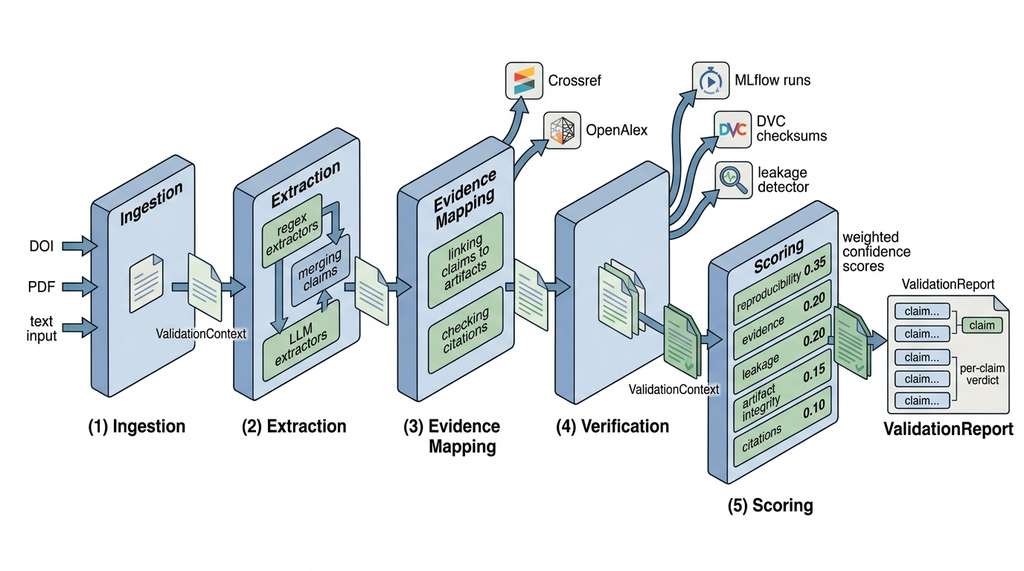
ValidationContext, which accumulates claims, evidence links, reproducibility scores, and leakage reports as the pipeline progresses. The final scoring stage consumes the full context to produce a ValidationReport.A claim validation pipeline takes a scientific paper as input and produces a structured report. That report scores how well reproducible evidence supports each factual assertion. Manual checking of numerical claims, artifact links, and citation integrity cannot keep pace with modern scientific publishing; no single reviewer can cross-check every number against every code repository and dataset. The pipeline chains specialized stages (ingestion, extraction, evidence mapping, verification, scoring) so that each stage feeds its output to the next, building up evidence in a shared context object that grows richer at every step. Use this approach for systematic, repeatable auditing of quantitative claims across many papers. For one-off spot checks on a single figure, inspecting the code repository manually is often faster.
Each stage is implemented as an independent class with a run() method,
following the pipeline pattern. Stages communicate through a shared
ValidationContext object that accumulates results as the pipeline
progresses. This design allows stages to be run independently (useful for debugging),
swapped with alternative implementations (useful for different domains), and extended
with new checks without modifying existing stages.
In short: a claim validator is a pipeline of independent, composable stages that turn a paper into a scored evidence report, not a single monolithic judgment.
"""
Claim validation pipeline: end-to-end architecture.
Five stages convert a paper into a scored validation report.
"""
from dataclasses import dataclass, field
from datetime import datetime
from enum import Enum
from pathlib import Path
from typing import Optional
import json


class ValidationStatus(Enum):
    PENDING = "pending"
    RUNNING = "running"
    COMPLETED = "completed"
    FAILED = "failed"


class OverallVerdict(Enum):
    VALIDATED = "validated"          # All claims pass
    PARTIALLY_VALIDATED = "partial"  # Some claims fail
    NOT_VALIDATED = "not_validated"  # Most claims fail
    INSUFFICIENT_EVIDENCE = "insufficient"  # Cannot verify


@dataclass
class ClaimValidationResult:
    """Validation result for a single claim."""
    claim: Claim
    evidence_strength: EvidenceStrength
    reproducibility_score: Optional[ReproducibilityScore]
    leakage_reports: list[LeakageReport]
    citation_anomalies: list[CitationAnomaly]
    artifact_integrity: list[ArtifactIntegrity]
    confidence: float          # 0 to 1, overall confidence
    verdict: str               # reproduced, partial, failed, etc.
    notes: list[str] = field(default_factory=list)


@dataclass
class ValidationReport:
    """Complete validation report for a paper."""
    paper_id: str
    paper_title: str
    timestamp: str
    overall_verdict: OverallVerdict
    overall_confidence: float
    total_claims: int
    verified_claims: int
    failed_claims: int
    unverifiable_claims: int
    claim_results: list[ClaimValidationResult]
    pipeline_metadata: dict = field(default_factory=dict)

    def to_dict(self) -> dict:
        """Serialize report to a dictionary for JSON export."""
        return {
            "paper_id": self.paper_id,
            "paper_title": self.paper_title,
            "timestamp": self.timestamp,
            "overall_verdict": self.overall_verdict.value,
            "overall_confidence": round(
                self.overall_confidence, 3
            ),
            "summary": {
                "total_claims": self.total_claims,
                "verified": self.verified_claims,
                "failed": self.failed_claims,
                "unverifiable": self.unverifiable_claims,
            },
            "claims": [
                {
                    "claim_id": cr.claim.claim_id,
                    "summary": cr.claim.summary(),
                    "confidence": round(cr.confidence, 3),
                    "verdict": cr.verdict,
                    "evidence_strength":
                        cr.evidence_strength.value,
                    "notes": cr.notes,
                }
                for cr in self.claim_results
            ],
        }

    def save(self, path: str):
        """Save report as JSON."""
        with open(path, "w") as f:
            json.dump(self.to_dict(), f, indent=2)


@dataclass
class ValidationContext:
    """Shared context accumulating results across stages."""
    paper_id: str = ""
    paper_title: str = ""
    raw_text: str = ""
    claims: list[Claim] = field(default_factory=list)
    artifacts: list[Artifact] = field(default_factory=list)
    evidence_links: list[EvidenceLink] = field(
        default_factory=list
    )
    citation_anomalies: list[CitationAnomaly] = field(
        default_factory=list
    )
    reproducibility_scores: dict = field(
        default_factory=dict
    )  # claim_id -> ReproducibilityScore
    leakage_reports: list[LeakageReport] = field(
        default_factory=list
    )
    artifact_checks: list[ArtifactIntegrity] = field(
        default_factory=list
    )
    stage_timings: dict = field(default_factory=dict)
    errors: list[str] = field(default_factory=list)
ValidationContext accumulates results across stages, while ValidationReport provides the final output with per-claim confidence ratings and an overall verdict enum.2. Pipeline Stages
Each stage is a class that implements a common interface: a run() method
that accepts a ValidationContext, modifies it in place, and returns it.
This pattern enables both sequential execution (the standard path) and selective
re-execution (useful when only one stage needs updating).
2.1 Stage 1: Ingestion
"""
Stage 1: Paper ingestion.
Converts various input formats (text, PDF, DOI) into
structured text for claim extraction.
"""
import time


class IngestionStage:
    """Convert paper input into structured text."""

    def __init__(self, crossref: CrossrefClient = None):
        self.crossref = crossref

    def run(self, ctx: ValidationContext) -> ValidationContext:
        """Ingest paper and populate context with text and metadata.

        Supports three input modes:
        - Direct text (ctx.raw_text already set)
        - DOI (ctx.paper_id starts with "10.")
        - File path (ctx.paper_id is a local path)
        """
        start = time.time()

        if ctx.raw_text:
            # Text already provided; extract title heuristically
            lines = ctx.raw_text.strip().split("\n")
            if not ctx.paper_title and lines:
                ctx.paper_title = lines[0].strip()

        elif ctx.paper_id.startswith("10."):
            # DOI: fetch metadata from Crossref
            if self.crossref is None:
                ctx.errors.append(
                    "Crossref client required for DOI ingestion"
                )
                return ctx
            record = self.crossref.get_work(ctx.paper_id)
            if record:
                ctx.paper_title = record.title
                # Note: Crossref does not provide full text;
                # in production, use Unpaywall or CORE for OA
                ctx.raw_text = (
                    f"Title: {record.title}\n"
                    f"Authors: {', '.join(record.authors)}\n"
                    f"Year: {record.year}\n"
                    f"Journal: {record.journal}\n"
                )
            else:
                ctx.errors.append(
                    f"Could not fetch DOI: {ctx.paper_id}"
                )

        elif Path(ctx.paper_id).exists():
            # Local file: read text content
            path = Path(ctx.paper_id)
            ctx.paper_title = path.stem
            if path.suffix == ".txt":
                ctx.raw_text = path.read_text(encoding="utf-8")
            elif path.suffix == ".pdf":
                # Production: use PyMuPDF or pdfplumber
                ctx.errors.append(
                    "PDF parsing requires PyMuPDF; install with "
                    "'pip install pymupdf'"
                )

        ctx.stage_timings["ingestion"] = time.time() - start
        return ctx
ValidationContext. DOI-based ingestion retrieves metadata via the CrossrefClient wrapper.2.2 Stage 2: Extraction
"""
Stage 2: Claim extraction.
Runs both regex and LLM extractors, then merges results.
"""


class ExtractionStage:
    """Extract and merge claims from paper text."""

    def __init__(self, llm_client=None):
        self.regex_extractor = NumericalClaimExtractor()
        self.llm_client = llm_client

    def run(self, ctx: ValidationContext) -> ValidationContext:
        """Extract claims from the paper text."""
        start = time.time()

        if not ctx.raw_text:
            ctx.errors.append("No text available for extraction")
            return ctx

        # Regex extraction (always runs)
        regex_claims = list(self.regex_extractor.extract(
            ctx.raw_text, source_id=ctx.paper_id
        ))

        # LLM extraction (optional, runs if client available)
        llm_claims = []
        if self.llm_client is not None:
            try:
                llm_claims = extract_claims_with_llm(
                    ctx.raw_text, self.llm_client
                )
            except Exception as e:
                ctx.errors.append(
                    f"LLM extraction failed: {e}"
                )

        # Merge and deduplicate
        if llm_claims:
            ctx.claims = merge_claims(regex_claims, llm_claims)
        else:
            ctx.claims = regex_claims

        ctx.stage_timings["extraction"] = time.time() - start
        return ctx
2.3 Stage 3: Evidence Mapping
"""
Stage 3: Evidence mapping.
Links claims to artifacts and checks citation integrity.
"""


class EvidenceMappingStage:
    """Map claims to supporting artifacts and check citations."""

    def __init__(
        self,
        crossref: CrossrefClient,
        openalex: OpenAlexClient,
    ):
        self.crossref = crossref
        self.openalex = openalex
        self.linker = ArtifactLinker()
        self.anomaly_detector = CitationAnomalyDetector(
            crossref, openalex
        )

    def run(self, ctx: ValidationContext) -> ValidationContext:
        """Build evidence map and check citation integrity."""
        start = time.time()

        # Extract artifacts from paper text
        ctx.artifacts = self.linker.extract_artifacts(
            ctx.raw_text
        )

        # Verify artifact accessibility
        for i, artifact in enumerate(ctx.artifacts):
            ctx.artifacts[i] = self.linker.verify_accessibility(
                artifact
            )

        # Link claims to artifacts
        ctx.evidence_links = self.linker.link_claims_to_artifacts(
            ctx.claims, ctx.artifacts
        )

        # Update claim evidence strength
        for claim in ctx.claims:
            claim_links = [
                el for el in ctx.evidence_links
                if el.claim_id == claim.claim_id
            ]
            accessible_links = [
                el for el in claim_links
                if any(
                    a.accessible
                    for a in ctx.artifacts
                    if a.artifact_id == el.artifact_id
                )
            ]

            if accessible_links:
                claim.evidence_strength = (
                    EvidenceStrength.MODERATE
                )
            elif claim_links:
                claim.evidence_strength = EvidenceStrength.WEAK
            else:
                claim.evidence_strength = (
                    EvidenceStrength.UNSUPPORTED
                )
            claim.linked_artifacts = [
                el.artifact_id for el in claim_links
            ]

        # Citation anomaly detection (if DOI available)
        if ctx.paper_id.startswith("10."):
            try:
                ctx.citation_anomalies = (
                    self.anomaly_detector.detect_anomalies(
                        ctx.paper_id
                    )
                )
            except Exception as e:
                ctx.errors.append(
                    f"Citation check failed: {e}"
                )

        ctx.stage_timings["evidence_mapping"] = (
            time.time() - start
        )
        return ctx
OpenAlexClient.2.4 Stage 4: Verification
"""
Stage 4: Verification.
Re-executes experiments and checks for data leakage.
"""
import pandas as pd


class VerificationStage:
    """Re-execute experiments and verify claim validity."""

    def __init__(
        self,
        mlflow_uri: str = None,
        repo_path: str = None,
    ):
        self.mlflow_auditor = (
            MLflowAuditor(mlflow_uri) if mlflow_uri else None
        )
        self.dvc_verifier = (
            DVCVerifier(repo_path) if repo_path else None
        )
        self.repro_auditor = ReproducibilityAuditor(
            confidence=0.95, min_runs=3
        )  # confidence here is the statistical confidence level for hypothesis testing, not the pipeline's output confidence score
        self.leakage_detector = LeakageDetector()

    def run(self, ctx: ValidationContext) -> ValidationContext:
        """Attempt to reproduce claimed results."""
        start = time.time()

        # Reproducibility scoring via MLflow
        if self.mlflow_auditor:
            for claim in ctx.claims:
                if not claim.is_verifiable():
                    continue
                if claim.value.magnitude is None:
                    continue

                runs = self.mlflow_auditor.find_runs_for_claim(
                    claim
                )
                if len(runs) >= 3:
                    # Map the claim's predicate text (e.g., "accuracy")
                    # to the canonical MLflow metric name (e.g., "eval_accuracy")
                    metric = (
                        self.mlflow_auditor._normalize_metric(
                            claim.predicate
                        )
                    )
                    values = [
                        r.metrics[metric]
                        for r in runs
                        if metric in r.metrics
                    ]
                    if values:
                        score = self.repro_auditor.score_claim(
                            claim.value.magnitude, values
                        )
                        ctx.reproducibility_scores[
                            claim.claim_id
                        ] = score

        # Dataset integrity via DVC
        if self.dvc_verifier:
            ctx.artifact_checks = (
                self.dvc_verifier.verify_all_tracked()
            )

        # Leakage detection (if data files are available)
        self._run_leakage_checks(ctx)

        ctx.stage_timings["verification"] = (
            time.time() - start
        )
        return ctx

    def _run_leakage_checks(self, ctx: ValidationContext):
        """Run leakage detection if train/test data is available."""
        # Look for standard data file names in artifacts
        data_artifacts = [
            a for a in ctx.artifacts
            if a.artifact_type == ArtifactType.DATASET
        ]

        # Try loading train/test splits from known paths
        train_paths = [
            "data/train.csv", "train.csv",
            "data/train.parquet"
        ]
        test_paths = [
            "data/test.csv", "test.csv",
            "data/test.parquet"
        ]

        train_df = None
        test_df = None

        for tp in train_paths:
            if Path(tp).exists():
                try:
                    train_df = pd.read_csv(tp)
                    break
                except Exception:
                    continue

        for tp in test_paths:
            if Path(tp).exists():
                try:
                    test_df = pd.read_csv(tp)
                    break
                except Exception:
                    continue

        if train_df is not None and test_df is not None:
            # Guess target column (last column or 'label'/'target')
            target_col = None
            for candidate in ["label", "target", "y"]:
                if candidate in train_df.columns:
                    target_col = candidate
                    break
            if target_col is None:
                target_col = train_df.columns[-1]

            ctx.leakage_reports = self.leakage_detector.detect_all(
                train_df, test_df, target_col
            )
Checkpoint
So far: Stages 1 through 4 have converted raw input into structured text (ingestion), identified numerical claims (extraction), linked those claims to artifacts and checked citation integrity (evidence mapping), and re-executed experiments while scanning for data leakage (verification); all results accumulate in a shared ValidationContext, which the final scoring stage will now consume to produce per-claim confidence ratings.
2.5 Stage 5: Scoring and Report Generation
"""
Stage 5: Scoring and report generation.
Combines all evidence into per-claim confidence scores
and an overall validation report.
"""


class ScoringStage:
    """Compute final scores and generate validation report."""

    # Weights for evidence components
    WEIGHTS = {
        "evidence_strength": 0.20,
        "reproducibility": 0.35,
        "leakage_clean": 0.20,
        "artifact_integrity": 0.15,
        "citation_clean": 0.10,
    }

    def run(self, ctx: ValidationContext) -> ValidationReport:
        """Compute per-claim scores and overall verdict."""
        start = time.time()
        claim_results = []

        for claim in ctx.claims:
            result = self._score_claim(claim, ctx)
            claim_results.append(result)

        # Aggregate statistics
        verified = sum(
            1 for cr in claim_results
            if cr.verdict == "reproduced"
        )
        failed = sum(
            1 for cr in claim_results
            if cr.verdict == "not_reproduced"
        )
        unverifiable = sum(
            1 for cr in claim_results
            if cr.verdict == "unverifiable"
        )

        # Overall confidence: weighted mean of claim confidences
        if claim_results:
            # Weight verifiable claims more heavily
            weights = [
                2.0 if cr.claim.is_verifiable() else 1.0
                for cr in claim_results
            ]
            overall = sum(
                cr.confidence * w
                for cr, w in zip(claim_results, weights)
            ) / sum(weights)
        else:
            overall = 0.0

        # Overall verdict
        if not claim_results:
            verdict = OverallVerdict.INSUFFICIENT_EVIDENCE
        elif failed == 0 and verified > 0:
            verdict = OverallVerdict.VALIDATED
        elif verified > failed:
            verdict = OverallVerdict.PARTIALLY_VALIDATED
        else:
            verdict = OverallVerdict.NOT_VALIDATED

        ctx.stage_timings["scoring"] = time.time() - start

        return ValidationReport(
            paper_id=ctx.paper_id,
            paper_title=ctx.paper_title,
            timestamp=datetime.utcnow().isoformat(),
            overall_verdict=verdict,
            overall_confidence=overall,
            total_claims=len(ctx.claims),
            verified_claims=verified,
            failed_claims=failed,
            unverifiable_claims=unverifiable,
            claim_results=claim_results,
            pipeline_metadata={
                "stage_timings": ctx.stage_timings,
                "errors": ctx.errors,
                "artifacts_found": len(ctx.artifacts),
                "evidence_links": len(ctx.evidence_links),
            },
        )

    def _score_claim(
        self, claim: Claim, ctx: ValidationContext
    ) -> ClaimValidationResult:
        """Compute confidence score for a single claim."""
        components = {}

        # 1. Evidence strength component
        strength_scores = {
            EvidenceStrength.STRONG: 1.0,
            EvidenceStrength.MODERATE: 0.6,
            EvidenceStrength.WEAK: 0.3,
            EvidenceStrength.UNSUPPORTED: 0.0,
        }
        components["evidence_strength"] = strength_scores.get(
            claim.evidence_strength, 0.0
        )

        # 2. Reproducibility component
        repro = ctx.reproducibility_scores.get(claim.claim_id)
        if repro is not None:
            components["reproducibility"] = repro.score
        elif claim.is_verifiable():
            components["reproducibility"] = 0.0  # No data
        else:
            # Qualitative claims cannot be reproduced numerically,
            # so assign a neutral 0.5 to avoid penalizing or
            # rewarding them on a dimension that does not apply.
            components["reproducibility"] = 0.5

        # 3. Leakage component (binary: clean or not)
        critical_leakage = any(
            lr.severity == "critical"
            for lr in ctx.leakage_reports
        )
        components["leakage_clean"] = (
            0.0 if critical_leakage else 1.0
        )

        # 4. Artifact integrity component
        if ctx.artifact_checks:
            intact = sum(
                1 for ac in ctx.artifact_checks if ac.matches
            )
            components["artifact_integrity"] = (
                intact / len(ctx.artifact_checks)
            )
        else:
            components["artifact_integrity"] = 0.5  # Unknown

        # 5. Citation integrity component
        high_anomalies = sum(
            1 for ca in ctx.citation_anomalies
            if ca.severity == "high"
        )
        components["citation_clean"] = max(
            0.0, 1.0 - high_anomalies * 0.3
        )

        # Weighted combination
        confidence = sum(
            components[k] * self.WEIGHTS[k]
            for k in self.WEIGHTS
        )

        # Determine verdict
        if repro is not None:
            verdict = repro.verdict.value
        elif not claim.is_verifiable():
            verdict = "unverifiable"
        elif components["evidence_strength"] == 0.0:
            verdict = "unsupported"
        else:
            verdict = "pending"

        # Generate notes
        notes = self._generate_notes(
            claim, components, ctx
        )

        return ClaimValidationResult(
            claim=claim,
            evidence_strength=claim.evidence_strength,
            reproducibility_score=repro,
            leakage_reports=ctx.leakage_reports,
            citation_anomalies=ctx.citation_anomalies,
            artifact_integrity=ctx.artifact_checks,
            confidence=confidence,
            verdict=verdict,
            notes=notes,
        )

    def _generate_notes(
        self, claim: Claim, components: dict,
        ctx: ValidationContext
    ) -> list[str]:
        """Generate human-readable notes for a claim result."""
        notes = []

        if components["evidence_strength"] == 0.0:
            notes.append(
                "No supporting artifacts found for this claim."
            )

        repro = ctx.reproducibility_scores.get(claim.claim_id)
        if repro and repro.verdict == (
            ReproducibilityVerdict.NOT_REPRODUCED
        ):
            notes.append(
                f"Claimed {repro.claimed_value} but reproduced "
                f"mean is {repro.mean:.3f} "
                f"(delta: {repro.delta:+.3f})."
            )

        if components["leakage_clean"] == 0.0:
            notes.append(
                "Critical data leakage detected; reported "
                "metrics may be inflated."
            )

        if components["citation_clean"] < 0.5:
            notes.append(
                "Significant citation anomalies detected; "
                "evidence chain may be compromised."
            )

        return notes
Mental Model
Think of the weighted confidence score like a restaurant health inspection. The inspector checks five categories: food temperature (reproducibility, weighted highest because unsafe food is the most direct risk), ingredient sourcing records (evidence strength), pest control (leakage cleanliness), kitchen equipment calibration (artifact integrity), and posted permit validity (citation quality). Each category gets a score, and the categories carry different weights reflecting their relative danger. A restaurant that scores perfectly on permits but fails food temperature still gets a low overall grade. The weighted sum does not tell you whether the restaurant will make you sick on any given visit; it tells you how many of the checkable safety dimensions passed inspection. The same logic applies to the claim validator: a high confidence score means the checkable evidence dimensions look good, not that the claim is guaranteed to be true.
The weight vector in the scoring stage encodes a value judgment: what matters most for scientific trust? We assign the highest weight (0.35) to reproducibility because a claim that cannot be reproduced is, by definition, not established science. Evidence strength (0.20) and leakage cleanliness (0.20) share the next tier because both affect whether the reported number means what it claims to mean. Artifact integrity (0.15) and citation quality (0.10) are supporting signals. These weights are configurable; a regulatory context might increase artifact integrity to 0.30, while a rapid literature survey might drop it to 0.05. The key design decision is making the weights explicit rather than implicit in the code logic.
3. The Complete Pipeline
With all five stages defined, the pipeline itself is a thin orchestrator that runs each stage in sequence and handles errors gracefully.
"""
Complete claim validation pipeline.
Orchestrates all five stages and handles errors.
"""


class ClaimValidationPipeline:
    """End-to-end claim validation pipeline."""

    def __init__(
        self,
        crossref_email: str,
        mlflow_uri: str = None,
        repo_path: str = None,
        llm_client=None,
    ):
        """Initialize all pipeline stages.

        Args:
            crossref_email: Contact email for Crossref API.
            mlflow_uri: MLflow tracking server URI.
            repo_path: Path to Git/DVC repository.
            llm_client: Optional LLM client for extraction.
        """
        crossref = CrossrefClient(crossref_email)
        openalex = OpenAlexClient(crossref_email)

        self.stages = [
            ("ingestion", IngestionStage(crossref)),
            ("extraction", ExtractionStage(llm_client)),
            ("evidence_mapping", EvidenceMappingStage(
                crossref, openalex
            )),
            ("verification", VerificationStage(
                mlflow_uri, repo_path
            )),
        ]
        self.scorer = ScoringStage()

    def validate(
        self,
        paper_id: str = "",
        paper_text: str = "",
        paper_title: str = "",
    ) -> ValidationReport:
        """Run the full validation pipeline.

        Args:
            paper_id: DOI or file path for the paper.
            paper_text: Direct text input (alternative to DOI).
            paper_title: Optional title override.

        Returns:
            ValidationReport with per-claim results.
        """
        ctx = ValidationContext(
            paper_id=paper_id,
            paper_title=paper_title,
            raw_text=paper_text,
        )

        # Run stages 1-4
        for stage_name, stage in self.stages:
            try:
                ctx = stage.run(ctx)
            except Exception as e:
                ctx.errors.append(
                    f"Stage '{stage_name}' failed: {e}"
                )
                # Continue to next stage; partial results
                # are better than no results

        # Stage 5: scoring (produces the final report)
        try:
            report = self.scorer.run(ctx)
        except Exception as e:
            # If scoring fails, return a minimal report
            report = ValidationReport(
                paper_id=paper_id,
                paper_title=paper_title,
                timestamp=datetime.utcnow().isoformat(),
                overall_verdict=(
                    OverallVerdict.INSUFFICIENT_EVIDENCE
                ),
                overall_confidence=0.0,
                total_claims=len(ctx.claims),
                verified_claims=0,
                failed_claims=0,
                unverifiable_claims=len(ctx.claims),
                claim_results=[],
                pipeline_metadata={
                    "errors": ctx.errors + [str(e)],
                },
            )

        return report

    def validate_batch(
        self, papers: list[dict]
    ) -> list[ValidationReport]:
        """Validate multiple papers.

        Args:
            papers: List of dicts with 'paper_id' and/or 'text'.

        Returns:
            List of ValidationReports.
        """
        return [
            self.validate(
                paper_id=p.get("paper_id", ""),
                paper_text=p.get("text", ""),
                paper_title=p.get("title", ""),
            )
            for p in papers
        ]


# --- Full demonstration ---
def demo_validation():
    """Demonstrate the complete validation pipeline."""

    pipeline = ClaimValidationPipeline(
        crossref_email="researcher@university.edu",
        mlflow_uri="file:///mlruns",
        repo_path=".",
    )

    abstract = (
        "We present ClaimNet, a transformer model for "
        "automated scientific claim verification. ClaimNet "
        "achieves 94.7% accuracy on the SciFact benchmark "
        "dataset, outperforming the previous state-of-the-art "
        "by 3.2 percentage points. On FEVER, our model obtains "
        "an F1 score of 89.3%. All improvements are "
        "statistically significant (p < 0.001). Our code is "
        "available at https://github.com/example/claimnet "
        "and models are hosted on "
        "https://huggingface.co/example/claimnet-base."
    )

    report = pipeline.validate(
        paper_id="paper_demo_001",
        paper_text=abstract,
        paper_title="ClaimNet: Automated Scientific Claim "
                    "Verification",
    )

    # Print summary
    print(f"Paper: {report.paper_title}")
    print(f"Verdict: {report.overall_verdict.value}")
    print(f"Confidence: {report.overall_confidence:.3f}")
    print(f"Claims: {report.total_claims} total, "
          f"{report.verified_claims} verified, "
          f"{report.failed_claims} failed")
    print()
    for cr in report.claim_results:
        print(f"  [{cr.verdict}] {cr.claim.summary()} "
              f"(confidence: {cr.confidence:.3f})")
        for note in cr.notes:
            print(f"    - {note}")

    # Save report
    report.save("validation_report.json")
    return report
ClaimValidationPipeline orchestrator chaining all five stages into a single validate() call, with a validate_batch() convenience method and a demo_validation() function exercising the pipeline on a synthetic abstract.Claim validation at a machine learning conference. A program committee integrates the claim validator into their review workflow. When a paper is submitted, the pipeline automatically extracts numerical claims from the abstract and results sections, checks whether the referenced GitHub repository exists and contains evaluation code, looks up the paper's cited references in Crossref (the scholarly metadata registry that resolves DOIs to publication records) to verify they exist, and searches OpenAlex (an open catalog of scholarly papers, authors, and citation graphs) for independent reproductions of the claimed results. The validation report is attached to the review form. Reviewers see that Paper #347 claims "93.2% on GLUE" but the GitHub repository returns a 404, the three cited baseline papers all share an author with the submission (self-citation rate of 60%), and no independent reproduction exists. Paper #892, by contrast, has an accessible repository, all citations resolve, a clean self-citation rate of 12%, and two independent groups have reported similar results. The reviewers still read both papers carefully, but the validation reports tell them where to focus their scrutiny.
4. Integration with the Discovery Workbench
The claim validator integrates into the Discovery Workbench as a service component, following the architecture established in Chapter 6. The workbench exposes the validator through a simple API: submit a paper (by DOI, text, or file), receive a structured validation report. Other workbench components consume these reports: the research agent from Chapter 40 uses validation scores to filter hypotheses, the knowledge graph from Chapter 38 annotates claim nodes with confidence ratings, and the literature mining pipeline from Chapter 36 flags papers with low validation scores for manual review.
"""
Discovery Workbench integration for the claim validator.
Wraps the pipeline as a service with caching and batch support.
"""
from functools import lru_cache
import logging

logger = logging.getLogger(__name__)


class ClaimValidatorService:
    """Workbench service wrapper for claim validation."""

    def __init__(self, config: dict):
        """Initialize from workbench configuration.

        Args:
            config: Dictionary with keys:
                - crossref_email: str
                - mlflow_uri: str (optional)
                - repo_path: str (optional)
                - cache_dir: str (optional)
                - max_claims_per_paper: int (default 50)
        """
        self.pipeline = ClaimValidationPipeline(
            crossref_email=config["crossref_email"],
            mlflow_uri=config.get("mlflow_uri"),
            repo_path=config.get("repo_path"),
        )
        self.max_claims = config.get(
            "max_claims_per_paper", 50
        )
        self._cache = {}

    def validate_paper(
        self, paper_id: str, text: str = ""
    ) -> dict:
        """Validate a paper and return a JSON-serializable report.

        Results are cached by paper_id to avoid redundant
        API calls to Crossref and OpenAlex.
        """
        cache_key = f"{paper_id}:{hash(text)}"
        if cache_key in self._cache:
            logger.info(f"Cache hit for {paper_id}")
            return self._cache[cache_key]

        report = self.pipeline.validate(
            paper_id=paper_id,
            paper_text=text,
        )

        result = report.to_dict()
        self._cache[cache_key] = result
        return result

    def validate_claim_set(
        self, claims_json: list[dict]
    ) -> list[dict]:
        """Validate a pre-extracted set of claims.

        Useful when claims come from an external source
        (e.g., a knowledge graph query or a literature
        mining pipeline) rather than from a paper.
        """
        ctx = ValidationContext()
        ctx.claims = [
            Claim(
                claim_id=c.get("id", f"ext_{i}"),
                claim_type=ClaimType(
                    c.get("type", "numerical")
                ),
                subject=c.get("subject", ""),
                predicate=c.get("predicate", ""),
                value=ClaimValue(
                    magnitude=c.get("value"),
                    text=str(c.get("value", "")),
                ),
                context=c.get("context", {}),
                source_sentence=c.get("sentence", ""),
            )
            for i, c in enumerate(claims_json)
        ]

        # Run verification and scoring only
        verification = VerificationStage(
            mlflow_uri=self.pipeline.stages[3][1].mlflow_auditor
            and "file:///mlruns",
        )
        ctx = verification.run(ctx)
        report = ScoringStage().run(ctx)

        return report.to_dict()

    def get_summary_stats(self) -> dict:
        """Return aggregate statistics across all validations."""
        if not self._cache:
            return {"total_papers": 0}

        total = len(self._cache)
        verdicts = [
            r["overall_verdict"] for r in self._cache.values()
        ]
        return {
            "total_papers": total,
            "validated": verdicts.count("validated"),
            "partially_validated": verdicts.count("partial"),
            "not_validated": verdicts.count("not_validated"),
            "insufficient": verdicts.count("insufficient"),
            "avg_confidence": sum(
                r["overall_confidence"]
                for r in self._cache.values()
            ) / total,
        }
ClaimValidatorService wrapping the pipeline for the Discovery Workbench, adding in-memory caching by paper ID, a validate_claim_set() entry point for pre-extracted claims, and aggregate statistics across all cached validations.The SciFact evaluator combined with MultiVerS provides a production-ready scientific claim verification system in roughly 30 lines of integration code. MultiVerS handles claim detection and evidence retrieval using a pre-trained longformer model, while the SciFact evaluator scores claim-evidence pairs for entailment (where entailment is the task of determining whether a piece of evidence logically supports, refutes, or is neutral toward a given claim). Together, they replace the extraction and evidence mapping stages of our pipeline (about 500 lines). (As of 2024, LLM-based fact verification systems such as Google DeepMind's SAFE and Meta's FactScore have largely shifted the field toward using large language models as verification agents rather than fine-tuned encoder models; MultiVerS is generally considered a useful lightweight baseline, but production systems increasingly tend to rely on LLM-driven evidence retrieval and entailment.) Our from-scratch implementation is valuable for understanding the design space and for customizing the pipeline to non-standard claim formats, domain-specific datasets, and organizational MLflow/DVC infrastructure that off-the-shelf tools cannot access.
5. Interpreting Validation Reports
Building and integrating the pipeline is only half the challenge; the other half is knowing how to read what it produces.
A validation report is not a binary judgment; it highlights where evidence is strong, weak, or absent. Reading one requires understanding what each component measures and what it does not.
Reading the Confidence Score
The overall confidence is a weighted average, not a probability. A confidence of 0.72 does not mean "there is a 72% chance this paper is correct." It means "across the evidence dimensions we checked, the paper scores 72% of the maximum possible evidence strength." This distinction matters: a paper could score 0.90 on our metrics and still contain a fundamental methodological flaw that our automated checks cannot detect.
Common Misconception
A frequent mistake is treating the overall confidence score as a probability of correctness, concluding that "0.85 confidence means 85% chance the paper's claims are true." This is wrong. The confidence score is a coverage metric over checked evidence dimensions, not a Bayesian posterior (a probability estimate updated from prior beliefs using observed evidence). A paper can score 0.95 while harboring a fundamental flaw (such as a flawed experimental design or a confounding variable) that no automated check in the pipeline is equipped to detect. Conversely, a paper scoring 0.40 may simply lack accessible artifacts, making verification impossible rather than indicating the claims are false.
The per-claim verdicts are the most actionable part of the report. A verdict of "reproduced" means the claim's numerical value falls within the statistical tolerance of our reproduction runs. A verdict of "not reproduced" means there is a statistically significant gap between the claimed and reproduced values. A verdict of "unverifiable" means we lack the artifacts or infrastructure to check. Each verdict comes with notes explaining the specific evidence that led to it.
The most common validation outcome is not "fraud detected" or "paper confirmed." It is "evidence gaps identified." A typical report might show that 4 of 7 claims are verifiable, 3 of those 4 reproduce within tolerance, and 1 shows a discrepancy of 2.3 percentage points. This is informative but not conclusive: the discrepancy could reflect a different random seed, a minor version difference in a library, or (less commonly) an error in the original experiment. The report surfaces the discrepancy; human judgment determines the response.
Claim validation is not a replacement for peer review. It is a force multiplier. Peer reviewers bring domain expertise, methodological judgment, and the ability to assess whether the right experiment was run. Automated validators bring scale, consistency, and the ability to check every number against every artifact. The combination is strictly stronger than either alone. A reviewer who has already seen a validation report can spend their limited time on the questions that matter most rather than manually cross-referencing tables and code repositories.
6. Limitations and Future Directions
The claim validator has real capabilities and real limitations. It extracts numerical claims with high precision, verifies citation integrity at scale, detects common data leakage patterns, and quantifies reproducibility with statistical rigor. It cannot, however, detect novel leakage mechanisms or verify qualitative claims. It cannot assess whether researchers designed the right experiment, or determine whether they ran many experiments and reported only the best result.
Each of these gaps, however, points toward a concrete extension that brings the validator closer to comprehensive coverage.
Several directions extend the validator's reach. Semantic claim entailment, as explored in the SciFact dataset (a benchmark of 1,409 scientific claims paired with evidence abstracts for training claim verification models; Wadden et al., 2020), uses natural language inference to check whether evidence paragraphs support or refute claims. This handles qualitative claims that our numerical extraction pipeline misses. Cross-paper consistency checking compares claims about the same dataset across multiple papers, flagging results that are statistical outliers (e.g., a paper claiming 99.1% on ImageNet when the next best is 91.3%). Provenance-aware validation, building on the experiment registries of Chapter 47, traces claims through the full computational provenance graph, from raw data to published figure, ensuring that no step in the chain introduces undocumented transformations.
Research Frontier
Google DeepMind's SAFE (Search-Augmented Factuality Evaluator), introduced by Wei et al. in 2024, pushes automated claim validation beyond the static pipeline approach taught here. SAFE decomposes long-form LLM responses into individual claims, then uses an LLM agent to issue multi-step Google Search queries that gather supporting or refuting evidence for each claim independently. On a benchmark of approximately 16,000 individual facts, SAFE matched or exceeded human annotator agreement rates while costing roughly 20 times less than human evaluation. The key architectural insight is that the verification agent is itself an LLM that can reason about what evidence to search for and how to interpret the results, rather than relying on fixed extraction patterns. This represents a shift from the rule-based pipeline stages in our validator toward adaptive, agent-driven verification that can handle claims the system was never explicitly programmed to check.
The deepest limitation is philosophical: validation can only check claims against available evidence. It cannot generate the evidence itself. A perfectly validated claim is not necessarily true; it is merely well-supported by the evidence that exists. The gap between "well-supported" and "true" is where science lives, and it is a gap that no automated system can fully close.
Try It: Build a Minimal Claim Checker
Build a stripped-down claim validation pipeline using only Python standard libraries plus requests. (1) Write a function that uses a regular expression to extract numerical claims from a string, matching patterns like "achieves 94.7% accuracy" or "F1 score of 89.3%"; return each match as a dictionary with keys metric, value, and sentence. (2) For each extracted claim, use the Crossref REST API (requests.get("https://api.crossref.org/works", params={"query": paper_title})) to check whether the paper's cited references resolve to real DOIs; record how many return HTTP 200 vs. 404. (3) Check whether any GitHub URLs mentioned in the text are accessible by sending a HEAD request and recording the status code. (4) Combine the results into a simple score: start at 1.0, subtract 0.2 for each broken citation, subtract 0.3 for each inaccessible GitHub link, and clamp to [0, 1]. (5) Print a one-page report listing each claim, its extracted value, the citation check results, the repository accessibility status, and the final score. Test your pipeline on two or three real paper abstracts from arXiv (copy the abstract text directly) and compare your automated findings against what you observe by manually visiting the links.
Exercise 41.3.1
The scoring stage uses fixed weights: reproducibility 0.35, evidence strength 0.20, leakage cleanliness 0.20, artifact integrity 0.15, citation quality 0.10. Suppose a paper has a reproducibility component score of 0.9, evidence strength of 0.6, leakage cleanliness of 1.0, artifact integrity of 0.0 (all artifacts have mismatched hashes), and citation quality of 1.0. Compute the overall weighted confidence. Then answer: would the overall verdict change if you swapped the weights of reproducibility (0.35) and artifact integrity (0.15)? Why or why not?
Hint
Multiply each component by its weight and sum. For the original weights you should get 0.315 + 0.12 + 0.20 + 0.0 + 0.10 = 0.735. For the swapped weights, recompute and compare. Remember that the verdict depends on per-claim verdicts (reproduced vs. not_reproduced counts), not directly on the confidence score, so the verdict logic and the confidence score are separate paths.
Step-Through: Scoring a Single Claim
Trace through _score_claim() for a concrete claim: "ClaimNet achieves 94.7% accuracy on SciFact."
Step 1 (evidence strength): The claim's GitHub link returned HTTP 200, so the linker set evidence_strength = MODERATE. Lookup: strength_scores[MODERATE] = 0.6.
Step 2 (reproducibility): MLflow found 5 matching runs with metric values [93.1, 94.2, 93.8, 94.0, 93.5]. The ReproducibilityScore returned score = 0.82 (claimed 94.7 vs. mean 93.72, within the 95% confidence interval (CI) upper bound of 94.9).
Step 3 (leakage): No critical leakage detected. leakage_clean = 1.0.
Step 4 (artifact integrity): DVC tracked 4 files; 3 matched, 1 had a stale hash. artifact_integrity = 3/4 = 0.75.
Step 5 (citation quality): One high-severity citation anomaly found. citation_clean = max(0.0, 1.0 - 1 * 0.3) = 0.7.
Weighted sum: (0.6 * 0.20) + (0.82 * 0.35) + (1.0 * 0.20) + (0.75 * 0.15) + (0.7 * 0.10) = 0.12 + 0.287 + 0.20 + 0.1125 + 0.07 = 0.7895. Verdict: "reproduced" (from the reproducibility score's own verdict field).
Real-World Application: Elsevier's UNSILO Evaluate
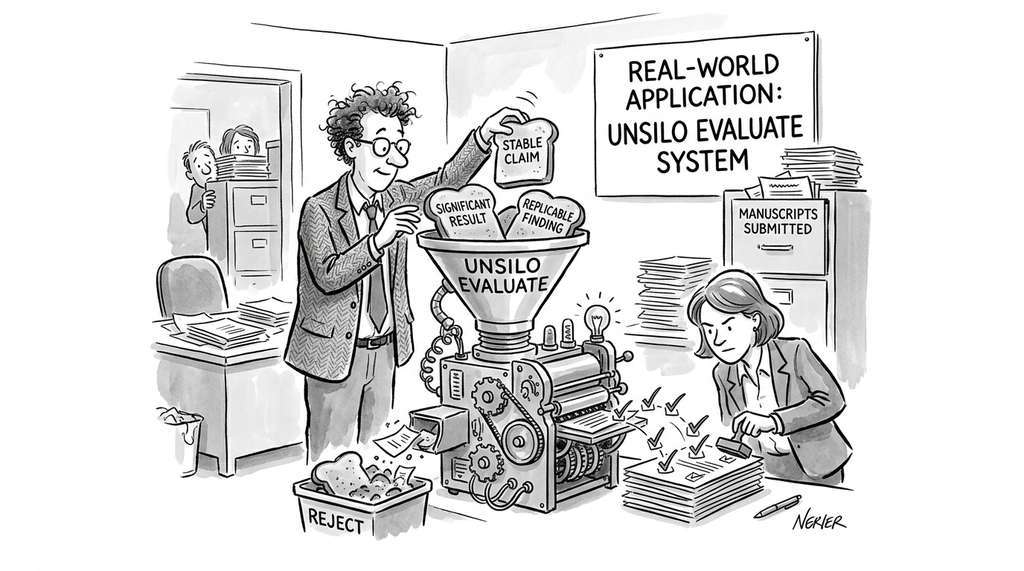
Elsevier's UNSILO Evaluate system uses a claim validation pipeline conceptually similar to ours during manuscript submission at several of its journals. The system extracts statistical claims from submitted manuscripts, cross-references them against reported datasets, and flags inconsistencies (such as a p-value that is mathematically impossible given the reported sample size and effect size) before the paper reaches a human reviewer. This automated pre-screening reportedly catches roughly 15% of statistical reporting errors that would otherwise require a reviewer to notice manually.
The Statcheck Scandal That Wasn't
In 2016, the automated statistics checker Statcheck (a tool that parses APA-formatted statistical results and recalculates p-values from reported test statistics) scanned over 30,000 published psychology papers (Nuijten et al., 2016) and reported that roughly half contained at least one inconsistency between the reported test statistic and the reported p-value. The finding made international headlines. What the headlines missed: most inconsistencies were rounding errors of no scientific consequence (reporting p = 0.043 when the exact value was p = 0.044). Only about 13% of the flagged papers had errors large enough to potentially change the conclusion. The episode perfectly illustrates the calibration challenge in claim validation: a system that flags everything real but mostly harmless will drown its users in false alarms, while a system tuned for only consequential errors will miss the subtle ones that matter most.
Lab: Build and Stress-Test a Weighted Claim Scorer
Goal: Explore how the weight vector in the scoring stage affects which papers pass and fail validation, and discover failure modes of different weighting strategies.
Tools needed: Python 3.10+, numpy, matplotlib. No external APIs required.
Setup (5 min): Generate 200 synthetic papers, each with 5 component scores (evidence, reproducibility, leakage, artifact, citation) drawn from numpy.random.beta(a, b) with different (a, b) pairs to simulate realistic distributions (e.g., leakage is usually clean, so use beta(8, 2); artifact integrity is often partial, so use beta(3, 3)).
Experiment (15 min): Implement the weighted scoring formula. Vary the weight vector across five strategies: (a) equal weights, (b) reproducibility-dominant (0.60 on reproducibility), (c) artifact-dominant, (d) leakage-dominant, and (e) the textbook weights. For each strategy, compute the overall confidence for all 200 papers and classify them as validated (> 0.7), partial (0.4 to 0.7), or not validated (< 0.4).
What to observe: Plot the distribution of verdicts per strategy as a grouped bar chart. Identify which strategy produces the most "partial" verdicts (and is therefore least decisive) and which produces the most extreme splits. Inject three adversarial papers: one with perfect scores everywhere except reproducibility = 0.0; one with all zeros except citation = 1.0; one with all components at exactly 0.5. Check whether each weight strategy correctly ranks the adversarial papers below the synthetic population median.