Prerequisites
This section builds on the vibe coding loop from Section 9.2 and the specification gap framework from Section 9.1. You should be comfortable writing pytest test cases and using Python type annotations. Familiarity with the concept of invariants from Chapter 4: Reasoning for Discovery will help with the property-based testing material.
Verification is the "observe" phase of the vibe coding loop, and repair is what happens when observation reveals problems. This section builds a layered verification stack: example-based tests (pytest) catch specific bugs, property-based tests (Hypothesis) catch classes of bugs, schema validators (Pydantic) catch structural violations, and static analysis (mypy, ruff) catches issues without running the code at all. Each layer catches bugs that the layers below it miss, and together they form an executable contract (a set of automated checks that define correctness in a way a machine can verify) that turns the vague aspiration of "make it work" into a precise, automatable definition of correctness (see Section 9.1 for the full specification gap framework that motivates this contract). The repair half of this section shows how to feed verification failures back to the model effectively, closing the loop from Section 9.2.
1. The Verification Stack
What if your code passes every unit test you wrote, yet silently corrupts data the moment a real user supplies an input you never considered? Example-based tests only check the specific inputs you thought of. Property-based tests only check the properties you defined. Type checkers only catch type errors, not logic errors. Each tool has blind spots that the others compensate for. The verification stack arranges these tools in a deliberate order, from fastest and cheapest to slowest and most thorough, as shown in Figure 9.3.1.
A verification stack is a fixed sequence of automated checking tools, ordered by speed and cost. It runs against every version of the generated code. No single tool catches all categories of defect: a linter sees style violations but not logic errors, while a test suite sees logic errors but not type mismatches. Each layer runs independently, produces a pass/fail verdict with structured details, and the runner aggregates all results into one report before any repair begins. Use a verification stack whenever you iterate on AI-generated code (the vibe coding loop). For a one-off script you will never modify again, pytest alone may suffice. For anything that will evolve across multiple generate/repair cycles, the full stack pays for itself within two or three iterations by catching errors that would otherwise cascade.
Layer 1: Static analysis (mypy and pyright, which are static type checkers that verify type annotations without running the code, along with ruff, a fast Python linter that checks style and catches common errors) runs in seconds, requires no test inputs, and catches type mismatches, unused imports, unreachable code, and style violations. Static analysis is the cheapest verification layer because it requires no test infrastructure and provides immediate feedback. In the vibe coding loop, static analysis runs first: if the generated code has type errors, there is no point running the test suite.
Layer 2: Unit tests (pytest) run in seconds to minutes and verify specific input-output pairs. Each test encodes one behavioral decision from the specification. Unit tests are the backbone of the executable contract because they are easy to write, easy to understand, and produce clear pass/fail signals that the model can act on.
Layer 3: Property-based tests (Hypothesis) run in seconds to minutes and verify invariants (properties that must hold true for all valid inputs, such as "the output list is always sorted" or "no input element is lost") across randomly generated inputs. Property tests are more powerful than unit tests because they explore the input space automatically, finding edge cases the developer never considered. They are also harder to write because they require the developer to articulate general properties rather than specific examples.
Checkpoint
So far: static analysis catches structural issues without running the code, unit tests verify specific input-output pairs, and property-based tests verify general invariants across randomly generated inputs; each layer compensates for the blind spots of the others.
Layer 4: Integration and end-to-end tests (Playwright, httpx) run in seconds to minutes and verify that components work together. End-to-end tests are the most expensive layer but also the most realistic: they test the system as a user would experience it. Section 9.4 covers browser-based testing with Playwright. In short: Each layer in the stack exists because every other layer has a blind spot.
import subprocess
import json
from dataclasses import dataclass

@dataclass
class VerificationResult:
    """Result from one layer of the verification stack."""
    layer: str
    passed: bool
    details: str
    duration_seconds: float

def run_verification_stack(
    source_file: str,
    test_file: str,
) -> list[VerificationResult]:
    """
    Run the full verification stack against generated code.

    Layers run in order; each layer runs regardless of whether
    previous layers passed (to collect all issues at once).
    """
    results = []
    import time

    # Layer 1: Static analysis with ruff (linting)
    t0 = time.time()
    ruff_result = subprocess.run(
        ["ruff", "check", source_file, "--output-format=json"],
        capture_output=True, text=True,
    )
    results.append(VerificationResult(
        layer="ruff",
        passed=ruff_result.returncode == 0,
        details=ruff_result.stdout[:500],
        duration_seconds=time.time() - t0,
    ))

    # Layer 2: Type checking with mypy
    t0 = time.time()
    mypy_result = subprocess.run(
        ["mypy", source_file, "--ignore-missing-imports"],
        capture_output=True, text=True,
    )
    results.append(VerificationResult(
        layer="mypy",
        passed=mypy_result.returncode == 0,
        details=mypy_result.stdout[:500],
        duration_seconds=time.time() - t0,
    ))

    # Layer 3: pytest (unit + property-based tests)
    t0 = time.time()
    pytest_result = subprocess.run(
        ["pytest", test_file, "-v", "--tb=short"],
        capture_output=True, text=True,
    )
    results.append(VerificationResult(
        layer="pytest",
        passed=pytest_result.returncode == 0,
        details=pytest_result.stdout[-1000:],  # last 1000 chars for failures
        duration_seconds=time.time() - t0,
    ))

    return results

def format_for_repair(results: list[VerificationResult]) -> str:
    """
    Format verification results as a repair prompt for the model.

    Only includes failing layers, with actionable details.
    """
    failures = [r for r in results if not r.passed]
    if not failures:
        return "All verification layers passed."

    lines = ["The following verification layers failed:\n"]
    for f in failures:
        lines.append(f"## {f.layer} (failed in {f.duration_seconds:.1f}s)")
        lines.append(f.details)
        lines.append("")

    lines.append("Please fix all issues. Do not change the test file.")
    return "\n".join(lines)
VerificationResult dataclass and format_for_repair function. Each layer produces a structured result; format_for_repair transforms failures into a repair prompt suitable for feeding back into the vibe coding loop.Run all layers even if an early layer fails. Collecting all failures at once gives the model a complete picture of what is wrong, enabling it to fix multiple issues in a single repair iteration rather than playing whack-a-mole across iterations. This principle (parallelize verification, serialize repair) directly improves the convergence rate from Section 9.2 by maximizing the information content of each steering message.
2. Property-Based Testing with Hypothesis
Example-based tests verify that specific inputs produce specific outputs. Property-based tests verify that all inputs (within a defined domain) satisfy a general property. The distinction is profound: an example test says "for input [3, 1, 2], the output is [1, 2, 3]"; a property test says "for any list of integers, the output is a sorted permutation of the input." The property test subsumes infinitely many example tests.
Mental Model
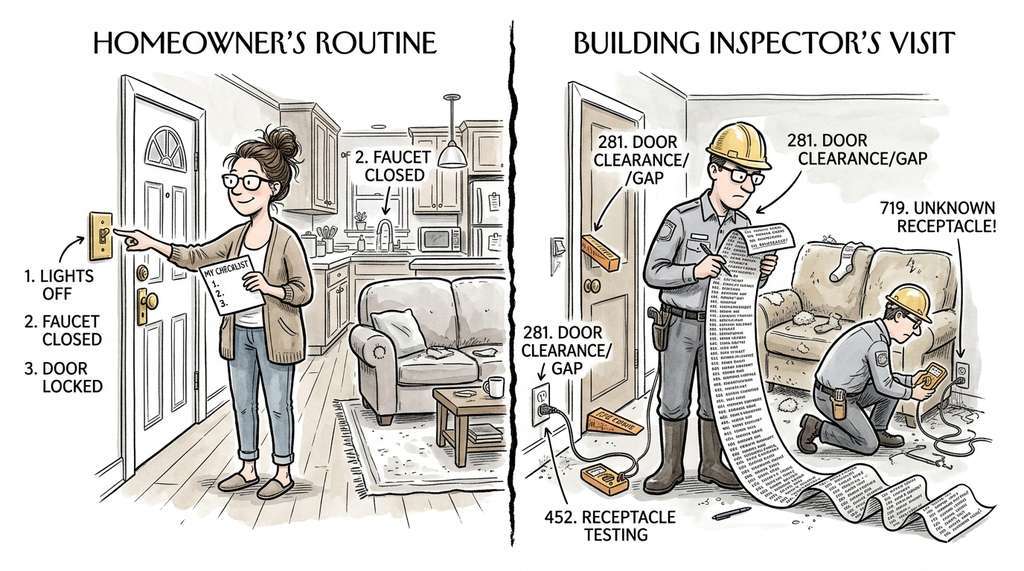
Think of property-based testing like a building inspector versus a homeowner. A homeowner (example-based testing) checks that the kitchen faucet works, the bedroom light switch flips, and the front door locks. An inspector (property-based testing) checks that every faucet delivers water within a pressure range, every switch controls the correct circuit, and every door meets fire-code clearance. The inspector does not enumerate each fixture individually; instead, she states a rule ("all outlets must be grounded") and then walks through the house testing outlets she encounters, including ones the homeowner forgot existed. Similarly, Hypothesis states a property ("the output is always sorted") and then generates inputs the developer never considered, including the empty list, the single-element list, and the list with all identical values.
Hypothesis is the standard property-based testing library for Python. It generates random inputs according to strategies (descriptions of valid input domains), runs the function under test, and checks that the specified property holds. When Hypothesis finds a failing input, it automatically shrinks it (that is, it reduces the failing input to the smallest example that still triggers the failure), making the bug report maximally informative.
from hypothesis import given, settings, assume
from hypothesis import strategies as st

# --- The function under test (generated by AI) ---
def merge_sorted(a: list[int], b: list[int]) -> list[int]:
    """Merge two sorted lists into one sorted list."""
    result = []
    i = j = 0
    while i < len(a) and j < len(b):
        if a[i] <= b[j]:
            result.append(a[i])
            i += 1
        else:
            result.append(b[j])
            j += 1
    result.extend(a[i:])
    result.extend(b[j:])
    return result

# --- Property-based tests ---

@given(
    a=st.lists(st.integers(min_value=-1000, max_value=1000)),
    b=st.lists(st.integers(min_value=-1000, max_value=1000)),
)
def test_merge_preserves_elements(a: list[int], b: list[int]):
    """Property: merging preserves all elements (no drops, no duplicates)."""
    a_sorted = sorted(a)
    b_sorted = sorted(b)
    merged = merge_sorted(a_sorted, b_sorted)
    assert sorted(merged) == sorted(a_sorted + b_sorted)

@given(
    a=st.lists(st.integers(min_value=-1000, max_value=1000)),
    b=st.lists(st.integers(min_value=-1000, max_value=1000)),
)
def test_merge_output_is_sorted(a: list[int], b: list[int]):
    """Property: output is always sorted."""
    a_sorted = sorted(a)
    b_sorted = sorted(b)
    merged = merge_sorted(a_sorted, b_sorted)
    for i in range(len(merged) - 1):
        assert merged[i] <= merged[i + 1], (
            f"Output not sorted at index {i}: {merged[i]} > {merged[i+1]}"
        )

@given(
    a=st.lists(st.integers(min_value=-1000, max_value=1000)),
    b=st.lists(st.integers(min_value=-1000, max_value=1000)),
)
def test_merge_length_is_sum(a: list[int], b: list[int]):
    """Property: output length equals sum of input lengths."""
    a_sorted = sorted(a)
    b_sorted = sorted(b)
    merged = merge_sorted(a_sorted, b_sorted)
    assert len(merged) == len(a_sorted) + len(b_sorted)
merge_sorted: element preservation via sorted-multiset equality, pairwise sorted-order verification, and length conservation across merged output.Step-Through: Hypothesis Shrinking a Failing Input
Trace through Hypothesis's shrinking process on a concrete example. Suppose
merge_sorted has a bug: it drops the last element of list b
when b is longer than a. Hypothesis generates a failing input:
a=[4, 7], b=[1, 3, 5, 9]. The merged output is
[1, 3, 4, 5, 7] (missing 9), so test_merge_length_is_sum
fails because len(merged)=5 but len(a)+len(b)=6.
Hypothesis now shrinks. Step 1: try a=[], b=[1, 3, 5, 9];
merged output is [1, 3, 5] (still drops last element), still fails.
Step 2: try a=[], b=[0, 0]; merged output is [0],
still fails. Step 3: try a=[], b=[0]; merged output is
[], still fails. Step 4: try a=[], b=[];
merged output is [], passes. Hypothesis reports the minimal reproducer:
a=[], b=[0]. That single-element case pinpoints the
off-by-one error far more clearly than the original six-element input.
The three properties above form a near-complete characterization (a set of properties that, taken together, constrain the function's behavior so tightly that any implementation satisfying all of them is typically correct) of the merge function: any function that preserves elements, produces sorted output, and preserves total length is, in practice, a correct merge. This characterization does not cover every conceivable property (for example, it does not verify stability of equal elements from different lists), but it is more powerful than any finite set of example tests because it covers the entire input domain for the properties it does specify.
That theoretical completeness becomes a practical superpower once the code under test is generated by a model whose implicit assumptions you cannot inspect. In the vibe coding loop, property-based tests serve a special role: they catch bugs that arise from the implicit assumptions component of the specification gap (Section 9.1). The developer may not think to test what happens when both input lists are empty, or when they contain duplicate values, or when one list is much longer than the other. Hypothesis generates all of these cases automatically.
A researcher asks Claude Code to implement a function that normalizes a vector to unit length. The example tests all pass (they use small integer vectors like [3, 4] and [1, 0, 0]). But a Hypothesis property test discovers that the function crashes on the zero vector [0, 0, 0] (division by zero) and returns incorrect results for very large vectors (floating-point overflow in the norm calculation). Neither edge case appeared in the hand-written tests. The property test that caught these issues is four lines of logic:
import numpy as np
from hypothesis import given
from hypothesis import strategies as st
from hypothesis.extra.numpy import arrays

@given(
    v=arrays(
        dtype=np.float64,
        shape=st.integers(min_value=1, max_value=100),
        elements=st.floats(
            min_value=-1e308, max_value=1e308,
            allow_nan=False, allow_infinity=False,
        ),
    )
)
def test_normalize_unit_length(v):
    """Property: normalized vector has unit length (or input is zero)."""
    norm = np.linalg.norm(v)
    if norm == 0:
        # Zero vector: function should return zero vector or raise
        try:
            result = normalize(v)
            assert np.allclose(result, 0.0)
        except ValueError:
            pass  # raising is also acceptable
    else:
        result = normalize(v)
        result_norm = np.linalg.norm(result)
        assert abs(result_norm - 1.0) < 1e-6, (
            f"Expected unit norm, got {result_norm}"
        )
arrays strategy generates vectors of arbitrary dimension (1 to 100) with arbitrary float64 values, covering the zero-vector and overflow edge cases that hand-written tests missed.3. Schema Validation with Pydantic
Property-based tests and example-based tests both verify that code behaves correctly, but an entire category of defect lies outside their reach: violations in the shape and type of the data itself. Where the previous two sections focused on whether code produces the right answers, schema validation asks a different question: does the data flowing between components have the right structure? In vibe coding for data-intensive applications (which most scientific applications are), the most common bugs are structural: a function returns a dictionary with the wrong keys, a nested field has the wrong type, or a numeric value falls outside its valid range. Pydantic, a Python library for data validation using type annotations and declarative field constraints, catches all of these automatically.
A single Pydantic model acts as type annotation (readable by mypy), runtime validator, JSON serializer, and documentation artifact (generates JSON Schema). One definition delivers all four functions.
from pydantic import BaseModel, Field, field_validator
from typing import Optional
from datetime import datetime

class ExperimentResult(BaseModel):
    """
    Schema contract for a single experiment result.

    This model serves as the executable contract between the data
    ingestion pipeline (AI-generated) and the analysis pipeline
    (human-written). Any violation raises ValidationError with
    a precise error message that can be fed back to the model.
    """
    experiment_id: str = Field(
        pattern=r"^EXP-\d{6}$",
        description="Experiment ID in format EXP-NNNNNN",
    )
    timestamp: datetime = Field(
        description="When the measurement was taken (UTC)",
    )
    measurement: float = Field(
        ge=-273.15,  # absolute zero in Celsius
        le=10000.0,
        description="Temperature measurement in Celsius",
    )
    uncertainty: float = Field(
        gt=0.0,
        description="Measurement uncertainty (must be positive)",
    )
    instrument: str = Field(
        min_length=1,
        max_length=100,
        description="Instrument identifier",
    )
    notes: Optional[str] = Field(
        default=None,
        max_length=1000,
        description="Optional free-text notes",
    )

    @field_validator("measurement")
    @classmethod
    def measurement_precision(cls, v: float) -> float:
        """Measurements should not have more than 4 decimal places."""
        if round(v, 4) != v:
            raise ValueError(
                f"Measurement {v} has excessive precision; "
                f"round to 4 decimal places"
            )
        return v

# Valid: passes all constraints
valid = ExperimentResult(
    experiment_id="EXP-000042",
    timestamp="2025-06-15T10:30:00Z",
    measurement=23.5,
    uncertainty=0.1,
    instrument="Thermocouple-A7",
)
print(valid.model_dump_json(indent=2))

# Invalid: multiple violations caught at once
try:
    invalid = ExperimentResult(
        experiment_id="EXP42",         # wrong format
        timestamp="2025-06-15",
        measurement=-300.0,            # below absolute zero
        uncertainty=-0.1,              # negative uncertainty
        instrument="",                 # too short
    )
except Exception as e:
    print(f"Validation errors:\n{e}")
    # Pydantic reports ALL violations, not just the first one
ExperimentResult model as executable schema contract. The model encodes domain constraints (temperature bounded by absolute zero, regex-validated ID format, strictly positive uncertainty) that would require dozens of lines of manual assertion code, and reports all violations at once rather than stopping at the first.
In the vibe coding loop, Pydantic models serve as the interface contract between
components. When you ask the model to generate a data ingestion function, you provide
the Pydantic model as part of the specification: "The function must return a list of
ExperimentResult objects." If the generated function returns data that
violates the schema, Pydantic's error message is detailed enough to serve directly
as steering feedback. This technique extends naturally to
MCP server development (Chapter 12),
where Pydantic models define the tool input/output schemas.
Hypothesis can generate test data directly from Pydantic models using the
hypothesis-pydantic plugin (or the built-in from_type strategy
with Pydantic v2). This eliminates the need to write custom strategies for complex
data structures. Instead of manually defining strategies for each field, you write one
line: st.from_type(ExperimentResult). Hypothesis reads the Pydantic
constraints (min/max values, string patterns, field validators) and generates valid
instances automatically. This reduces property test setup from roughly 20 lines of
strategy code to a single line. The combination of Hypothesis and Pydantic is
particularly powerful for scientific data pipelines, where data schemas are complex
and edge cases are numerous.
Real-World Application: Continuous Integration at Stripe
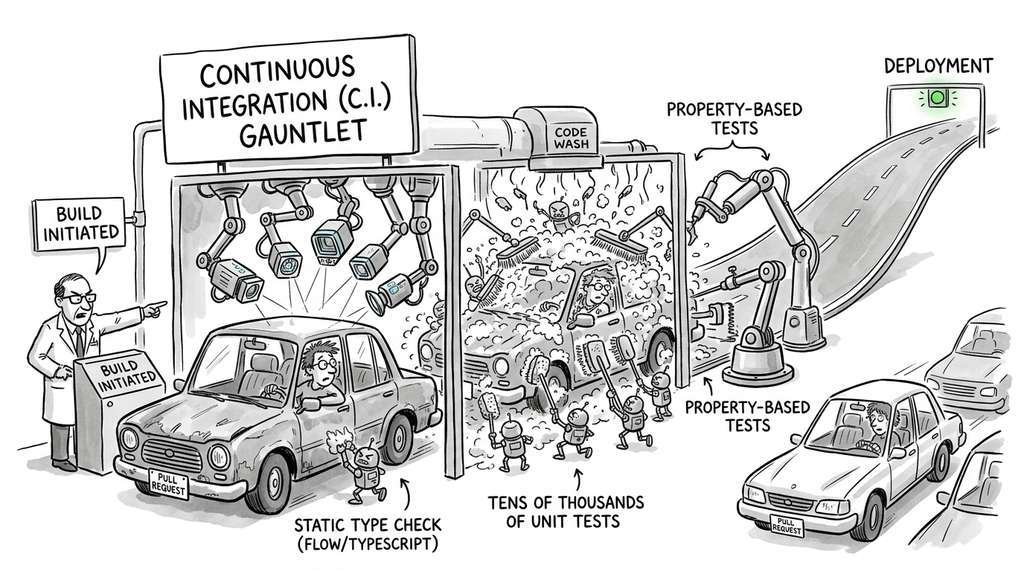
Stripe's payment processing API reportedly uses a layered verification stack similar to the one described here. Every pull request triggers static type checking (Flow/TypeScript), tens of thousands of unit tests, and property-based tests that generate random transaction payloads to verify that amount calculations never lose cents to floating-point rounding. According to public engineering blog posts, the property tests have caught numerous rounding bugs that hand-written example tests missed, because no human would think to test a \$0.01 charge split across 37 line items in 4 different currencies.
4. The Repair Loop: Feeding Failures Back
Verification without repair is diagnosis without treatment. The repair loop takes verification failures, formats them as actionable feedback, and feeds them back to the model. The quality of this formatting directly affects repair efficiency (the \(\alpha_t\) parameter from Section 9.2, where \(\alpha_t\) measures the fraction of remaining defects eliminated per iteration).
Three principles govern effective repair feedback:
Principle 1: Show the full failure context. Do not paraphrase error messages. Include the complete stack trace, the failing assertion, the actual versus expected values, and the test name. The model needs the raw data, not your interpretation of it.
Structuring the Repair Message
Principle 2: Separate structural failures from behavioral failures. A type error ("expected int, got str") requires a different repair strategy than a logic error ("expected 42, got 41"). Presenting them separately helps the model prioritize. Fix structural issues first (they often cause cascading behavioral failures), then address behavioral issues.
Principle 3: Constrain the repair scope. Tell the model which files it
may modify and which it must not. "Fix the implementation in pipeline.py.
Do not modify test_pipeline.py." This prevents the model from "fixing" a
test failure by weakening the test, which is a common failure mode when the repair
prompt is unconstrained.
Common Misconception
A common misconception is that "all tests pass" means the code is correct. Passing tests only means the code satisfies the properties you remembered to check; it says nothing about properties you omitted. If your test suite contains only example-based tests with hand-picked inputs, entire categories of bugs (boundary conditions, empty inputs, concurrent access, overflow) can hide in the untested input space. This is why the verification stack uses multiple layers with different coverage strategies: each layer probes a region of the defect space that the others leave dark.
Exercise 9.3.1
A colleague's repair prompt reads: "The tests failed. Please fix the code." Rewrite this
prompt so that it follows all three principles of effective repair feedback (full failure
context, structural/behavioral separation, scope constraint). Assume the failing layer is
pytest, the source file is transform.py, the test file is
test_transform.py, and the failure message is
AssertionError: expected [1, 2, 3] but got [1, 2] in
test_drop_duplicates_preserves_order.
Hint
Your rewritten prompt should include three clearly separated sections: (1) the exact assertion error and test name, (2) a label indicating this is a behavioral (logic) failure rather than a structural (type/lint) failure, and (3) an explicit instruction stating which file to modify and which file to leave untouched.from dataclasses import dataclass
@dataclass
class RepairPrompt:
"""Structured repair prompt for the vibe coding loop."""
original_spec: str
source_file: str
test_file: str
failures: list[VerificationResult]
def render(self) -> str:
"""Render the repair prompt as a string for the model."""
sections = []
# Remind the model of the original specification
sections.append("## Original Specification")
sections.append(self.original_spec)
sections.append("")
# Separate structural and behavioral failures
structural = [f for f in self.failures if f.layer in ("ruff", "mypy")]
behavioral = [f for f in self.failures if f.layer in ("pytest",)]
if structural:
sections.append("## Structural Issues (fix these first)")
for f in structural:
sections.append(f"### {f.layer}")
sections.append(f.details)
sections.append("")
if behavioral:
sections.append("## Behavioral Issues")
for f in behavioral:
sections.append(f"### {f.layer}")
sections.append(f.details)
sections.append("")
# Constrain the repair scope
sections.append("## Constraints")
sections.append(f"- Only modify `{self.source_file}`")
sections.append(f"- Do NOT modify `{self.test_file}`")
sections.append("- Do NOT weaken any test assertions")
sections.append("- All existing passing tests must continue to pass")
return "\n".join(sections)
RepairPrompt class with structural/behavioral failure separation. The render method embeds all three repair principles: it includes full failure details from each VerificationResult, groups structural issues (ruff, mypy) before behavioral issues (pytest), and appends explicit scope constraints forbidding test modification.
What does a complete repair cycle look like in practice? The developer runs the verification
pipeline, receives a report showing that mypy found a type error on line 14 and pytest
found one failing assertion in test_normalize. The RepairPrompt
renders these into a structured message. The developer pastes (or the tool automatically
feeds) this message into the next model turn, along with the current source file. The
model reads the structured failures, identifies that the type error (returning
str instead of float) is also the root cause of the test failure,
and produces a corrected version. The developer runs the pipeline again. If all layers
pass, the cycle is complete; if new failures appear, the cycle repeats. In practice, most
single-function repairs converge within one to three iterations when the repair prompt
follows the three principles above.
The scope constraint ("do not modify the test file") deserves emphasis. Without it, the model frequently "repairs" a bug by changing the test's expected value to match the buggy output. This is formally correct (all tests pass) but semantically wrong (the specification has been weakened). In the search framework, weakening tests is equivalent to expanding the solution space \(S^*\) rather than navigating to a better point within it. It feels like progress (the pass rate goes up) but represents regression.
5. Putting It Together: The Automated Verification Pipeline
The following class combines all verification layers into a single automated pipeline that can be invoked from the command line or integrated into a continuous integration / continuous deployment (CI/CD) workflow. This pipeline is the workhorse of the "observe" phase in the vibe coding loop.
import subprocess
import time
import json
from pathlib import Path
from dataclasses import dataclass, field

@dataclass
class VerificationPipeline:
    """
    Automated verification pipeline for vibe-coded projects.

    Runs all verification layers in sequence, collects results,
    and generates a repair prompt if any layer fails.
    """
    source_files: list[str]
    test_files: list[str]
    results: list[VerificationResult] = field(default_factory=list)

    def run_layer(
        self, name: str, cmd: list[str],
    ) -> VerificationResult:
        """Run a single verification layer and capture the result."""
        t0 = time.time()
        proc = subprocess.run(cmd, capture_output=True, text=True, timeout=120)
        elapsed = time.time() - t0
        return VerificationResult(
            layer=name,
            passed=proc.returncode == 0,
            details=(proc.stdout + proc.stderr)[-1500:],
            duration_seconds=elapsed,
        )

    def run_all(self) -> list[VerificationResult]:
        """Run the full verification stack."""
        self.results = []

        # Layer 1: Linting
        self.results.append(self.run_layer(
            "ruff", ["ruff", "check"] + self.source_files,
        ))

        # Layer 2: Type checking
        self.results.append(self.run_layer(
            "mypy", ["mypy", "--ignore-missing-imports"] + self.source_files,
        ))

        # Layer 3: Tests (unit + property-based)
        self.results.append(self.run_layer(
            "pytest",
            ["pytest"] + self.test_files + ["-v", "--tb=short", "-x"],
        ))

        return self.results

    @property
    def all_passed(self) -> bool:
        return all(r.passed for r in self.results)

    def summary(self) -> str:
        """One-line summary for logging."""
        total = len(self.results)
        passed = sum(1 for r in self.results if r.passed)
        elapsed = sum(r.duration_seconds for r in self.results)
        return f"{passed}/{total} layers passed in {elapsed:.1f}s"


# Usage in the vibe coding loop
pipeline = VerificationPipeline(
    source_files=["src/pipeline.py"],
    test_files=["tests/test_pipeline.py"],
)
results = pipeline.run_all()
print(pipeline.summary())

if not pipeline.all_passed:
    repair = RepairPrompt(
        original_spec="...",  # from Section 9.1
        source_file="src/pipeline.py",
        test_file="tests/test_pipeline.py",
        failures=[r for r in results if not r.passed],
    )
    print(repair.render())
VerificationPipeline class orchestrating ruff, mypy, and pytest as sequential layers. The run_all method collects every layer's result regardless of earlier failures, and the usage block shows integration with RepairPrompt to close the vibe coding loop from Section 9.2.Research Frontier
A 2024-2025 research direction called "verification-guided generation" integrates the verification stack directly into the generation process rather than running it as a post-hoc check. AlphaCodium (Ridnik et al., 2024) alternates between generation and testing in a structured flow, achieving state-of-the-art results on competitive programming benchmarks. More recently, CodeMonkeys (Ehrlich et al., 2025) scales verification-guided repair to entire repositories: the system decomposes repository-level tasks into per-file sub-problems, generates candidate edits for each file, and then runs the project's own test suite as the verification oracle, iterating repairs until the tests pass. On the SWE-bench Verified benchmark, CodeMonkeys resolved 57.4% of real-world GitHub issues (as of mid-2025, several systems have surpassed this mark, with top entries exceeding 60%; the trajectory confirms that verification-guided repair scales reliably), demonstrating that the verification-and-repair loop taught in this section extends well beyond single-function exercises to production codebases with hundreds of interacting files. The implication for vibe coders is practical: tools that integrate verification into generation (such as Claude Code's internal test-running loop) tend to converge faster than tools that treat generation and verification as separate steps, because each generation step receives immediate feedback rather than deferred batch results.
When Hypothesis finds a failing test case, it does not just report the input that caused the failure. It shrinks the input to the smallest example that still triggers the bug. If your function fails on a list of 47 elements, Hypothesis will try shorter lists, smaller numbers, and simpler structures until it finds the minimal reproducer. A bug report that says "fails on [0]" is vastly more debuggable than one that says "fails on [847, -3, 0, 291, ...]". This shrinking behavior is especially valuable in the vibe coding repair loop because the minimal reproducer gives the model the clearest possible signal about the root cause.
6. Repair Anti-Patterns
Not all repairs move the session toward convergence. Three anti-patterns are common enough to warrant explicit warnings.
Test weakening occurs when the model changes the test to match the buggy output rather than fixing the code. Guard against this by making the test file read-only or by including a "do not modify tests" constraint in every repair prompt.
Overfitting to failures occurs when the model adds special-case logic to pass specific failing tests without addressing the underlying bug. The result is code that passes the current test suite but fails on any new input. Property-based tests are the primary defense: they generate new inputs on every run, making overfitting significantly harder because the model cannot anticipate which specific inputs Hypothesis will produce next.
Regression cascades occur when fixing one test breaks several others, triggering a chain of fixes and breaks that never stabilizes. This is the "oscillating pass rate" pathology from Section 9.2. The root cause is usually tight coupling between components. The fix is to decompose the function into smaller, independently testable units and repair each unit separately.
Try It: Build a Verification Stack for a CSV Parser
This mini-project walks you through constructing and running a complete verification
stack for a small but realistic function. You need Python 3.10+, pytest, hypothesis,
pydantic, ruff, and mypy (all installable via pip install pytest hypothesis
pydantic ruff mypy).
- Create a file
csv_parser.pywith a functionparse_csv(text: str) -> list[dict[str, str]]that splits a CSV string (with a header row) into a list of dictionaries. Write it yourself or ask an AI to generate it. - Create a Pydantic model
CsvRowwith fieldsname: str(min_length=1),age: int(ge=0, le=150), andemail: str(pattern for a basic email format). Write a wrapper function that parses the CSV, then validates each row against the model. - In
test_csv_parser.py, write two example-based tests (one for a normal three-row CSV, one for an empty CSV), plus one Hypothesis property test: given a list of validCsvRowobjects, serialize them to CSV text, parse them back, and assert the round-trip preserves all values. - Run the full stack in order:
ruff check csv_parser.py, thenmypy csv_parser.py, thenpytest test_csv_parser.py -v. Record which layers pass and which fail. - For each failure, write a one-sentence diagnosis, fix the code (not the tests), and re-run the stack until all layers pass. Count how many repair iterations you needed.
Lab: Property-Based Bug Hunting in a Statistics Library
Goal: Use Hypothesis to discover bugs in a small statistics module by writing property-based tests rather than example-based tests, and measure how many additional defects the property tests surface.
Tools needed: Python 3.10+, pytest, hypothesis (install via
pip install pytest hypothesis).
Setup (5 min): Create a file stats.py with four functions:
mean(xs), median(xs), stdev(xs), and
normalize(xs) (subtract mean, divide by standard deviation). Implement them
yourself, or ask an AI to generate them. Do not hand-test them yet.
Experiment (15 min): In test_stats.py, write property-based
tests using st.lists(st.floats(allow_nan=False, allow_infinity=False), min_size=1).
Test these properties: (1) mean of a constant list equals that constant,
(2) median is always between min and max,
(3) stdev of a constant list is zero, (4) normalize output has
mean approximately zero and standard deviation approximately one.
What to vary: Try different min_size and
max_size settings for the list strategy. Try restricting floats to small
ranges (e.g., min_value=-100, max_value=100) versus the full float range.
Observe how the number and type of discovered failures changes.
What to observe: Record each unique bug Hypothesis finds (division by zero on single-element lists, floating-point precision failures on very large values, empty-list crashes). Count how many of these bugs you would have caught with three hand-picked example tests. The gap between those two counts is the value of property-based testing.
Exercises
- (Conceptual) For each layer of the verification stack (static analysis, unit tests, property tests, end-to-end tests), give one example of a bug it would catch that the layers below it would miss. Then give one example of a bug that no layer in the stack would catch.
-
(Coding) Write a Hypothesis property test for a function
parse_csv_row(row: str) -> list[str]that parses a single line of CSV. Your property tests should verify: (1) round-trip consistency (formatting the parsed result back to CSV produces the original input), (2) the number of fields is consistent for all rows of the same structure, and (3) quoted fields preserve commas and newlines. Usest.text()andst.lists()to generate test inputs. -
(Analysis) Implement the
VerificationPipelineand run it against a small Python project (your own or a tutorial project). Record the pass/fail results for each layer. Which layer catches the most issues? How many of the issues caught by static analysis would also be caught by the test suite?
What's Next
With the verification and repair machinery in place, Section 9.4: Building Through Conversation puts everything together in a complete, end-to-end recipe. That section builds a scientific data explorer web application from scratch, starting with failing tests, generating code through iterative conversation, verifying with the full stack, and repairing until all contracts pass. The recipe demonstrates the entire vibe coding methodology on a realistic project.