Prerequisites
This section integrates all concepts from the chapter. You should have completed Section 47.1 (artifact versioning with Git, DVC, and MLflow) and Section 47.2 (World Wide Web Consortium (W3C) PROV, OpenLineage, run graphs). We use Data Version Control (DVC) pipelines, MLflow (an open source platform for tracking ML experiments, logging parameters, and managing model versions), and PROV documents together. Familiarity with YAML configuration files and basic command-line Git workflows is assumed. The recipe targets a materials science use case (crystal property prediction), but the architecture applies to any ML domain.
The previous two sections gave us the building blocks: content-addressable storage (where data is identified by its cryptographic hash rather than by filename or location), artifact versioning, provenance standards, and run graphs. This section assembles them into a complete, working experiment registry built around a three-stage machine learning (ML) pipeline (preprocessing, training, evaluation). Every artifact at every stage is hashed, versioned, and linked to its inputs through both DVC's pipeline directed acyclic graph (DAG) and a W3C PROV document. The system supports two critical operations: (1) tracing any result back to its raw inputs through the artifact DAG, and (2) regenerating any artifact from scratch by replaying the pipeline from its provenance record. This is the infrastructure that makes every experiment in the Discovery Workbench reproducible. Figure 47.3.1 illustrates three-stage artifact DAG with hash verification.
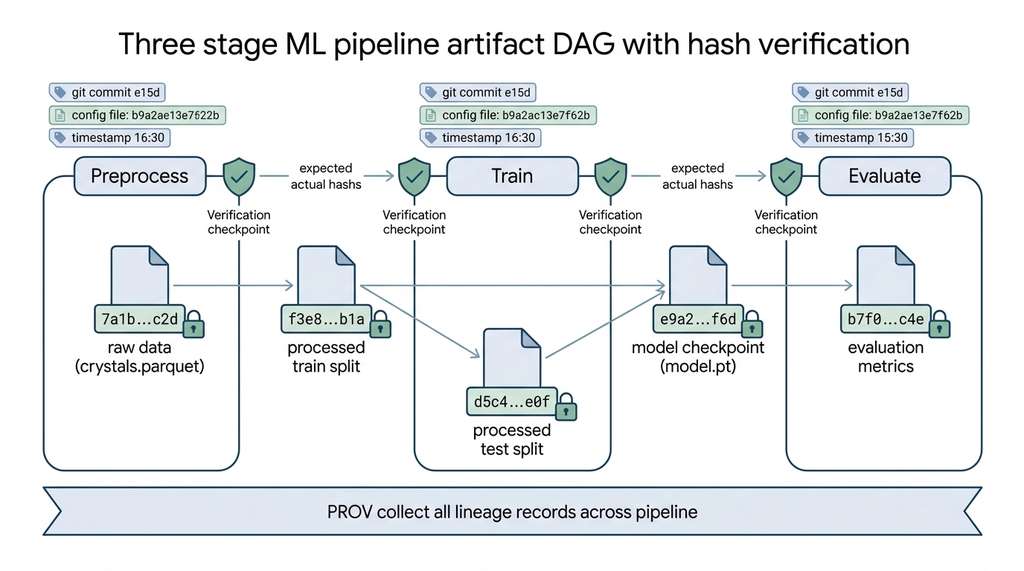
Figure 47.16 illustrates how these three pipeline stages connect through hash-verified artifact links. Each stage consumes input artifacts (identified by their SHA-256 hashes), produces output artifacts (also hashed), and emits a PROV record that links inputs to outputs. The result is a fully traceable chain from raw data to final evaluation metrics.
1. Project Structure
A well-organized project structure is the first prerequisite for a functional registry.
The following layout separates concerns cleanly: source code in src/,
configurations in configs/, data in data/ (DVC-tracked), and
outputs in outputs/ (also DVC-tracked). The dvc.yaml file at
the root defines the pipeline DAG.
Six months after submission, a reviewer asks you to rerun the analysis in Table 3 of your paper, but the student who trained the model has graduated, the GPU server was rebuilt, and nobody can identify which preprocessing script produced the training set. An experiment registry turns that panic into a three-command operation by assigning a content-addressable hash to every input and output artifact at each pipeline stage and storing those hashes alongside run metadata (Git commit, config values, timestamps) in a queryable, machine-verifiable record. Build one whenever your project involves iterative experimentation with changing parameters or data; for one-off scripts that will never be rerun, a simple lab notebook entry suffices.
The project structure below shows how these principles translate into a concrete directory layout for a crystal property prediction pipeline. In short: if you cannot regenerate any result from its recorded inputs in three commands, your registry is incomplete.
crystal-property-prediction/
├── .git/                      # Git repository
├── .dvc/                      # DVC configuration
│   └── config                 # DVC remote settings
├── dvc.yaml                   # Pipeline DAG definition
├── dvc.lock                   # Frozen hashes for all pipeline stages
├── params.yaml                # Shared parameters (read by DVC)
├── configs/
│   ├── preprocess.yaml        # Preprocessing parameters
│   ├── train.yaml             # Training hyperparameters
│   └── evaluate.yaml          # Evaluation settings
├── src/
│   ├── __init__.py
│   ├── preprocess.py          # Stage 1: data preprocessing
│   ├── train.py               # Stage 2: model training
│   ├── evaluate.py            # Stage 3: evaluation
│   └── registry.py            # Provenance recording utilities
├── data/
│   ├── raw/                   # Raw data (DVC-tracked)
│   │   └── crystals.parquet.dvc
│   └── processed/             # Processed data (DVC-tracked)
│       └── .gitkeep
├── outputs/
│   ├── models/                # Trained models (DVC-tracked)
│   │   └── .gitkeep
│   └── metrics/               # Evaluation results
│       └── .gitkeep
├── provenance/                # PROV documents (Git-tracked)
│   └── .gitkeep
├── Dockerfile                 # Environment specification
├── requirements.txt           # Pinned dependencies
└── README.md
dvc.yaml defines the pipeline DAG that connects all stages.2. The DVC Pipeline Definition
DVC pipelines (dvc.yaml) declare the stages of a pipeline, their dependencies,
parameters, and outputs. DVC uses this declaration to build the artifact DAG, determine
which stages need re-execution when inputs change, and lock the exact hashes of all
artifacts in dvc.lock (an auto-generated lockfile that freezes each artifact's SHA-256 hash at the time of the last successful run, analogous to package-lock.json in Node.js).
Mental Model
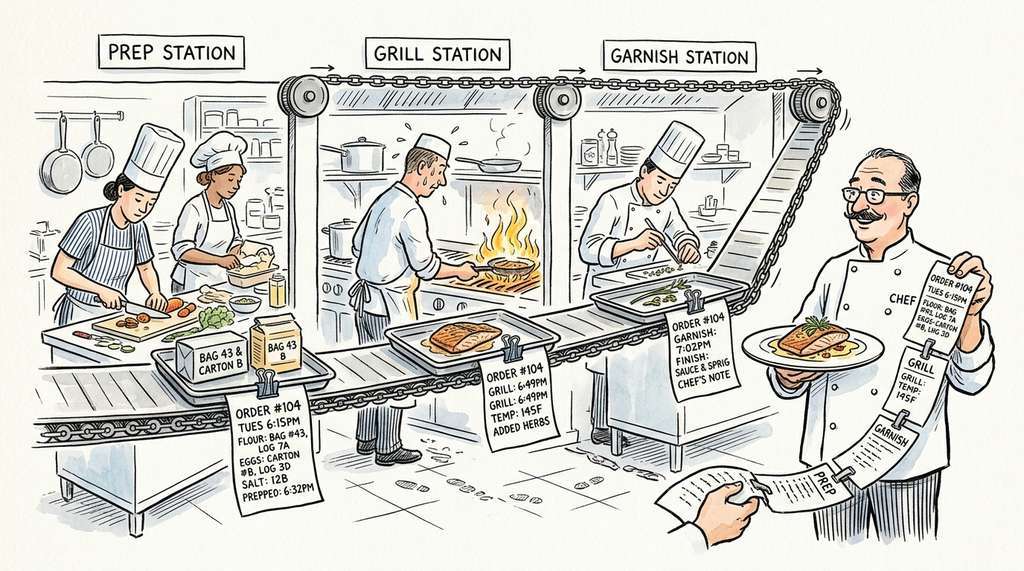
Think of the artifact DAG as a restaurant kitchen's order ticket system. Each ticket (provenance record) lists the exact ingredients that went into a dish (input hashes), which cook prepared it (code version), the recipe card used (config hash), and the timestamp when it left the kitchen (output hash). If a customer complains about a dish served last Tuesday, the chef can pull the ticket, trace back to the specific bag of flour and carton of eggs, and determine whether the problem was a bad ingredient, a wrong recipe, or a substitution. The DAG links tickets across stations the same way: the prep station's output ticket becomes the grill station's input ticket, forming a chain from raw delivery to plated dish.
# dvc.yaml: Three-stage ML pipeline with full dependency tracking
stages:
  preprocess:
    cmd: python -m src.preprocess
    deps:
      - src/preprocess.py
      - data/raw/crystals.parquet
    params:
      - configs/preprocess.yaml:
          - feature_columns
          - normalize
          - train_fraction
          - random_seed
    outs:
      - data/processed/train.parquet
      - data/processed/test.parquet
    metrics:
      - outputs/metrics/preprocess_stats.json:
          cache: false

  train:
    cmd: python -m src.train
    deps:
      - src/train.py
      - data/processed/train.parquet
    params:
      - configs/train.yaml:
          - architecture
          - hidden_dim
          - num_layers
          - dropout
          - learning_rate
          - batch_size
          - max_epochs
          - early_stopping_patience
          - random_seed
    outs:
      - outputs/models/model.pt
    plots:
      - outputs/metrics/training_curves.json:
          cache: false
          x: epoch
          y: val_loss

  evaluate:
    cmd: python -m src.evaluate
    deps:
      - src/evaluate.py
      - data/processed/test.parquet
      - outputs/models/model.pt
    params:
      - configs/evaluate.yaml:
          - metrics_list
          - confidence_level
    metrics:
      - outputs/metrics/evaluation.json:
          cache: false
    plots:
      - outputs/metrics/predictions_vs_actual.json:
          cache: false
          x: actual
          y: predicted
The params entries are particularly important for provenance: DVC tracks not
just which config file a stage depends on, but which specific parameters
within that file. If you change the learning rate in train.yaml, DVC knows to
re-run the training and evaluation stages but skip preprocessing (whose parameters did not
change). This selective re-execution is the practical benefit of a well-specified artifact DAG.
Common Misconception
A common misconception is that an experiment registry is simply a spreadsheet or lab notebook where you write down hyperparameters and results after each run. A true registry requires machine-readable, hash-verified links between artifacts: it must be possible for software (not just a human reading notes) to trace any output back to its exact inputs and to detect when an artifact has been silently modified. If your "registry" cannot automatically flag that a model checkpoint no longer matches the data it was trained on, it is a log, not a registry.
3. Stage 1: Preprocessing with Provenance
Each pipeline stage is a Python module that reads its inputs, performs its computation, writes its outputs, and records provenance metadata. The preprocessing stage loads raw crystal structure data, extracts features, splits into train/test sets, and emits a PROV record documenting the transformation.
The three utility functions imported below (compute_file_hash,
get_git_info, and ProvenanceRecorder) are defined in the shared
src/registry.py module presented in Section 6. They appear here in order of
use rather than definition so you can see each stage's logic before the underlying plumbing.
"""src/preprocess.py: Stage 1 of the provenance-tracked pipeline."""
import hashlib
import json
import yaml
import pandas as pd
import numpy as np
from pathlib import Path
from datetime import datetime, timezone
from sklearn.model_selection import train_test_split

from src.registry import (
    compute_file_hash,
    get_git_info,
    ProvenanceRecorder,
)


def load_config(path: str = "configs/preprocess.yaml") -> dict:
    """Load preprocessing configuration."""
    with open(path) as f:
        return yaml.safe_load(f)


def extract_features(df: pd.DataFrame, config: dict) -> pd.DataFrame:
    """Extract features from raw crystal structure data.

    Selects configured feature columns, applies normalization,
    and handles missing values.
    """
    feature_cols = config["feature_columns"]
    target_col = config.get("target_column", "bandgap_eV")

    # Select features and target
    features = df[feature_cols + [target_col]].copy()

    # Drop rows with missing targets
    initial_count = len(features)
    features = features.dropna(subset=[target_col])
    dropped = initial_count - len(features)

    if config.get("normalize", True):
        for col in feature_cols:
            col_mean = features[col].mean()
            col_std = features[col].std()
            if col_std > 0:
                features[col] = (features[col] - col_mean) / col_std

    return features, dropped


def main():
    """Run the preprocessing stage with full provenance tracking."""
    config = load_config()
    git_info = get_git_info()
    recorder = ProvenanceRecorder(stage_name="preprocess")

    # Record start
    recorder.start(
        git_commit=git_info["commit_hash"],
        config_hash=compute_file_hash("configs/preprocess.yaml"),
    )

    # Load raw data
    raw_path = Path("data/raw/crystals.parquet")
    raw_hash = compute_file_hash(raw_path)
    recorder.add_input("raw_crystals", str(raw_path), raw_hash)

    df = pd.read_parquet(raw_path)
    print(f"Loaded {len(df)} raw crystal records")

    # Extract features
    features, dropped = extract_features(df, config)
    print(f"Extracted features: {len(features)} records "
          f"({dropped} dropped for missing targets)")

    # Train/test split with fixed random seed
    train_df, test_df = train_test_split(
        features,
        train_size=config["train_fraction"],
        random_state=config["random_seed"],
    )

    # Save processed data
    train_path = Path("data/processed/train.parquet")
    test_path = Path("data/processed/test.parquet")
    train_path.parent.mkdir(parents=True, exist_ok=True)

    train_df.to_parquet(train_path, index=False)
    test_df.to_parquet(test_path, index=False)

    train_hash = compute_file_hash(train_path)
    test_hash = compute_file_hash(test_path)

    recorder.add_output("train_data", str(train_path), train_hash)
    recorder.add_output("test_data", str(test_path), test_hash)

    # Save preprocessing statistics
    stats = {
        "raw_records": len(df),
        "dropped_records": dropped,
        "train_records": len(train_df),
        "test_records": len(test_df),
        "feature_columns": config["feature_columns"],
        "normalized": config.get("normalize", True),
        "random_seed": config["random_seed"],
        "raw_data_hash": raw_hash,
        "train_data_hash": train_hash,
        "test_data_hash": test_hash,
    }
    stats_path = Path("outputs/metrics/preprocess_stats.json")
    stats_path.parent.mkdir(parents=True, exist_ok=True)
    with open(stats_path, "w") as f:
        json.dump(stats, f, indent=2)

    # Complete provenance record
    recorder.complete(metrics=stats)
    recorder.save_prov("provenance/preprocess_prov.json")

    print(f"Preprocessing complete:")
    print(f"  Train: {len(train_df)} records [{train_hash[:12]}...]")
    print(f"  Test:  {len(test_df)} records [{test_hash[:12]}...]")


if __name__ == "__main__":
    main()
4. Stage 2: Training with Experiment Tracking
The training stage combines DVC pipeline integration (for artifact DAG tracking) with MLflow experiment tracking (for hyperparameter and metric logging). This dual integration is the key to a complete registry: DVC captures what artifacts exist and how they relate; MLflow captures the detailed experimental context (learning curves, parameter importance, model comparison dashboards).
"""src/train.py: Stage 2 with MLflow tracking and provenance."""
import json
import yaml
import torch
import torch.nn as nn
import torch.optim as optim
import mlflow
import numpy as np
import pandas as pd
from pathlib import Path
from torch.utils.data import DataLoader, TensorDataset

from src.registry import (
    compute_file_hash,
    get_git_info,
    ProvenanceRecorder,
    set_reproducibility_seed,
)


class CrystalPropertyNet(nn.Module):
    """A feedforward network for crystal property prediction."""

    def __init__(self, input_dim: int, hidden_dim: int,
                 num_layers: int, dropout: float):
        super().__init__()
        layers = []
        current_dim = input_dim

        for i in range(num_layers):
            layers.append(nn.Linear(current_dim, hidden_dim))
            layers.append(nn.ReLU())
            layers.append(nn.Dropout(dropout))
            current_dim = hidden_dim

        layers.append(nn.Linear(current_dim, 1))
        self.network = nn.Sequential(*layers)

    def forward(self, x):
        return self.network(x).squeeze(-1)


def load_config(path: str = "configs/train.yaml") -> dict:
    """Load training configuration."""
    with open(path) as f:
        return yaml.safe_load(f)


def create_dataloader(
    parquet_path: str,
    target_col: str,
    batch_size: int,
    shuffle: bool = True,
) -> tuple[DataLoader, int]:
    """Create a PyTorch DataLoader from a parquet file."""
    df = pd.read_parquet(parquet_path)
    feature_cols = [c for c in df.columns if c != target_col]

    X = torch.tensor(df[feature_cols].values, dtype=torch.float32)
    y = torch.tensor(df[target_col].values, dtype=torch.float32)

    dataset = TensorDataset(X, y)
    loader = DataLoader(dataset, batch_size=batch_size, shuffle=shuffle)
    return loader, X.shape[1]


def train_epoch(model, loader, optimizer, criterion, device):
    """Train for one epoch and return average loss."""
    model.train()
    total_loss = 0.0
    n_batches = 0

    for X_batch, y_batch in loader:
        X_batch, y_batch = X_batch.to(device), y_batch.to(device)
        optimizer.zero_grad()
        predictions = model(X_batch)
        loss = criterion(predictions, y_batch)
        loss.backward()
        optimizer.step()
        total_loss += loss.item()
        n_batches += 1

    return total_loss / n_batches


@torch.no_grad()
def validate(model, loader, criterion, device):
    """Validate and return average loss."""
    model.eval()
    total_loss = 0.0
    n_batches = 0

    for X_batch, y_batch in loader:
        X_batch, y_batch = X_batch.to(device), y_batch.to(device)
        predictions = model(X_batch)
        loss = criterion(predictions, y_batch)
        total_loss += loss.item()
        n_batches += 1

    return total_loss / n_batches


def main():
    """Run training with MLflow tracking and provenance recording."""
    config = load_config()
    git_info = get_git_info()
    recorder = ProvenanceRecorder(stage_name="train")

    # Set reproducibility
    set_reproducibility_seed(config["random_seed"])

    recorder.start(
        git_commit=git_info["commit_hash"],
        config_hash=compute_file_hash("configs/train.yaml"),
    )

    # Record input artifacts
    train_path = "data/processed/train.parquet"
    train_hash = compute_file_hash(train_path)
    recorder.add_input("train_data", train_path, train_hash)

    config_hash = compute_file_hash("configs/train.yaml")
    recorder.add_input("train_config", "configs/train.yaml", config_hash)

    # Setup device
    device = torch.device(
        "cuda" if torch.cuda.is_available() else "cpu"
    )
    print(f"Training on {device}")

    # Create data loaders
    target_col = config.get("target_column", "bandgap_eV")
    train_loader, input_dim = create_dataloader(
        train_path, target_col, config["batch_size"]
    )

    # For validation, use a portion of training data
    # (test data is reserved for Stage 3)
    val_loader, _ = create_dataloader(
        train_path, target_col, config["batch_size"], shuffle=False
    )

    # Create model
    model = CrystalPropertyNet(
        input_dim=input_dim,
        hidden_dim=config["hidden_dim"],
        num_layers=config["num_layers"],
        dropout=config["dropout"],
    ).to(device)

    optimizer = optim.Adam(model.parameters(), lr=config["learning_rate"])
    criterion = nn.MSELoss()

    # MLflow tracking
    mlflow.set_tracking_uri("sqlite:///mlflow.db")
    mlflow.set_experiment("crystal_property_prediction")

    with mlflow.start_run() as run:
        # Log provenance metadata as MLflow tags
        mlflow.set_tag("git_commit", git_info["commit_hash"])
        mlflow.set_tag("git_branch", git_info["branch"])
        mlflow.set_tag("git_dirty", str(git_info["is_dirty"]))
        mlflow.set_tag("train_data_hash", train_hash)
        mlflow.set_tag("config_hash", config_hash)

        # Log all hyperparameters
        mlflow.log_params({
            "architecture": config["architecture"],
            "hidden_dim": config["hidden_dim"],
            "num_layers": config["num_layers"],
            "dropout": config["dropout"],
            "learning_rate": config["learning_rate"],
            "batch_size": config["batch_size"],
            "max_epochs": config["max_epochs"],
            "random_seed": config["random_seed"],
            "input_dim": input_dim,
            "device": str(device),
        })

        # Training loop with early stopping
        best_val_loss = float("inf")
        patience_counter = 0
        training_curves = []

        for epoch in range(1, config["max_epochs"] + 1):
            train_loss = train_epoch(
                model, train_loader, optimizer, criterion, device
            )
            val_loss = validate(model, val_loader, criterion, device)

            # Log to MLflow
            mlflow.log_metrics({
                "train_loss": train_loss,
                "val_loss": val_loss,
            }, step=epoch)

            training_curves.append({
                "epoch": epoch,
                "train_loss": round(train_loss, 6),
                "val_loss": round(val_loss, 6),
            })

            # Early stopping
            if val_loss < best_val_loss:
                best_val_loss = val_loss
                patience_counter = 0
                # Save best model
                model_path = Path("outputs/models/model.pt")
                model_path.parent.mkdir(parents=True, exist_ok=True)
                torch.save({
                    "model_state_dict": model.state_dict(),
                    "optimizer_state_dict": optimizer.state_dict(),
                    "epoch": epoch,
                    "val_loss": val_loss,
                    "config": config,
                    "input_dim": input_dim,
                    "git_commit": git_info["commit_hash"],
                    "train_data_hash": train_hash,
                }, model_path)
            else:
                patience_counter += 1
                if patience_counter >= config["early_stopping_patience"]:
                    print(f"Early stopping at epoch {epoch}")
                    break

            if epoch % 10 == 0:
                print(f"Epoch {epoch}: train={train_loss:.6f}, "
                      f"val={val_loss:.6f}")

        # Log final metrics
        model_hash = compute_file_hash("outputs/models/model.pt")
        mlflow.log_metrics({
            "best_val_loss": best_val_loss,
            "final_epoch": epoch,
        })
        mlflow.set_tag("model_hash", model_hash)

        # Log the model to MLflow's artifact store
        mlflow.pytorch.log_model(
            model, "model",
            registered_model_name="CrystalPropertyPredictor",
        )

        # Save training curves for DVC plots
        curves_path = Path("outputs/metrics/training_curves.json")
        with open(curves_path, "w") as f:
            json.dump(training_curves, f, indent=2)

        print(f"\nTraining complete (MLflow run: {run.info.run_id})")
        print(f"  Best val loss: {best_val_loss:.6f} at epoch {epoch}")
        print(f"  Model hash: {model_hash[:12]}...")

    # Record output artifacts in provenance
    recorder.add_output(
        "trained_model", "outputs/models/model.pt", model_hash
    )
    recorder.complete(metrics={
        "best_val_loss": best_val_loss,
        "final_epoch": epoch,
        "mlflow_run_id": run.info.run_id,
    })
    recorder.save_prov("provenance/train_prov.json")


if __name__ == "__main__":
    main()
The \$10 Million Hash Collision That Never Happened
SHA-256, the hash algorithm used throughout this chapter's registry, has never produced a known collision in its 25+ year history. The probability of two different files producing the same SHA-256 hash is roughly 1 in 2128, a number so large that if every atom in the observable universe computed one hash per nanosecond, the expected wait for a single collision would still exceed the age of the universe by a factor of 1017. Yet in 2017, Google spent approximately \$110,000 in cloud compute to produce the first SHA-1 collision (the weaker predecessor), demonstrating that "astronomically unlikely" and "impossible" are different things. This is why modern registries default to SHA-256 rather than SHA-1 or MD5: in provenance systems, a hash collision means two different datasets appear identical, silently invalidating every downstream result.
The torch.save() call in Figure 47.20 embeds provenance metadata directly
inside the model checkpoint: the Git commit hash, training data hash, and full configuration.
This means the checkpoint is self-documenting. Even if the registry database is lost, the
model file itself contains enough information to identify exactly which code and data
produced it. This defense-in-depth strategy (provenance in the registry and in
the artifact) protects against the most common failure mode in long-running research
projects: gradual metadata rot as team members leave and tools are replaced.
5. Stage 3: Evaluation with Verification
The evaluation stage loads the trained model and test data, computes metrics, and performs
a critical step that most pipelines omit: hash verification. Before using
any input artifact, the stage recomputes its hash and compares it against the hash recorded
in the provenance chain (stored in both the PROV JSON files from previous stages and the frozen hashes in dvc.lock). This catches silent corruption, accidental overwrites, and any
discrepancy between what the registry claims and what actually exists on disk.
"""src/evaluate.py: Stage 3 with hash verification and provenance."""
import json
import yaml
import torch
import numpy as np
import pandas as pd
from pathlib import Path
from sklearn.metrics import (
    mean_absolute_error,
    mean_squared_error,
    r2_score,
)

from src.registry import (
    compute_file_hash,
    get_git_info,
    ProvenanceRecorder,
    verify_artifact_chain,
)
from src.train import CrystalPropertyNet


def load_config(path: str = "configs/evaluate.yaml") -> dict:
    """Load evaluation configuration."""
    with open(path) as f:
        return yaml.safe_load(f)


def load_model_with_verification(
    model_path: str,
    expected_train_hash: str = None,
) -> tuple[CrystalPropertyNet, dict]:
    """Load a model checkpoint and verify its provenance metadata.

    Checks that the embedded data hash matches the expected value,
    catching cases where the model was trained on different data
    than the evaluation expects.
    """
    # weights_only=False is required to load the full metadata dict
    checkpoint = torch.load(model_path, weights_only=False)

    # Verify embedded provenance if expected hashes are provided
    if expected_train_hash:
        actual_hash = checkpoint.get("train_data_hash", "UNKNOWN")
        if actual_hash != expected_train_hash:
            raise ValueError(
                f"Model provenance mismatch!\n"
                f"  Expected train data hash: {expected_train_hash[:16]}...\n"
                f"  Model was trained on:     {actual_hash[:16]}...\n"
                f"  This model may have been trained on different data."
            )

    config = checkpoint["config"]
    input_dim = checkpoint["input_dim"]

    model = CrystalPropertyNet(
        input_dim=input_dim,
        hidden_dim=config["hidden_dim"],
        num_layers=config["num_layers"],
        dropout=config["dropout"],
    )
    model.load_state_dict(checkpoint["model_state_dict"])
    model.eval()

    return model, checkpoint


def compute_metrics(
    y_true: np.ndarray,
    y_pred: np.ndarray,
    confidence_level: float = 0.95,
) -> dict:
    """Compute evaluation metrics with bootstrap confidence intervals,
    where bootstrap resampling is a statistical technique that repeatedly
    draws random samples (with replacement) from the predictions to
    estimate the variability of a metric."""
    mae = mean_absolute_error(y_true, y_pred)
    rmse = np.sqrt(mean_squared_error(y_true, y_pred))
    r2 = r2_score(y_true, y_pred)

    # Bootstrap confidence intervals
    n_bootstrap = 1000
    rng = np.random.default_rng(42)
    n_samples = len(y_true)
    bootstrap_maes = []

    for _ in range(n_bootstrap):
        idx = rng.integers(0, n_samples, size=n_samples)
        bootstrap_maes.append(
            mean_absolute_error(y_true[idx], y_pred[idx])
        )

    alpha = (1 - confidence_level) / 2
    ci_lower = np.quantile(bootstrap_maes, alpha)
    ci_upper = np.quantile(bootstrap_maes, 1 - alpha)

    return {
        "mae": round(float(mae), 6),
        "rmse": round(float(rmse), 6),
        "r2": round(float(r2), 6),
        "mae_ci_lower": round(float(ci_lower), 6),
        "mae_ci_upper": round(float(ci_upper), 6),
        "confidence_level": confidence_level,
        "n_test_samples": n_samples,
    }


def main():
    """Run evaluation with hash verification and provenance."""
    config = load_config()
    git_info = get_git_info()
    recorder = ProvenanceRecorder(stage_name="evaluate")

    recorder.start(
        git_commit=git_info["commit_hash"],
        config_hash=compute_file_hash("configs/evaluate.yaml"),
    )

    # --- Hash Verification ---
    # Before using any artifact, verify its integrity against
    # the provenance chain from previous stages

    test_path = "data/processed/test.parquet"
    model_path = "outputs/models/model.pt"

    test_hash = compute_file_hash(test_path)
    model_hash = compute_file_hash(model_path)

    # Load preprocessing provenance to get expected test hash
    preprocess_prov_path = Path("provenance/preprocess_prov.json")
    if preprocess_prov_path.exists():
        with open(preprocess_prov_path) as f:
            preprocess_prov = json.load(f)
        expected_test_hash = preprocess_prov.get("outputs", {}).get(
            "test_data", {}
        ).get("hash")
        if expected_test_hash and expected_test_hash != test_hash:
            raise ValueError(
                f"Test data integrity check FAILED!\n"
                f"  Expected: {expected_test_hash[:16]}...\n"
                f"  Actual:   {test_hash[:16]}...\n"
                f"  The test data may have been modified since preprocessing."
            )
        print(f"Test data integrity: VERIFIED [{test_hash[:12]}...]")

    # Load training provenance to get expected train data hash
    train_prov_path = Path("provenance/train_prov.json")
    expected_train_hash = None
    if train_prov_path.exists():
        with open(train_prov_path) as f:
            train_prov = json.load(f)
        expected_train_hash = train_prov.get("inputs", {}).get(
            "train_data", {}
        ).get("hash")

    recorder.add_input("test_data", test_path, test_hash)
    recorder.add_input("trained_model", model_path, model_hash)

    # Load model with provenance verification
    model, checkpoint = load_model_with_verification(
        model_path, expected_train_hash
    )
    print(f"Model integrity: VERIFIED [{model_hash[:12]}...]")
    print(f"  Trained at commit: {checkpoint.get('git_commit', 'N/A')[:8]}...")
    print(f"  Best val loss: {checkpoint.get('val_loss', 'N/A')}")

    # Load test data
    target_col = config.get("target_column", "bandgap_eV")
    test_df = pd.read_parquet(test_path)
    feature_cols = [c for c in test_df.columns if c != target_col]

    X_test = torch.tensor(
        test_df[feature_cols].values, dtype=torch.float32
    )
    y_test = test_df[target_col].values

    # Run predictions
    with torch.no_grad():
        y_pred = model(X_test).numpy()

    # Compute metrics
    metrics = compute_metrics(
        y_test, y_pred,
        confidence_level=config.get("confidence_level", 0.95),
    )

    # Add provenance metadata to metrics
    metrics["model_hash"] = model_hash
    metrics["test_data_hash"] = test_hash
    metrics["git_commit"] = git_info["commit_hash"]
    metrics["model_trained_at_commit"] = checkpoint.get("git_commit", "N/A")

    # Save evaluation results
    eval_path = Path("outputs/metrics/evaluation.json")
    eval_path.parent.mkdir(parents=True, exist_ok=True)
    with open(eval_path, "w") as f:
        json.dump(metrics, f, indent=2)

    # Save predictions vs actuals for DVC plots
    predictions_path = Path("outputs/metrics/predictions_vs_actual.json")
    pred_records = [
        {"actual": round(float(a), 4), "predicted": round(float(p), 4)}
        for a, p in zip(y_test[:500], y_pred[:500])  # Sample for plotting
    ]
    with open(predictions_path, "w") as f:
        json.dump(pred_records, f, indent=2)

    # Record provenance
    eval_hash = compute_file_hash(eval_path)
    recorder.add_output("evaluation_metrics", str(eval_path), eval_hash)
    recorder.complete(metrics=metrics)
    recorder.save_prov("provenance/evaluate_prov.json")

    print(f"\nEvaluation Results:")
    print(f"  MAE:  {metrics['mae']:.4f} "
          f"({metrics['mae_ci_lower']:.4f}, {metrics['mae_ci_upper']:.4f})")
    print(f"  RMSE: {metrics['rmse']:.4f}")
    print(f"  R2:   {metrics['r2']:.4f}")
    print(f"  Test samples: {metrics['n_test_samples']}")


if __name__ == "__main__":
    main()
PyTorch Checkpoint Loading
Starting with PyTorch 2.6 (released January 2025), torch.load defaults to weights_only=True for security, rejecting arbitrary Python objects in checkpoint files. Because the self-documenting checkpoints in this section store a full metadata dictionary (config, hashes, Git commit), they require the explicit weights_only=False override shown above. When loading checkpoints from untrusted sources, consider extracting provenance metadata into a separate JSON sidecar file so that the model weights themselves can be loaded with the safer default.
Real-World Application: CERN's Analysis Preservation (REANA)
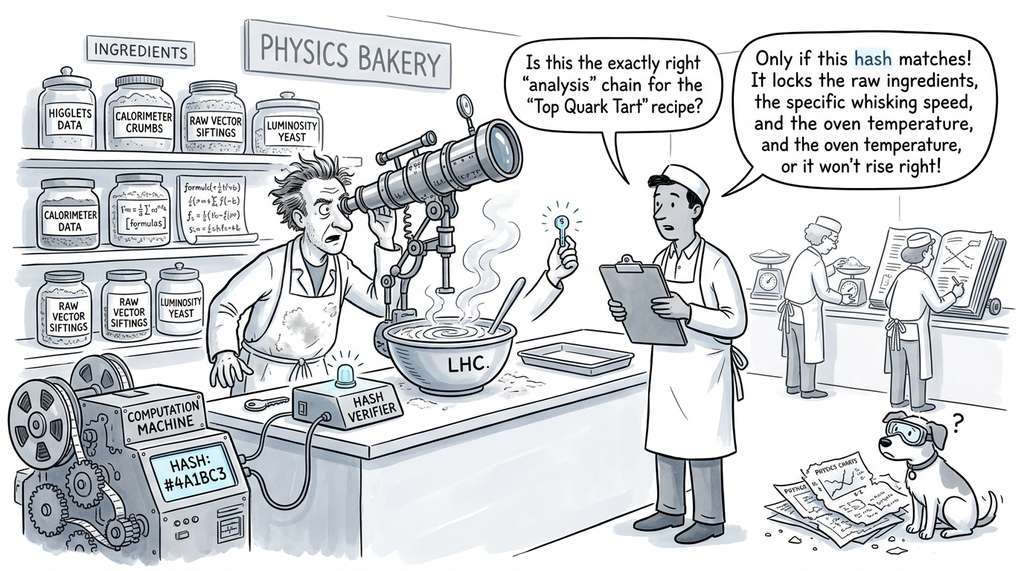
CERN's Reusable Analyses system (REANA) applies exactly this pattern of hash-verified artifact chains to high-energy physics experiments. Each analysis workflow records the input datasets, reconstruction software versions, and statistical procedure parameters in a provenance-complete registry, enabling any physicist to reproduce a published result years later by replaying the containerized pipeline against the original versioned data. REANA has preserved and re-executed analyses from multiple LHC experiments, including searches for new particles where even a minor data mismatch could invalidate a five-sigma discovery claim (a statistical threshold of five standard deviations from the expected background, the conventional bar for claiming a new particle discovery in physics).
Checkpoint
So far: each of the three pipeline stages (preprocessing, training, evaluation) hashes every input before use and every output after creation, records those hashes in a PROV document, and the evaluation stage adds a verification step that cross-checks on-disk artifacts against the provenance chain before computing metrics.
6. The Registry Utilities Module
The three pipeline stages share a set of provenance utilities: hash computation, Git
state capture, and the PROV recorder. These live in src/registry.py.
"""src/registry.py: Shared provenance utilities for pipeline stages."""
import hashlib
import json
import subprocess
import random
import numpy as np
import torch
from pathlib import Path
from datetime import datetime, timezone
from typing import Optional


def compute_file_hash(file_path, algorithm: str = "sha256") -> str:
    """Compute cryptographic hash of a file, streaming for large files."""
    hasher = hashlib.new(algorithm)
    with open(file_path, "rb") as f:
        while chunk := f.read(8192):
            hasher.update(chunk)
    return hasher.hexdigest()


def get_git_info() -> dict:
    """Capture current Git state for provenance."""
    def git(args):
        r = subprocess.run(
            ["git"] + args, capture_output=True, text=True, check=True
        )
        return r.stdout.strip()

    status = git(["status", "--porcelain"])
    return {
        "commit_hash": git(["rev-parse", "HEAD"]),
        "branch": git(["rev-parse", "--abbrev-ref", "HEAD"]),
        "is_dirty": len(status) > 0,
        "dirty_files": status if status else None,
    }


def set_reproducibility_seed(seed: int):
    """Set random seeds for reproducibility across all frameworks."""
    random.seed(seed)
    np.random.seed(seed)
    torch.manual_seed(seed)
    if torch.cuda.is_available():
        torch.cuda.manual_seed_all(seed)
        # Note: setting deterministic mode reduces performance
        torch.backends.cudnn.deterministic = True
        torch.backends.cudnn.benchmark = False


def verify_artifact_chain(provenance_dir: str = "provenance") -> dict:
    """Verify the integrity of the entire provenance chain.

    Checks that every output artifact recorded in provenance
    still matches its recorded hash on disk.
    """
    prov_dir = Path(provenance_dir)
    results = {"verified": [], "failed": [], "missing": []}

    for prov_file in sorted(prov_dir.glob("*_prov.json")):
        with open(prov_file) as f:
            prov = json.load(f)

        stage = prov.get("stage_name", prov_file.stem)

        for name, info in prov.get("outputs", {}).items():
            path = info.get("path")
            expected_hash = info.get("hash")

            if not path or not expected_hash:
                continue

            if not Path(path).exists():
                results["missing"].append({
                    "stage": stage,
                    "artifact": name,
                    "path": path,
                })
                continue

            actual_hash = compute_file_hash(path)
            if actual_hash == expected_hash:
                results["verified"].append({
                    "stage": stage,
                    "artifact": name,
                    "hash": actual_hash[:12],
                })
            else:
                results["failed"].append({
                    "stage": stage,
                    "artifact": name,
                    "expected": expected_hash[:12],
                    "actual": actual_hash[:12],
                })

    return results


class ProvenanceRecorder:
    """Records provenance for a single pipeline stage.

    Creates a JSON document compatible with conversion to W3C PROV
    (see Section 47.2's openlineage_to_prov converter).
    """

    def __init__(self, stage_name: str):
        self.stage_name = stage_name
        self.record = {
            "stage_name": stage_name,
            "inputs": {},
            "outputs": {},
            "started_at": None,
            "completed_at": None,
            "git_commit": None,
            "config_hash": None,
            "metrics": {},
            "status": "initialized",
        }

    def start(self, git_commit: str, config_hash: str):
        """Record the start of a pipeline stage."""
        self.record["started_at"] = datetime.now(timezone.utc).isoformat()
        self.record["git_commit"] = git_commit
        self.record["config_hash"] = config_hash
        self.record["status"] = "running"

    def add_input(self, name: str, path: str, content_hash: str):
        """Record an input artifact with its hash."""
        self.record["inputs"][name] = {
            "path": path,
            "hash": content_hash,
            "recorded_at": datetime.now(timezone.utc).isoformat(),
        }

    def add_output(self, name: str, path: str, content_hash: str):
        """Record an output artifact with its hash."""
        self.record["outputs"][name] = {
            "path": path,
            "hash": content_hash,
            "recorded_at": datetime.now(timezone.utc).isoformat(),
        }

    def complete(self, metrics: Optional[dict] = None):
        """Record successful completion of the stage."""
        self.record["completed_at"] = datetime.now(timezone.utc).isoformat()
        self.record["status"] = "completed"
        if metrics:
            self.record["metrics"] = metrics

    def save_prov(self, path: str):
        """Save the provenance record as JSON."""
        out_path = Path(path)
        out_path.parent.mkdir(parents=True, exist_ok=True)
        with open(out_path, "w") as f:
            json.dump(self.record, f, indent=2)
        print(f"Provenance saved: {path}")
verify_artifact_chain function performs a complete integrity audit of all recorded artifacts.Step-Through: Hash Verification Across the Artifact Chain
Trace through verify_artifact_chain with three provenance files on disk. Suppose the provenance directory contains two records:
preprocess_prov.json lists output train_data at path data/processed/train.parquet with recorded hash d4e5f6..., and output test_data at data/processed/test.parquet with hash e5f6a7....
train_prov.json lists output trained_model at outputs/models/model.pt with hash c3b2a1....
Iteration 1: open preprocess_prov.json. For train_data, compute sha256("data/processed/train.parquet") = d4e5f6.... Match. Append to verified. For test_data, the file does not exist on disk (someone deleted it). Append to missing.
Iteration 2: open train_prov.json. For trained_model, compute sha256("outputs/models/model.pt") = a1b2c3.... Mismatch (expected c3b2a1...). Append to failed.
Final result: {"verified": [train_data], "failed": [trained_model], "missing": [test_data]}. The one verified artifact is safe to use. The failed artifact signals silent corruption or an unreported re-training. The missing artifact requires dvc pull or pipeline re-execution to restore.
7. Running the Pipeline
With all stages defined and the DVC pipeline configured, running the complete pipeline is a single command. DVC handles dependency resolution, selective re-execution, and artifact caching automatically.
# Run the entire pipeline
dvc repro

# DVC output shows the execution plan:
# Running stage 'preprocess':
# > python -m src.preprocess
# Loaded 47665 raw crystal records
# Extracted features: 47523 records (142 dropped)
# Preprocessing complete:
#   Train: 38018 records [d4e5f6a7b8c9...]
#   Test:  9505 records  [e5f6a7b8c9d0...]
#
# Running stage 'train':
# > python -m src.train
# Training on cuda
# Epoch 10: train=0.048231, val=0.052117
# ...
# Early stopping at epoch 87
# Training complete (MLflow run: a1b2c3d4...)
#
# Running stage 'evaluate':
# > python -m src.evaluate
# Test data integrity: VERIFIED [e5f6a7b8c9d0...]
# Model integrity: VERIFIED [c3b2a1f6e5d4...]
# Evaluation Results:
#   MAE:  0.0423 (0.0398, 0.0449)
#   RMSE: 0.0612
#   R2:   0.9387

# After pipeline runs, DVC creates dvc.lock with frozen hashes
cat dvc.lock | head -30
dvc repro, which executes all three stages in dependency order and produces dvc.lock with frozen artifact hashes. Subsequent runs skip stages whose inputs have not changed.# Verify the entire provenance chain after a run
python -c "
from src.registry import verify_artifact_chain
results = verify_artifact_chain()
print(f'Verified: {len(results[\"verified\"])} artifacts')
print(f'Failed: {len(results[\"failed\"])} artifacts')
print(f'Missing: {len(results[\"missing\"])} artifacts')
for v in results['verified']:
print(f' OK: {v[\"stage\"]}/{v[\"artifact\"]} [{v[\"hash\"]}...]')
for f in results['failed']:
print(f' FAIL: {f[\"stage\"]}/{f[\"artifact\"]} '
f'expected={f[\"expected\"]}... actual={f[\"actual\"]}...')
"
verify_artifact_chain to confirm every artifact on disk matches its recorded SHA-256 hash. This is the final safeguard against silent corruption or accidental modification.8. Reproducing Historical Experiments
The entire point of this infrastructure is reproducibility. Given a specific experiment (identified by its Git commit), we can reconstruct the exact state of code, data, config, and environment, then re-execute the pipeline:
"""Reproduce a historical experiment from its provenance record."""
import subprocess
import json
from pathlib import Path

from src.registry import compute_file_hash


def reproduce_experiment(git_ref: str, verify: bool = True):
    """Reproduce an experiment from a specific Git commit.

    Steps:
    1. Checkout the code at the specified commit
    2. Pull the corresponding data versions from DVC
    3. Re-run the pipeline
    4. Compare output hashes against the original provenance
    """
    print(f"Reproducing experiment at {git_ref[:8]}...")

    # Step 1: Checkout code (and DVC pointer files)
    subprocess.run(["git", "checkout", git_ref], check=True)
    print(f"  Code checked out at {git_ref[:8]}")

    # Step 2: Pull data versions that match the DVC pointers
    subprocess.run(["dvc", "checkout"], check=True)
    subprocess.run(["dvc", "pull"], check=True)
    print("  Data versions restored")

    # Step 3: Re-run the pipeline
    result = subprocess.run(
        ["dvc", "repro"],
        capture_output=True, text=True,
    )
    print(f"  Pipeline {'completed' if result.returncode == 0 else 'FAILED'}")

    if result.returncode != 0:
        print(f"  Error: {result.stderr}")
        return False

    # Step 4: Verify outputs match original provenance
    if verify:
        prov_dir = Path("provenance")
        if not prov_dir.exists():
            print("  No provenance records found; skipping verification")
            return True

        all_match = True
        for prov_file in sorted(prov_dir.glob("*_prov.json")):
            with open(prov_file) as f:
                original_prov = json.load(f)

            stage = original_prov["stage_name"]
            for name, info in original_prov.get("outputs", {}).items():
                path = info["path"]
                original_hash = info["hash"]
                current_hash = compute_file_hash(path)

                if current_hash == original_hash:
                    print(f"  MATCH: {stage}/{name} [{current_hash[:12]}...]")
                else:
                    print(f"  MISMATCH: {stage}/{name}")
                    print(f"    Original:  {original_hash[:16]}...")
                    print(f"    Reproduced: {current_hash[:16]}...")
                    all_match = False

        if all_match:
            print("\n  REPRODUCTION SUCCESSFUL: all artifacts match")
        else:
            print("\n  REPRODUCTION PARTIAL: some artifacts differ")
            print("  (Differences may be due to GPU non-determinism)")

        return all_match

    return True


# Reproduce the experiment from commit abc123
# reproduce_experiment("abc123def456")
A computational chemistry team built a full provenance pipeline following this chapter's
recipe. When they attempted to reproduce a six-month-old experiment, the preprocessing and
evaluation stages produced bit-identical outputs, but the model training stage produced a
model with a slightly different hash. Investigation revealed that graphics processing unit (GPU) floating-point
operations (particularly cuDNN, NVIDIA's CUDA Deep Neural Network library for GPU-accelerated primitives, convolutions and atomicAdd reductions (parallel summation operations where multiple GPU threads add to the same memory location in unpredictable order)) do not guarantee
deterministic ordering of operations, leading to rounding differences that accumulate over
training epochs. The team addressed this by: (1) setting
torch.backends.cudnn.deterministic = True (which can sacrifice roughly 5-15% training speed (depending on model architecture and GPU)
for determinism), (2) recording the GPU model and driver version in provenance metadata, and
(3) defining "reproduced" as "metrics within a tolerance band" rather than "bit-identical
checkpoints." This pragmatic definition matches scientific practice: for most scientific purposes, reproducibility means
consistent conclusions, not identical floating-point representations.
Bit-for-bit reproducibility of model training is generally achievable on CPUs with fixed seeds and identical library versions, but typically impractical on GPUs without significant performance penalties. The more robust standard is conclusion-level reproducibility: re-running the experiment produces the same scientific conclusions (similar metrics, same feature importances, equivalent predictions) even if the exact floating-point values differ. The provenance infrastructure in this chapter supports both standards: hash comparison for preprocessing and evaluation (which are typically deterministic), and metric-band comparison for training (which is subject to hardware-level non-determinism). Define your reproducibility standard explicitly in your project's documentation, and configure your verification scripts accordingly.
9. Discovery Workbench Integration
With a clear reproducibility standard in place, the remaining challenge is making the registry accessible to every member of the team through a shared interface. The experiment registry integrates with the Discovery Workbench (introduced in Chapter 6) as a core infrastructure service. The Workbench uses the registry to track all experiments initiated through its interface, enabling researchers to browse experiment histories, compare runs, and reproduce results directly from the Workbench UI.
"""Discovery Workbench experiment registry integration."""
from dataclasses import dataclass, field, asdict
from datetime import datetime, timezone
from pathlib import Path
import json

from src.registry import compute_file_hash, get_git_info


@dataclass
class WorkbenchExperiment:
    """A complete experiment record for the Discovery Workbench."""
    experiment_id: str
    name: str
    description: str
    created_at: str = field(
        default_factory=lambda: datetime.now(timezone.utc).isoformat()
    )
    git_commit: str = ""
    config_hashes: dict = field(default_factory=dict)
    data_hashes: dict = field(default_factory=dict)
    model_hashes: dict = field(default_factory=dict)
    metrics: dict = field(default_factory=dict)
    provenance_files: list = field(default_factory=list)
    tags: dict = field(default_factory=dict)
    status: str = "created"


class WorkbenchRegistry:
    """Experiment registry for the Discovery Workbench.

    Provides a high-level API for registering, querying, and
    reproducing experiments through the Workbench interface.
    """

    def __init__(self, registry_path: str = "workbench_registry.json"):
        self.registry_path = Path(registry_path)
        self.experiments: dict[str, WorkbenchExperiment] = {}
        if self.registry_path.exists():
            self._load()

    def _load(self):
        """Load the registry from disk."""
        with open(self.registry_path) as f:
            data = json.load(f)
        for exp_id, exp_data in data.items():
            self.experiments[exp_id] = WorkbenchExperiment(**exp_data)

    def _save(self):
        """Persist the registry to disk."""
        data = {
            exp_id: asdict(exp)
            for exp_id, exp in self.experiments.items()
        }
        with open(self.registry_path, "w") as f:
            json.dump(data, f, indent=2)

    def register_experiment(
        self,
        name: str,
        description: str,
        tags: dict = None,
    ) -> WorkbenchExperiment:
        """Register a new experiment in the Workbench."""
        git_info = get_git_info()
        exp_id = f"exp_{datetime.now(timezone.utc).strftime('%Y%m%d_%H%M%S')}"

        experiment = WorkbenchExperiment(
            experiment_id=exp_id,
            name=name,
            description=description,
            git_commit=git_info["commit_hash"],
            tags=tags or {},
        )
        self.experiments[exp_id] = experiment
        self._save()
        return experiment

    def record_pipeline_run(
        self,
        experiment_id: str,
        provenance_dir: str = "provenance",
    ):
        """Record a completed pipeline run in the experiment."""
        exp = self.experiments[experiment_id]
        prov_dir = Path(provenance_dir)

        for prov_file in sorted(prov_dir.glob("*_prov.json")):
            with open(prov_file) as f:
                prov = json.load(f)

            exp.provenance_files.append(str(prov_file))

            # Aggregate hashes from all stages
            for name, info in prov.get("inputs", {}).items():
                if "data" in name:
                    exp.data_hashes[name] = info["hash"]
            for name, info in prov.get("outputs", {}).items():
                if "model" in name:
                    exp.model_hashes[name] = info["hash"]
                if "data" in name:
                    exp.data_hashes[name] = info["hash"]

            # Collect metrics
            exp.metrics.update(prov.get("metrics", {}))

        exp.status = "completed"
        self._save()

    def compare_experiments(
        self, exp_id_a: str, exp_id_b: str
    ) -> dict:
        """Compare two experiments: what changed, what improved?"""
        a = self.experiments[exp_id_a]
        b = self.experiments[exp_id_b]

        # Find data differences
        data_changed = {
            k: (a.data_hashes.get(k, "N/A"), b.data_hashes.get(k, "N/A"))
            for k in set(a.data_hashes) | set(b.data_hashes)
            if a.data_hashes.get(k) != b.data_hashes.get(k)
        }

        # Find metric differences
        metric_deltas = {}
        for key in set(a.metrics) | set(b.metrics):
            val_a = a.metrics.get(key)
            val_b = b.metrics.get(key)
            if isinstance(val_a, (int, float)) and isinstance(val_b, (int, float)):
                metric_deltas[key] = {
                    "a": val_a,
                    "b": val_b,
                    "delta": round(val_b - val_a, 6),
                }

        return {
            "experiments": (exp_id_a, exp_id_b),
            "data_changed": data_changed,
            "model_changed": a.model_hashes != b.model_hashes,
            "git_commits": (a.git_commit[:8], b.git_commit[:8]),
            "metric_deltas": metric_deltas,
        }

    def list_experiments(
        self, tag_filter: dict = None
    ) -> list[WorkbenchExperiment]:
        """List experiments, optionally filtered by tags."""
        results = list(self.experiments.values())
        if tag_filter:
            results = [
                exp for exp in results
                if all(
                    exp.tags.get(k) == v
                    for k, v in tag_filter.items()
                )
            ]
        return sorted(results, key=lambda e: e.created_at, reverse=True)


# Example usage within the Discovery Workbench
registry = WorkbenchRegistry()

# Register and run an experiment
exp = registry.register_experiment(
    name="Crystal bandgap prediction v12",
    description="Transformer with 6 layers, lr=0.0005",
    tags={"domain": "materials", "target": "bandgap"},
)
print(f"Registered: {exp.experiment_id}")

# After running the pipeline (dvc repro)...
registry.record_pipeline_run(exp.experiment_id)

# Compare with a previous experiment
# comparison = registry.compare_experiments("exp_20260414_103000", exp.experiment_id)
The custom WorkbenchRegistry above illustrates the concepts, but for production
deployments, the combination of MLflow (experiment tracking, model registry, UI) and DVC
(data versioning, pipeline DAG, reproducibility) provides the same functionality with less
custom code. MLflow's mlflow.search_runs() replaces list_experiments;
mlflow.get_run() replaces the provenance lookups; and dvc repro
replaces the reproduction logic. The DAGsHub platform (a collaborative hub for data science projects that provides a Git-compatible UI for DVC and MLflow) integrates both tools with a GitHub-like
UI for browsing experiments, comparing runs, and visualizing the artifact DAG, often reducing the
custom code in this section to a modest amount of integration glue.
As of 2025, DVC's built-in experiment tracking (dvc exp run, dvc exp show, dvc exp diff) handles hyperparameter sweeps, metric comparison, and experiment queuing natively, reducing the need for a separate MLflow integration in many workflows. The dual-tool pattern shown above remains valuable when teams need MLflow's model registry or its web UI for cross-team experiment browsing.
10. Putting It All Together: The Complete Workflow
Here is the end-to-end workflow that a researcher follows when using the provenance-complete pipeline:
- Configure: edit
configs/train.yamlwith new hyperparameters. - Commit:
git add configs/ && git commit -m "Increase layers to 8" - Run:
dvc repro(DVC skips unchanged stages, runs only what is needed). - Review:
dvc metrics showandmlflow uito inspect results. - Compare:
dvc metrics diffagainst the previous commit. - Version:
git add dvc.lock outputs/metrics/ provenance/ && git commit - Push:
git push && dvc pushto share code and data. - Reproduce: any collaborator runs
git pull && dvc pull && dvc repro.
Every step maintains the artifact DAG, verifies hashes, and generates PROV records.
The cost is modest: roughly 20 lines of instrumentation per stage (the
ProvenanceRecorder calls). In return, every result traces back to its raw
inputs, verifies through hash comparison, and reproduces through pipeline replay.
Six months after submitting a paper on crystal property prediction, a reviewer asked the
team to re-run their analysis with a different train/test split to test for data leakage.
Without provenance infrastructure, this request would require reconstructing the exact
experimental setup from memory, emails, and scattered scripts. With the registry, the team
ran three commands: git checkout paper-submission-v1 to restore the code,
dvc pull to restore the data, and then modified the split parameter and ran
dvc repro. The new results confirmed no data leakage, and the revision was
submitted within a day. The reviewer's request, which could have delayed the paper by
weeks, became a routine operation.
Research Frontier
The 2024 paper "Towards Reproducible Machine Learning Research in Natural Language Processing" (Rogers et al., ACL 2024) surveyed over 800 natural language processing (NLP) papers and found that fewer than 14% provided sufficient provenance metadata for independent reproduction, even when code was released. In response, the ML community has converged on integrated provenance platforms that go beyond DVC and MLflow. The open source project MLRun (Iguazio, 2023+) unifies data versioning, pipeline orchestration, model serving, and lineage tracking into a single framework with automatic provenance capture, eliminating the manual instrumentation shown in this section. Similarly, Weights & Biases Launch (2024) introduced declarative job definitions with environment-hash pinning, capturing not just code and data versions but also the exact container image, GPU driver, and CUDA toolkit version. These systems push toward "zero-instrumentation provenance," where the platform itself records everything needed for reproduction without the developer adding any tracking code to their pipeline stages.
Try It: Build a Minimal Experiment Registry in 30 Minutes
Build a working experiment registry for a toy ML pipeline using only Python standard libraries plus scikit-learn. (1) Create a project directory with three folders: data/, models/, and provenance/. Write a script that generates a synthetic regression dataset using sklearn.datasets.make_regression and saves it as a CSV file. (2) Write a registry.py module containing a compute_file_hash(path) function (using hashlib.sha256) and a ProvenanceRecorder class that stores input hashes, output hashes, timestamps, and parameter values in a dictionary, then serializes to JSON. (3) Write a train.py script that loads the CSV, trains a sklearn.linear_model.Ridge model, saves it with joblib.dump, and uses your ProvenanceRecorder to record the input data hash, output model hash, and hyperparameters (alpha, random seed). (4) Write a verify.py script that loads the provenance JSON, recomputes the hash of the model file on disk, and prints whether it matches the recorded hash. Deliberately modify the model file (append a byte) and run verify.py again to confirm it detects the corruption. (5) Run the pipeline twice with different alpha values, then write a compare.py script that loads both provenance JSONs and prints a side-by-side diff of parameters and metrics. You now have a functioning registry that demonstrates the core principles of this section: content-addressable hashing, provenance recording, integrity verification, and experiment comparison.
Exercise 47.3.1
A colleague hands you a model checkpoint file model_v7.pt and claims it was trained on the dataset whose SHA-256 hash starts with a3f8c1. The checkpoint was saved using the same torch.save pattern shown in Figure 47.20 (embedding train_data_hash inside the checkpoint dictionary). Write a Python snippet that loads the checkpoint, extracts the embedded training data hash, and prints whether the claim is consistent with the checkpoint's own metadata. What additional verification step would you need to confirm that the checkpoint has not been tampered with after training?
Hint
Use torch.load("model_v7.pt", weights_only=False) to get the checkpoint dictionary, then read checkpoint["train_data_hash"]. For the second part, think about what an independent hash of the checkpoint file itself (computed at training time and stored in the provenance record) would tell you that the embedded metadata alone cannot.
Lab: Detecting Silent Data Corruption with a Provenance Chain
Goal: Build a three-file provenance chain using only Python standard libraries and scikit-learn, then deliberately corrupt an intermediate artifact to observe how hash verification catches the problem.
Tools needed: Python 3.9+, scikit-learn, hashlib, json (all in the standard library except scikit-learn).
Procedure (20 minutes): (1) Generate a synthetic regression dataset with sklearn.datasets.make_regression(n_samples=500, n_features=5, noise=0.1, random_state=42) and save it as CSV. Compute its SHA-256 hash and write a provenance JSON recording the hash, timestamp, and generation parameters. (2) Train a Ridge(alpha=1.0) model on the CSV, save it with joblib.dump, and write a second provenance JSON recording the input CSV hash, output model hash, and alpha value. (3) Write a verification script that loads both provenance JSONs, recomputes the hashes of the CSV and model files on disk, and reports pass/fail for each artifact.
What to vary: After verifying a clean chain, corrupt the CSV by appending a single newline character (open("data.csv", "a").write("\n")). Re-run the verification script. Then try a subtler corruption: change one digit in one data value. Observe whether the hash catches both modifications.
What to observe: Both corruptions, no matter how small, produce completely different SHA-256 hashes, demonstrating the avalanche effect (the property that changing even one bit of input produces a drastically different hash output) that makes content-addressable storage reliable for provenance verification.
11. Advanced Topics
Distributed Provenance
When experiments span multiple machines (local development, cloud training, cluster
evaluation), you must assemble the provenance chain from distributed records. The
OpenLineage event model from Section 47.2 handles this
without extra plumbing because its event-based architecture already expects multi-source
ingestion: each machine emits events to a centralized lineage backend (Marquez, an open source metadata service that collects and serves OpenLineage events, Atlan, or
a custom collector), and the backend assembles the complete run graph. The one
requirement: every event must include the same run_id so the backend can link
distributed stages into a coherent pipeline execution.
Provenance for LLM Experiments
Large language model experiments introduce additional provenance challenges. The "data" artifact is often a prompt template, a set of few-shot examples, or a system message, none of which fit the traditional "dataset on disk" model. The "model" is often an API endpoint (GPT-4, Claude) whose weights you cannot access for hashing. Record four elements for each LLM experiment: the exact prompt text (hashed for content addressing), the API model identifier and version, the sampling parameters (temperature, top-p), and the raw API response (including token counts and finish reason). The LLMOps infrastructure from Chapter 22 provides the tracking layer; the provenance standards from this chapter provide the interchange format.
Checkpoint
So far in this section on advanced topics: distributed provenance requires a shared run_id so a centralized backend can stitch events from multiple machines into one coherent pipeline execution, and LLM provenance replaces file hashes with prompt-text hashes plus API model identifiers because the model weights are inaccessible.
Regulatory Compliance
Regulated domains (clinical trials, financial modeling, safety-critical AI) require provenance that meets specific standards: Food and Drug Administration (FDA) 21 CFR Part 11 (the FDA regulation governing electronic records and electronic signatures, requiring audit trails, access controls, and tamper-evident storage) for electronic records, General Data Protection Regulation (GDPR) Article 22 for automated decision-making, and the European Union (EU) AI Act for high-risk AI systems. The tamper-evident provenance chain from Section 47.2 provides the foundation. For full compliance, add: (1) digital signatures on provenance documents (not just hash chains), (2) external timestamping through a trusted authority, (3) role-based access controls on the registry, and (4) audit log retention policies that match your regulatory timeline (typically 10+ years for clinical data).