Prerequisites
This section builds on the artifact versioning concepts from Section 47.1, particularly content-addressable storage and the artifact directed acyclic graph (DAG). Familiarity with Chapter 38: Knowledge Graph Discovery will help with the graph-based provenance representations, though it is not required. The provenance standards introduced here are self-contained; no prior knowledge of W3C specifications is assumed.
The artifact store from Section 47.1 answers "what exists?" and "what produced what?" But these relationships are encoded in custom Python classes, locked inside a single system. When a collaborator at another institution needs to understand how your published model was produced, they cannot run your Python code to inspect the DAG. When a regulatory body audits your machine learning (ML) pipeline, they need a format they can ingest into their own tools. Provenance standards solve this portability problem by defining a shared vocabulary for describing lineage. This section introduces two complementary standards: W3C PROV (the web standard for provenance interchange) and OpenLineage (the data engineering standard for runtime lineage collection). Together, they let you describe, serialize, exchange, and query provenance across organizational and tooling boundaries.
1. The W3C PROV Data Model
Suppose a regulator asks you to prove, right now, that the model behind a clinical decision was never trained on retracted patient data: could your lab answer in under five minutes? The W3C PROV family of specifications (Moreau & Missier, 2013) exists so the answer can be yes. PROV defines a domain-agnostic, formally specified data model for provenance. The model supports multiple serialization formats: JSON, Resource Description Framework (RDF), Extensible Markup Language (XML), and a human-readable notation called PROV-N (a compact textual syntax where each statement maps directly to one PROV relation). The model is built on three core types and the relationships between them. Figure 47.2.1 illustrates W3C PROV data model applied to an ML pipeline.
Data provenance is a structured record of the origin, transformations, and ownership chain of every artifact in a computational pipeline. Without provenance, reproducing a result means reconstructing every decision, code version, and data snapshot by hand. That reconstruction becomes impractical as pipelines grow in complexity or span multiple teams. Each time a process consumes inputs and produces outputs, a provenance system records that relationship as a typed graph edge. The edge links the input artifacts, the transformation activity, and the output artifacts. Use formal provenance standards (such as W3C PROV or OpenLineage, covered below) whenever your work crosses organizational boundaries, faces external audits, or requires long-term reproducibility. For single-researcher exploratory work, lightweight experiment loggers like MLflow tracking may suffice. In short: provenance turns "I think this model used clean data" into "I can prove it in one query."
- Entity: a physical, digital, or conceptual thing. In our context: a dataset, a model checkpoint, a configuration file, or an evaluation report.
- Activity: something that occurs over a period of time and acts upon entities. In our context: a preprocessing run, a training job, or an evaluation pass.
- Agent: something that bears responsibility for an activity. In our context: a researcher, an automated pipeline, or a Discovery Workbench agent.
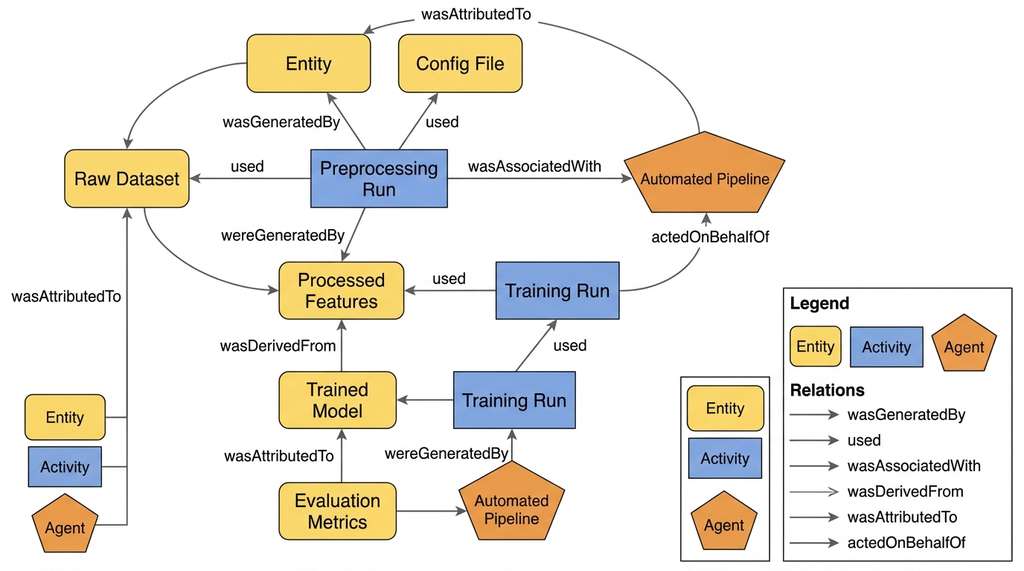
Figure 47.9 illustrates how these three core types interconnect. Each arrow represents one of the six PROV relations listed in Table 47.3, showing the bipartite structure (where a bipartite graph is one whose nodes split into two disjoint sets, here entities and activities, with edges running only between sets) that links entities to the activities that consumed or produced them, and the agents responsible for those activities.
used, wasGeneratedBy, wasAssociatedWith, wasDerivedFrom, and wasAttributedTo.Mental Model
Think of provenance like the traceability system behind a packaged food product. The Entity is the jar of tomato sauce on the shelf; the Activity is the canning process at the factory (with a timestamp and batch number); the Agent is the company responsible for that batch. The used relation says which farm's tomatoes went into that batch; wasGeneratedBy says which canning run produced the jar; wasDerivedFrom says the sauce came from those specific tomatoes. If a food safety recall is triggered, inspectors follow these links backward from jar to farm, exactly the way backward_lineage traces from a trained model to its raw data. And just as the food system only works when every handler in the supply chain logs their step, computational provenance only works when every pipeline stage records its inputs and outputs.
These three types are connected by a small set of relations (summarized in Table 47.3) that capture the essential provenance semantics:
| Relation | Domain | Range | Meaning |
|---|---|---|---|
wasGeneratedBy |
Entity | Activity | The entity was produced by the activity |
used |
Activity | Entity | The activity consumed the entity as input |
wasAssociatedWith |
Activity | Agent | The agent was responsible for the activity |
wasDerivedFrom |
Entity | Entity | The first entity was derived from the second |
wasAttributedTo |
Entity | Agent | The entity was produced under the agent's responsibility |
actedOnBehalfOf |
Agent | Agent | The first agent acted under the authority of the second |
The wasDerivedFrom relation is a convenience shortcut: it asserts that one
entity was produced from another without specifying the intermediate activity. For full
provenance, the decomposition into used + wasGeneratedBy through
an explicit activity is preferred, because it captures the transformation that connected
input to output. Formally, if entity \(e_2\) was derived from entity \(e_1\), there exists
an activity \(a\) such that:
Exercise 47.2.1
A three-stage pipeline produces the following provenance relationships: Activity clean
uses Entity raw.csv and generates Entity cleaned.csv. Activity
train uses cleaned.csv and Entity params.yaml, and generates
Entity model.pkl. Activity eval uses model.pkl and Entity
test.csv, and generates Entity report.json. Write the six PROV relation
statements (using wasGeneratedBy and used) that capture this lineage. Then
list the full backward lineage of report.json: which entities and activities appear
when you trace all ancestors?
Hint
Start from report.json and work backward through each wasGeneratedBy to
find the producing activity, then follow each used edge from that activity to its input
entities. Repeat recursively for any entity that itself has a wasGeneratedBy relation.
You should find five ancestor entities and three ancestor activities.
Step-Through: Backward Lineage Query
Trace through the backward_lineage algorithm (formally implemented in section 5 below using NetworkX) on a tiny run graph with these nodes
and edges. Entities: D1, D2, M1. Activities:
A1, A2. Edges (directed): D1 → A1 (used), A1 → D2
(wasGeneratedBy), D2 → A2 (used), A2 → M1 (wasGeneratedBy).
Call backward_lineage("M1"). The function calls nx.ancestors(graph, "M1"),
which performs a reverse BFS (breadth-first search, traversing the graph layer by layer from the starting node) from M1:
Step 1: predecessors of M1 = {A2}. Visited = {A2}.
Step 2: predecessors of A2 = {D2}. Visited = {A2, D2}.
Step 3: predecessors of D2 = {A1}. Visited = {A2, D2, A1}.
Step 4: predecessors of A1 = {D1}. Visited = {A2, D2, A1, D1}.
Step 5: predecessors of D1 = {} (no more). Final ancestor set = {A2, D2, A1, D1}.
Result: the model M1 depends on all four upstream nodes. A regeneration_order call
would filter to activities only and return [A1, A2] in topological order.
The artifact DAG from Section 47.1 is, in PROV terms, a bipartite graph of entities and
activities connected by used and wasGeneratedBy edges. The
transition from our custom Python classes to PROV is not a conceptual change; it is a
vocabulary change that makes the same information portable. The RunRecord
becomes a PROV Activity. The artifact hashes become PROV Entity identifiers. The
input_hashes become used relations. The output_hashes
become wasGeneratedBy relations. The payoff is that any PROV-compatible tool
can now ingest, display, and query your experiment lineage.
Common Misconception
A frequent mistake is assuming that Git version control already provides data provenance. Git tracks file changes over time in a single repository, but it does not record which input files were consumed by which computation to produce which output files. A Git log tells you that model.pt was committed at 2pm, but it cannot tell you which version of the training data, which preprocessing script, or which hyperparameter configuration produced that model. Provenance is about causal derivation relationships between artifacts across an entire pipeline, not about file-level change history within a single repository.
2. Implementing PROV in Python
The following example (Figure 47.10) encodes a two-stage ML pipeline (preprocessing followed by training) as a PROV document. The prov Python library provides a complete implementation of the W3C PROV
data model with serialization to PROV-N, PROV-JSON, and RDF:
"""Encoding ML pipeline provenance with the W3C PROV data model."""
import prov.model as prov
from prov.dot import prov_to_dot
from datetime import datetime, timezone


def create_pipeline_provenance() -> prov.ProvDocument:
    """Create a PROV document describing a two-stage ML pipeline."""
    doc = prov.ProvDocument()

    # Define namespaces for our identifiers
    doc.set_default_namespace("https://discoveryai.example.org/prov/")
    doc.add_namespace("dvc", "https://discoveryai.example.org/dvc/")
    doc.add_namespace("mlflow", "https://discoveryai.example.org/mlflow/")
    doc.add_namespace("git", "https://discoveryai.example.org/git/")

    # --- Entities (artifacts) ---

    # Raw dataset
    raw_data = doc.entity("dvc:raw_crystals_v2", {
        "prov:type": "dvc:Dataset",
        "dvc:hash": "a1b2c3d4e5f6...",
        "dvc:size_bytes": 1073741824,
        "prov:label": "Raw crystal structure dataset v2",
    })

    # Preprocessing configuration
    preprocess_config = doc.entity("git:config/preprocess.yaml@abc123", {
        "prov:type": "git:ConfigFile",
        "git:commit": "abc123def456",
        "prov:label": "Preprocessing configuration",
    })

    # Processed features (output of preprocessing)
    processed_data = doc.entity("dvc:processed_features_v3", {
        "prov:type": "dvc:Dataset",
        "dvc:hash": "f6e5d4c3b2a1...",
        "dvc:size_bytes": 536870912,
        "prov:label": "Processed feature matrix v3",
    })

    # Training configuration
    train_config = doc.entity("git:config/train.yaml@abc123", {
        "prov:type": "git:ConfigFile",
        "git:commit": "abc123def456",
        "prov:label": "Training configuration (lr=0.0005, layers=6)",
    })

    # Trained model
    model = doc.entity("mlflow:CrystalPredictor/v12", {
        "prov:type": "mlflow:RegisteredModel",
        "mlflow:run_id": "run_20260415_042",
        "mlflow:version": 12,
        "prov:label": "CrystalPredictor model v12",
    })

    # Evaluation metrics
    metrics = doc.entity("mlflow:run_20260415_042/metrics", {
        "prov:type": "mlflow:Metrics",
        "mlflow:mae": 0.042,
        "mlflow:r2": 0.94,
        "prov:label": "Evaluation metrics (MAE=0.042, R2=0.94)",
    })

    # --- Activities (runs) ---

    preprocess_run = doc.activity(
        "dvc:preprocess_run_001",
        startTime=datetime(2026, 4, 15, 10, 0, tzinfo=timezone.utc),
        endTime=datetime(2026, 4, 15, 10, 5, tzinfo=timezone.utc),
        other_attributes={
            "prov:type": "dvc:PipelineStage",
            "prov:label": "Data preprocessing",
            "git:commit": "abc123def456",
        }
    )

    train_run = doc.activity(
        "mlflow:train_run_042",
        startTime=datetime(2026, 4, 15, 10, 10, tzinfo=timezone.utc),
        endTime=datetime(2026, 4, 15, 12, 30, tzinfo=timezone.utc),
        other_attributes={
            "prov:type": "mlflow:TrainingRun",
            "prov:label": "Model training",
            "git:commit": "abc123def456",
            "mlflow:experiment_id": "crystal_property_prediction",
        }
    )

    # --- Agents ---

    researcher = doc.agent("git:alice@lab.org", {
        "prov:type": "prov:Person",
        "prov:label": "Alice (lead researcher)",
    })

    pipeline = doc.agent("dvc:automated_pipeline", {
        "prov:type": "prov:SoftwareAgent",
        "prov:label": "DVC automated pipeline",
    })

    # --- Relations ---

    # Preprocessing stage
    doc.wasGeneratedBy(processed_data, preprocess_run)
    doc.used(preprocess_run, raw_data)
    doc.used(preprocess_run, preprocess_config)
    doc.wasAssociatedWith(preprocess_run, pipeline)

    # Training stage
    doc.wasGeneratedBy(model, train_run)
    doc.wasGeneratedBy(metrics, train_run)
    doc.used(train_run, processed_data)
    doc.used(train_run, train_config)
    doc.wasAssociatedWith(train_run, pipeline)

    # Delegation: pipeline acts on behalf of researcher
    doc.actedOnBehalfOf(pipeline, researcher)

    # Derivation shortcuts (redundant but useful for querying)
    doc.wasDerivedFrom(processed_data, raw_data)
    doc.wasDerivedFrom(model, processed_data)

    # Attribution
    doc.wasAttributedTo(model, researcher)

    return doc


# Create and serialize the provenance document
doc = create_pipeline_provenance()

# Serialize to PROV-JSON (machine-readable)
prov_json = doc.serialize(format="json")
print("PROV-JSON document created")

# Serialize to PROV-N (human-readable)
prov_n = doc.serialize(format="provn")
print("\nPROV-N representation:")
print(prov_n[:500])

# Visualize as a graph (requires graphviz)
dot = prov_to_dot(doc)
dot.write_png("provenance_graph.jpg")
print("\nProvenance graph saved to provenance_graph.jpg")
The PROV-N serialization of this document, shown in Figure 47.11, is a human-readable representation that reads almost like natural language:
document
  prefix dvc  <https://discoveryai.example.org/dvc/>
  prefix mlflow <https://discoveryai.example.org/mlflow/>

  entity(dvc:raw_crystals_v2, [prov:type="dvc:Dataset"])
  entity(dvc:processed_features_v3, [prov:type="dvc:Dataset"])
  entity(mlflow:CrystalPredictor/v12, [prov:type="mlflow:RegisteredModel"])

  activity(dvc:preprocess_run_001, 2026-04-15T10:00:00Z, 2026-04-15T10:05:00Z)
  activity(mlflow:train_run_042, 2026-04-15T10:10:00Z, 2026-04-15T12:30:00Z)

  wasGeneratedBy(dvc:processed_features_v3, dvc:preprocess_run_001)
  used(dvc:preprocess_run_001, dvc:raw_crystals_v2)
  wasGeneratedBy(mlflow:CrystalPredictor/v12, mlflow:train_run_042)
  used(mlflow:train_run_042, dvc:processed_features_v3)

  wasDerivedFrom(mlflow:CrystalPredictor/v12, dvc:raw_crystals_v2)
endDocument
The prov Python package (pip install prov) provides the full W3C
PROV data model in roughly 10 lines of setup per document. It handles serialization to
four formats (PROV-N, PROV-JSON, PROV-XML, RDF/Turtle), graph visualization via Graphviz,
and validation against the PROV constraints specification. Without the library, implementing
the PROV data model from scratch would typically require on the order of several hundred lines of Python for the
core types and relations, plus a comparable amount for each serialization format.
3. The OpenLineage Specification
While W3C PROV provides a general-purpose provenance model, OpenLineage is a specification designed specifically for runtime lineage collection in data pipelines. Where PROV captures provenance as a document authored after the fact, OpenLineage captures lineage as a stream of events emitted during pipeline execution. This event-driven model integrates naturally with orchestration tools (Airflow, Dagster, Spark) that already emit lifecycle events. (As of 2024, OpenLineage has reached version 1.0 and added column-level lineage support, with additional integrations for Apache Flink and Great Expectations.)
OpenLineage defines three event types that map to pipeline execution phases:
- RunEvent (START): emitted when a job begins execution. Contains the job name, namespace, and input datasets.
- RunEvent (RUNNING): optionally emitted during execution with progress information.
- RunEvent (COMPLETE/FAIL/ABORT): emitted when a job finishes. Contains output datasets, metrics, and error information (for failures).
Each event carries facets, where a facet is a named, schema-validated metadata extension that describes a specific aspect of the job, dataset, or run. Standard facets include SQL queries, schema information, data quality metrics, and source code locations. Custom facets allow domain-specific metadata (crystal structure properties, simulation parameters, assay conditions). The code in Figure 47.12 demonstrates how to emit these events from Python.
"""OpenLineage event emission for ML pipeline lineage tracking."""
import json
import uuid
from datetime import datetime, timezone
from dataclasses import dataclass, field, asdict
from typing import Optional


@dataclass
class OpenLineageDataset:
    """An OpenLineage dataset reference."""
    namespace: str        # e.g., "s3://my-bucket"
    name: str             # e.g., "data/crystals.parquet"
    facets: dict = field(default_factory=dict)


@dataclass
class OpenLineageJob:
    """An OpenLineage job reference."""
    namespace: str        # e.g., "https://discoveryai.example.org"
    name: str             # e.g., "crystal_preprocessing"
    facets: dict = field(default_factory=dict)


@dataclass
class OpenLineageRunEvent:
    """A single OpenLineage event capturing pipeline state."""
    eventType: str        # "START", "RUNNING", "COMPLETE", "FAIL", "ABORT"
    eventTime: str        # ISO 8601
    run: dict             # {"runId": uuid}
    job: dict             # Job reference
    inputs: list = field(default_factory=list)
    outputs: list = field(default_factory=list)
    producer: str = "https://discoveryai.example.org/pipeline/v1"


class OpenLineageEmitter:
    """Emit OpenLineage events during pipeline execution."""

    def __init__(self, job_namespace: str, job_name: str):
        self.run_id = str(uuid.uuid4())
        self.job = OpenLineageJob(namespace=job_namespace, name=job_name)
        self.events: list[dict] = []

    def emit_start(
        self,
        inputs: list[OpenLineageDataset],
    ) -> dict:
        """Emit a START event when the job begins."""
        event = OpenLineageRunEvent(
            eventType="START",
            eventTime=datetime.now(timezone.utc).isoformat(),
            run={"runId": self.run_id},
            job=asdict(self.job),
            inputs=[asdict(ds) for ds in inputs],
        )
        event_dict = asdict(event)
        self.events.append(event_dict)
        self._send(event_dict)
        return event_dict

    def emit_complete(
        self,
        outputs: list[OpenLineageDataset],
        run_facets: Optional[dict] = None,
    ) -> dict:
        """Emit a COMPLETE event when the job finishes successfully."""
        event = OpenLineageRunEvent(
            eventType="COMPLETE",
            eventTime=datetime.now(timezone.utc).isoformat(),
            run={
                "runId": self.run_id,
                "facets": run_facets or {},
            },
            job=asdict(self.job),
            outputs=[asdict(ds) for ds in outputs],
        )
        event_dict = asdict(event)
        self.events.append(event_dict)
        self._send(event_dict)
        return event_dict

    def emit_fail(self, error_message: str) -> dict:
        """Emit a FAIL event when the job encounters an error."""
        event = OpenLineageRunEvent(
            eventType="FAIL",
            eventTime=datetime.now(timezone.utc).isoformat(),
            run={
                "runId": self.run_id,
                "facets": {
                    "errorMessage": {
                        "_producer": "https://discoveryai.example.org",
                        "_schemaURL": "https://openlineage.io/spec/facets/1-0-0/ErrorMessageRunFacet.json",
                        "message": error_message,
                        "programmingLanguage": "python",
                    }
                },
            },
            job=asdict(self.job),
        )
        event_dict = asdict(event)
        self.events.append(event_dict)
        self._send(event_dict)
        return event_dict

    def _send(self, event: dict):
        """Send event to the lineage backend (console for demo)."""
        print(f"[OpenLineage] {event['eventType']}: "
              f"{self.job.name} (run {self.run_id[:8]}...)")


# Example: instrument a preprocessing step
emitter = OpenLineageEmitter(
    job_namespace="https://discoveryai.example.org",
    job_name="crystal_feature_extraction",
)

# Emit START with input datasets
emitter.emit_start(inputs=[
    OpenLineageDataset(
        namespace="s3://crystal-data",
        name="raw/structures_v2.parquet",
        facets={
            "schema": {
                "fields": [
                    {"name": "formula", "type": "string"},
                    {"name": "space_group", "type": "integer"},
                    {"name": "lattice_params", "type": "array"},
                ]
            },
            "dataSource": {"uri": "s3://crystal-data/raw/structures_v2.parquet"},
        },
    )
])

# ... perform preprocessing ...

# Emit COMPLETE with output datasets
emitter.emit_complete(
    outputs=[
        OpenLineageDataset(
            namespace="s3://crystal-data",
            name="processed/features_v3.parquet",
            facets={
                "schema": {
                    "fields": [
                        {"name": "feature_vector", "type": "array"},
                        {"name": "target_bandgap", "type": "float"},
                    ]
                },
                "rowCount": {"rowCount": 47523},
            },
        )
    ],
    run_facets={
        "processing": {
            "durationMs": 305000,
            "recordsProcessed": 47523,
            "recordsDropped": 142,
        }
    },
)
A pharmaceutical company has three teams contributing to a drug discovery pipeline: a chemistry team that generates molecular screening data, a computational team that trains property prediction models, and a biology team that validates predictions in wet-lab assays. Each team uses different tools (the chemists use a Laboratory Information Management System (LIMS), the computational team uses MLflow, the biologists use electronic lab notebooks). By instrumenting each tool to emit OpenLineage events to a shared Marquez backend (where Marquez is an open-source metadata service that stores and queries OpenLineage events as a graph), the company can trace the lineage of any assay result back through the model prediction to the original screening data, across all three teams' toolchains, without requiring any team to change their primary workflow.
4. PROV vs. OpenLineage: Complementary Standards
W3C PROV and OpenLineage serve different but complementary roles. Table 47.4 summarizes the key differences. Understanding when to use each prevents over-engineering:
| Dimension | W3C PROV | OpenLineage |
|---|---|---|
| Capture model | Document (retrospective) | Event stream (runtime) |
| Scope | General-purpose provenance | Data pipeline lineage |
| Granularity | Arbitrary (atoms to galaxies) | Job/dataset/run level |
| Serialization | JSON, RDF, XML, PROV-N | JSON events |
| Ecosystem | Academic, government, W3C | Data engineering (Airflow, Spark, dbt) |
| Best for | Publication, audit, archive | Operational lineage tracking |
The practical pattern is: emit OpenLineage events during pipeline execution, aggregate them in a lineage backend (such as Marquez), and export the aggregated lineage as W3C PROV documents for publication, archival, or regulatory submission. Figure 47.13 shows the bridge code that converts between the two:
"""Convert OpenLineage events to W3C PROV documents."""
import prov.model as prov
from datetime import datetime


def openlineage_to_prov(events: list[dict]) -> prov.ProvDocument:
    """Convert a sequence of OpenLineage events into a PROV document.

    Groups events by run ID, creates PROV Activities for each run,
    PROV Entities for each dataset, and connects them with
    used/wasGeneratedBy relations.
    """
    doc = prov.ProvDocument()
    doc.set_default_namespace("https://discoveryai.example.org/prov/")
    doc.add_namespace("ol", "https://openlineage.io/")

    # Group events by run ID
    runs: dict[str, list[dict]] = {}
    for event in events:
        run_id = event["run"]["runId"]
        runs.setdefault(run_id, []).append(event)

    seen_entities = set()

    for run_id, run_events in runs.items():
        # Find the START and terminal events
        start_event = next(
            (e for e in run_events if e["eventType"] == "START"), None
        )
        end_event = next(
            (e for e in run_events
             if e["eventType"] in ("COMPLETE", "FAIL", "ABORT")),
            None,
        )

        if not start_event:
            continue

        job_name = start_event["job"]["name"]

        # Create the PROV Activity
        start_time = datetime.fromisoformat(start_event["eventTime"])
        end_time = (
            datetime.fromisoformat(end_event["eventTime"])
            if end_event else None
        )

        activity_id = f"ol:run/{run_id}"
        doc.activity(
            activity_id,
            startTime=start_time,
            endTime=end_time,
            other_attributes={
                "prov:type": "ol:JobRun",
                "prov:label": job_name,
                "ol:runId": run_id,
            },
        )

        # Create entities for input datasets and link with 'used'
        for inp in start_event.get("inputs", []):
            entity_id = f"ol:dataset/{inp['namespace']}/{inp['name']}"
            if entity_id not in seen_entities:
                doc.entity(entity_id, {
                    "prov:type": "ol:Dataset",
                    "prov:label": inp["name"],
                    "ol:namespace": inp["namespace"],
                })
                seen_entities.add(entity_id)
            doc.used(activity_id, entity_id)

        # Create entities for output datasets and link with
        # 'wasGeneratedBy'
        if end_event and end_event["eventType"] == "COMPLETE":
            for out in end_event.get("outputs", []):
                entity_id = f"ol:dataset/{out['namespace']}/{out['name']}"
                if entity_id not in seen_entities:
                    doc.entity(entity_id, {
                        "prov:type": "ol:Dataset",
                        "prov:label": out["name"],
                        "ol:namespace": out["namespace"],
                    })
                    seen_entities.add(entity_id)
                doc.wasGeneratedBy(entity_id, activity_id)

    return doc


# Convert collected OpenLineage events to PROV
prov_doc = openlineage_to_prov(emitter.events)
print(prov_doc.serialize(format="provn"))
used and wasGeneratedBy relations for cross-system provenance interchange.5. Run Graphs and Provenance Queries
With provenance captured in a structured format, we can build a run graph: a queryable graph database of all experiments, artifacts, and their relationships. The implementation below uses NetworkX (a Python library for creating, manipulating, and analyzing graph data structures) to store the graph in memory. The run graph enables questions that are impossible to answer with flat experiment logs:
- What data was used to train the model currently deployed in production? (backward lineage)
- Which downstream models are affected if I retract this dataset? (forward lineage / impact analysis)
- Show me all runs that used dataset version X with learning rate > 0.001. (filtered search)
- What changed between the model that scored 0.94 and the one that scored 0.91? (diff analysis)
Checkpoint
So far: W3C PROV gives you a portable vocabulary (Entity, Activity, Agent plus six relations) for describing lineage; OpenLineage gives you a runtime event stream for collecting it; a run graph combines the two into a queryable structure that supports backward lineage, forward impact, and cross-run comparison.
"""Queryable run graph using NetworkX for provenance analysis."""
import networkx as nx
from dataclasses import dataclass


class RunGraph:
    """A queryable graph of experiment runs and artifacts."""

    def __init__(self):
        self.graph = nx.DiGraph()

    def add_entity(self, entity_id: str, **attrs):
        """Add an artifact (entity) node to the graph."""
        self.graph.add_node(entity_id, node_type="entity", **attrs)

    def add_activity(self, activity_id: str, **attrs):
        """Add a run (activity) node to the graph."""
        self.graph.add_node(activity_id, node_type="activity", **attrs)

    def add_used(self, activity_id: str, entity_id: str):
        """Record that an activity used an entity as input."""
        self.graph.add_edge(entity_id, activity_id, relation="used")

    def add_generated(self, entity_id: str, activity_id: str):
        """Record that an activity generated an entity as output."""
        self.graph.add_edge(activity_id, entity_id, relation="wasGeneratedBy")

    def backward_lineage(self, entity_id: str) -> set[str]:
        """Find all ancestors of an entity (what was it derived from?)."""
        return nx.ancestors(self.graph, entity_id)

    def forward_impact(self, entity_id: str) -> set[str]:
        """Find all descendants of an entity (what depends on it?)."""
        return nx.descendants(self.graph, entity_id)

    def find_runs_using(
        self,
        entity_id: str,
        filter_fn=None,
    ) -> list[str]:
        """Find all runs that consumed a specific entity."""
        runs = []
        for successor in self.graph.successors(entity_id):
            node = self.graph.nodes[successor]
            if node.get("node_type") == "activity":
                if filter_fn is None or filter_fn(node):
                    runs.append(successor)
        return runs

    def diff_runs(self, run_a: str, run_b: str) -> dict:
        """Compare two runs: what inputs, params, and outputs differ?"""
        inputs_a = {
            n for n in self.graph.predecessors(run_a)
            if self.graph.nodes[n].get("node_type") == "entity"
        }
        inputs_b = {
            n for n in self.graph.predecessors(run_b)
            if self.graph.nodes[n].get("node_type") == "entity"
        }

        outputs_a = {
            n for n in self.graph.successors(run_a)
            if self.graph.nodes[n].get("node_type") == "entity"
        }
        outputs_b = {
            n for n in self.graph.successors(run_b)
            if self.graph.nodes[n].get("node_type") == "entity"
        }

        return {
            "inputs_only_in_a": inputs_a - inputs_b,
            "inputs_only_in_b": inputs_b - inputs_a,
            "shared_inputs": inputs_a & inputs_b,
            "outputs_only_in_a": outputs_a - outputs_b,
            "outputs_only_in_b": outputs_b - outputs_a,
            "params_a": self.graph.nodes[run_a],
            "params_b": self.graph.nodes[run_b],
        }

    def regeneration_order(self, entity_id: str) -> list[str]:
        """Topological order (a linear ordering of nodes such that every
        dependency appears before the node that depends on it) of
        activities needed to regenerate an entity."""
        ancestors = self.backward_lineage(entity_id)
        # Filter to activity nodes only
        activities = {
            n for n in ancestors
            if self.graph.nodes[n].get("node_type") == "activity"
        }
        # Add any activity that directly produces the target
        for pred in self.graph.predecessors(entity_id):
            if self.graph.nodes[pred].get("node_type") == "activity":
                activities.add(pred)
        # Return in topological (execution) order
        subgraph = self.graph.subgraph(ancestors | {entity_id})
        topo = list(nx.topological_sort(subgraph))
        return [n for n in topo if n in activities]


# Build a run graph
rg = RunGraph()

# Add entities
rg.add_entity("raw_data_v2", label="Raw crystals", dvc_hash="a1b2c3...")
rg.add_entity("features_v3", label="Processed features", dvc_hash="d4e5f6...")
rg.add_entity("model_v12", label="Trained model", mlflow_version=12)
rg.add_entity("config_v1", label="Training config", lr=0.0005)

# Add activities
rg.add_activity("preprocess_001", label="Preprocessing", duration_s=305)
rg.add_activity("train_042", label="Training", duration_s=8400, lr=0.0005)

# Add relations
rg.add_used("preprocess_001", "raw_data_v2")
rg.add_generated("features_v3", "preprocess_001")
rg.add_used("train_042", "features_v3")
rg.add_used("train_042", "config_v1")
rg.add_generated("model_v12", "train_042")

# Query: what does model_v12 depend on?
lineage = rg.backward_lineage("model_v12")
print(f"Model v12 lineage ({len(lineage)} ancestors):")
for ancestor in lineage:
    node = rg.graph.nodes[ancestor]
    print(f"  {ancestor}: {node.get('label', 'unknown')}")

# Query: if raw_data_v2 is retracted, what is affected?
impact = rg.forward_impact("raw_data_v2")
print(f"\nImpact of retracting raw_data_v2: {len(impact)} downstream artifacts")

# Query: regeneration plan for model_v12
plan = rg.regeneration_order("model_v12")
print(f"\nRegeneration plan for model_v12: {plan}")
RunGraph class with methods for backward lineage tracing, forward impact analysis, run-to-run diffing, and topologically sorted regeneration plans.Most teams build provenance to trace backward: "how was this model produced?" But the highest-value query is often the forward one: "if I discover a problem with this dataset, what else is affected?" In a large research organization, a single dataset retraction can invalidate dozens of downstream models, papers, and decisions. Without a run graph that supports forward impact analysis, discovering the blast radius of a data quality issue typically requires manual archaeology through email chains, shared drives, and institutional memory. With the graph, it is a single function call.
6. Provenance for the Discovery Workbench
The run graph gives us a general-purpose engine for lineage queries, but a production research platform needs provenance recording woven into its pipeline execution, not bolted on after the fact.
The Discovery Workbench introduced in Chapter 6 includes a provenance layer that stores lineage for all Workbench operations. The standards from this section connect directly to the Workbench architecture through a provenance recorder that instruments Workbench pipeline stages. Figure 47.15 shows the recorder implementation.
"""Discovery Workbench provenance integration."""
import prov.model as prov
from datetime import datetime, timezone
from contextlib import contextmanager
from typing import Generator


class WorkbenchProvenanceRecorder:
    """Records provenance for Discovery Workbench pipeline stages.

    Integrates with the Workbench's event system to automatically
    capture lineage as experiments execute.
    """

    def __init__(self, workbench_id: str):
        self.workbench_id = workbench_id
        self.doc = prov.ProvDocument()
        self.doc.set_default_namespace(
            f"https://discoveryai.example.org/workbench/{workbench_id}/"
        )
        self.doc.add_namespace("wb", "https://discoveryai.example.org/workbench/")

        # Register the Workbench as an agent
        self.doc.agent(f"wb:{workbench_id}", {
            "prov:type": "wb:DiscoveryWorkbench",
            "prov:label": f"Discovery Workbench ({workbench_id})",
        })

    @contextmanager
    def track_stage(
        self,
        stage_name: str,
        input_ids: list[str],
    ) -> Generator[dict, None, None]:
        """Context manager that tracks a pipeline stage's provenance.

        Usage:
            with recorder.track_stage("preprocess", ["raw_data"]) as ctx:
                result = preprocess(raw_data)
                ctx["outputs"] = [("processed_data", result_hash)]
                ctx["metrics"] = {"records": 47523}
        """
        stage_id = f"stage:{stage_name}:{datetime.now(timezone.utc).strftime('%Y%m%d%H%M%S')}"
        start_time = datetime.now(timezone.utc)

        # Create the activity
        self.doc.activity(stage_id, startTime=start_time, other_attributes={
            "prov:type": "wb:PipelineStage",
            "prov:label": stage_name,
        })

        # Link to the Workbench agent
        self.doc.wasAssociatedWith(stage_id, f"wb:{self.workbench_id}")

        # Record input usage
        for input_id in input_ids:
            if not self.doc.get_record(input_id):
                self.doc.entity(input_id, {"prov:type": "wb:Artifact"})
            self.doc.used(stage_id, input_id)

        # Yield context for the stage to populate outputs
        context = {"outputs": [], "metrics": {}}
        try:
            yield context
        finally:
            end_time = datetime.now(timezone.utc)

            # Update the activity with end time
            # (prov library handles this via the activity record)

            # Record outputs
            for output_id, output_hash in context.get("outputs", []):
                self.doc.entity(output_id, {
                    "prov:type": "wb:Artifact",
                    "wb:contentHash": output_hash,
                })
                self.doc.wasGeneratedBy(output_id, stage_id)

                # Derivation from each input
                for input_id in input_ids:
                    self.doc.wasDerivedFrom(output_id, input_id)

    def export_prov_json(self) -> str:
        """Export the full provenance document as PROV-JSON."""
        return self.doc.serialize(format="json")

    def export_prov_n(self) -> str:
        """Export the full provenance document as human-readable PROV-N."""
        return self.doc.serialize(format="provn")


# Example: Workbench pipeline with automatic provenance
recorder = WorkbenchProvenanceRecorder("wb_crystal_2026")

# Stage 1: preprocessing
with recorder.track_stage("feature_extraction", ["raw_crystals_v2"]) as ctx:
    # ... actual preprocessing would happen here ...
    ctx["outputs"] = [("features_v3", "d4e5f6a7b8...")]
    ctx["metrics"] = {"records_in": 47665, "records_out": 47523}

# Stage 2: training
with recorder.track_stage("model_training", ["features_v3", "config_v1"]) as ctx:
    # ... actual training would happen here ...
    ctx["outputs"] = [("model_v12", "c3b2a1f6e5...")]
    ctx["metrics"] = {"epochs": 87, "val_mae": 0.042}

# Export provenance for archival
print(recorder.export_prov_n())
WorkbenchProvenanceRecorder using a track_stage context manager that automatically records start/end timestamps, input used edges, output wasGeneratedBy edges, and derivation relations for each pipeline stage.7. Provenance Integrity and Tamper Detection
Recording provenance automatically, as the Workbench recorder does, solves the collection problem, but it raises a new question: how can anyone verify that the recorded history has not been altered after the fact?
Provenance is only useful when trustworthy. A record that can be altered after the fact is worse than none: it creates false confidence. Two mechanisms strengthen integrity: signing provenance documents (using cryptographic signatures to bind a provenance record to the identity of its author, covered conceptually here but not implemented until Section 47.4) and chaining records. Figure 47.16 demonstrates the chaining approach:
"""Tamper-evident provenance chains using hash linking."""
import hashlib
import json
from datetime import datetime, timezone


class ProvenanceChain:
    """An append-only, tamper-evident chain of provenance records.

    Each record includes the hash of the previous record, forming
    a hash chain (similar to a blockchain's structure, but without
    consensus or mining). Modifying any historical record breaks
    the chain, making tampering detectable.
    """

    def __init__(self):
        self.records: list[dict] = []

    def _hash_record(self, record: dict) -> str:
        """Compute the hash of a provenance record."""
        canonical = json.dumps(record, sort_keys=True).encode("utf-8")
        return hashlib.sha256(canonical).hexdigest()

    def append(self, record: dict) -> dict:
        """Append a new record to the chain."""
        # Link to the previous record
        if self.records:
            record["_prev_hash"] = self._hash_record(self.records[-1])
        else:
            record["_prev_hash"] = "GENESIS"

        record["_timestamp"] = datetime.now(timezone.utc).isoformat()
        record["_index"] = len(self.records)
        record["_hash"] = self._hash_record(record)

        self.records.append(record)
        return record

    def verify_integrity(self) -> tuple[bool, list[int]]:
        """Verify the entire chain. Returns (is_valid, broken_indices)."""
        broken = []

        for i, record in enumerate(self.records):
            # Verify self-hash
            expected_hash = record.pop("_hash")
            actual_hash = self._hash_record(record)
            record["_hash"] = expected_hash

            if actual_hash != expected_hash:
                broken.append(i)
                continue

            # Verify chain linkage
            if i > 0:
                prev_record = self.records[i - 1].copy()
                expected_prev = self._hash_record(prev_record)
                if record["_prev_hash"] != expected_prev:
                    broken.append(i)

        return len(broken) == 0, broken


# Build a provenance chain
chain = ProvenanceChain()

chain.append({
    "event": "dataset_registered",
    "entity": "raw_crystals_v2",
    "hash": "a1b2c3d4...",
    "agent": "alice@lab.org",
})

chain.append({
    "event": "preprocessing_complete",
    "activity": "preprocess_001",
    "inputs": ["raw_crystals_v2"],
    "outputs": ["features_v3"],
    "agent": "automated_pipeline",
})

chain.append({
    "event": "model_trained",
    "activity": "train_042",
    "inputs": ["features_v3", "config_v1"],
    "outputs": ["model_v12"],
    "metrics": {"mae": 0.042},
    "agent": "automated_pipeline",
})

# Verify the chain
is_valid, broken = chain.verify_integrity()
print(f"Chain integrity: {'VALID' if is_valid else 'BROKEN'}")
print(f"Records: {len(chain.records)}, Broken: {broken}")
ProvenanceChain with SHA-256 hash linking: each record stores the hash of its predecessor, so modifying any historical entry breaks the chain and is detected by verify_integrity.The hash chain in Figure 47.16 detects accidental modifications and deters casual tampering, but it does not prevent a determined adversary who controls the storage from rewriting the entire chain. For adversarial tamper resistance, you need external anchoring: publishing chain head hashes to an independent timestamping service, a public ledger, or a trusted third party. For most scientific research contexts, the hash chain provides adequate integrity assurance; for regulatory or legal contexts, consult your compliance team about appropriate anchoring mechanisms.
Real-World Application: Marquez at WeWork/Datakin
The Marquez project (originally developed at WeWork, now a Linux Foundation AI & Data project) implements an OpenLineage-compatible metadata service that collects runtime lineage events from Airflow, Spark, and dbt (a SQL-based transformation tool that compiles analytics queries into dependency-ordered pipelines) jobs. Large production deployments can ingest millions of lineage events per day, enabling data platform teams to answer "which dashboards break if this table schema changes?" in seconds rather than hours of manual investigation. Marquez stores the lineage as a queryable graph, serving both forward impact analysis for change management and backward lineage for regulatory data audits. (As of 2024, Marquez supports column-level lineage and dataset symlinks; Datakin, the company that maintained Marquez after WeWork, was acquired by Astronomer, further strengthening the integration between OpenLineage and the Airflow ecosystem.)
The Provenance Standard That Almost Described the Universe
The W3C PROV specification was intentionally designed to be domain-agnostic to the point of absurdity. During the standardization process, working group members tested the model by encoding the provenance of a cake recipe, the lineage of a published newspaper article, and the causal history of a supernova observation. The same three types (Entity, Activity, Agent) and six relations handled all of them. One committee member reportedly joked that PROV could describe the provenance of the PROV specification itself, and the group proceeded to do exactly that, publishing a formal PROV document describing how the PROV recommendation was derived from its working drafts, which were generated by editing activities associated with named working group members.
Research Frontier
The LineageGraph system (Namaki et al., 2023, "Efficient Querying of Versioned and Lineage-Aware ML Pipelines," VLDB 2023) introduces compact graph representations that compress lineage metadata by up to 100x compared to naive PROV storage, enabling sub-second backward and forward lineage queries over repositories with millions of pipeline runs. Their key insight is that most pipeline executions share large structural overlaps (the same DAG topology with different data versions), so a template-based encoding can factor out the shared structure and store only the per-run deltas. This compression makes it practical to retain full provenance for every experiment in long-running research programs without the storage and query-latency costs that often push teams toward sampling or discarding historical lineage.
8. The Provenance Maturity Model
Hash chains and signed documents represent the most rigorous end of the provenance spectrum, but most teams do not need that level of assurance from day one; the right investment depends on the stakes of the project.
Not every project needs full W3C PROV compliance with tamper-evident chains. A practical approach is to adopt provenance incrementally, advancing through the maturity levels shown in Table 47.5 as the project's needs grow:
| Level | What You Track | Tools | When to Use |
|---|---|---|---|
| L0: Ad hoc | Nothing systematic | Lab notebooks, emails | Never (included for contrast) |
| L1: Logged | Parameters and metrics per run | MLflow tracking, Weights & Biases (W&B) | Individual exploration |
| L2: Versioned | Code + data + config versions per run | Git + DVC (Data Version Control, a tool that applies Git-like versioning to large data files and ML pipelines) + MLflow | Team projects, publications |
| L3: Traced | Full artifact DAG with hash verification | DVC pipelines + PROV | Reproducibility-critical research |
| L4: Auditable | Tamper-evident chains, signed provenance | PROV + hash chains + timestamping | Regulatory, clinical, safety-critical |
The recipe in Section 47.3 implements Level 3 (full artifact DAG with hash verification) and includes optional Level 4 extensions for teams that need auditability.
Try It: Build and Query a Provenance Graph for a Scikit-learn Pipeline
1. Install dependencies: pip install prov networkx scikit-learn. Create a new Python script called provenance_lab.py.
2. Load the Iris dataset with sklearn.datasets.load_iris(), split it into train/test sets, and record each split as a PROV Entity (with attributes for row count and a SHA-256 hash of the array contents via hashlib.sha256(array.tobytes()).hexdigest()).
3. Train a DecisionTreeClassifier, recording the training step as a PROV Activity with start/end timestamps. Link the training data Entity to the Activity with doc.used(), and the saved model Entity to the Activity with doc.wasGeneratedBy().
4. Evaluate the model on the test set, recording evaluation as a second Activity that used both the model and the test data Entities, and that wasGeneratedBy a metrics Entity containing accuracy and F1 score.
5. Serialize the PROV document to JSON with doc.serialize(format="json") and save it alongside the model. Then build a RunGraph (using the NetworkX class from this section), populate it from the same entities and activities, and call backward_lineage("metrics") to verify that the query returns the full chain: raw data, train split, model, and test split.
Lab: Build a Self-Provenance-Tracking Scikit-learn Pipeline
Goal: Instrument a complete ML pipeline so that every stage automatically emits
W3C PROV records, then query the resulting provenance graph to answer lineage questions.
Tools needed: Python 3.9+, pip install prov networkx scikit-learn pandas.
Procedure: (1) Load the California Housing dataset with
sklearn.datasets.fetch_california_housing(). (2) Build a three-stage pipeline:
feature scaling (StandardScaler), Principal Component Analysis (PCA) dimensionality reduction, and
GradientBoostingRegressor training. (3) Wrap each stage in a
WorkbenchProvenanceRecorder.track_stage context manager (adapted from Figure 47.15),
recording input/output array hashes via hashlib.sha256(arr.tobytes()).hexdigest().
(4) Serialize the resulting PROV document to JSON and load it into a RunGraph.
What to vary: Change the number of PCA components (3, 5, 8) and retrain. Each
variant should produce a separate PROV Activity with distinct input/output hashes.
What to observe: Call backward_lineage on each trained model entity
and confirm that the ancestor sets share the raw data and scaler output but diverge at the PCA
stage. Call diff_runs on two training activities to see exactly which inputs differ.
Estimated time: 20 minutes.