Prerequisites
This section opens the chapter. You should be comfortable with single-agent discovery loops from Chapter 53 and the multi-agent workflow patterns (role definitions, workflow graphs, state machines) from Chapter 17. The hypothesis generation techniques from Chapter 39 provide the scientific task that these agent teams will tackle.
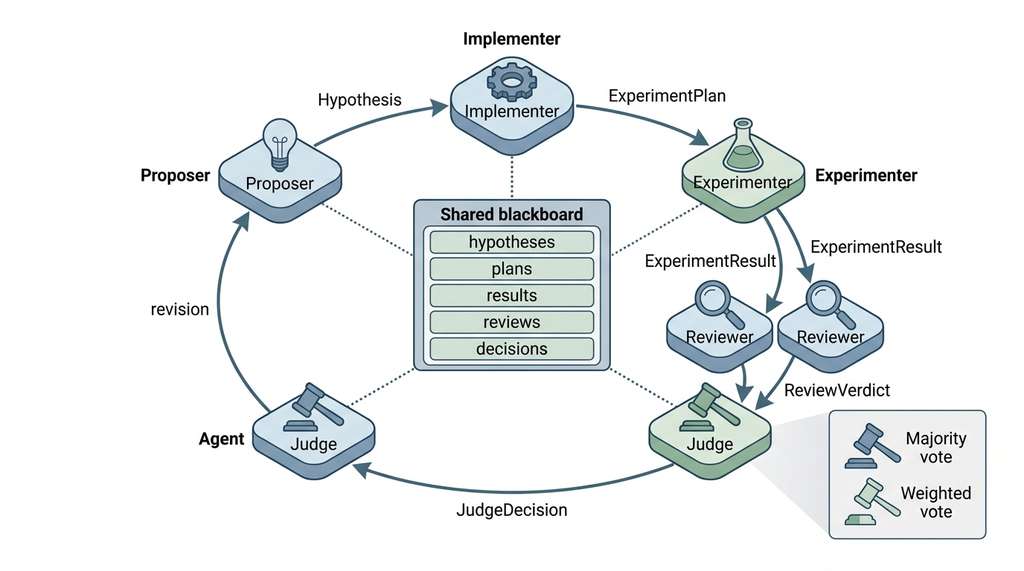
Science is not a solitary activity. The most productive research groups combine specialists who bring different skills, perspectives, and critical instincts. Multi-agent discovery systems replicate this social structure: a proposer generates hypotheses, an implementer turns them into executable experiments, an experimenter runs the experiments and collects results, reviewers critique the methodology and conclusions, and a judge makes accept/reject decisions. This section defines these roles formally, builds the coordination architectures that connect them, and establishes the mathematical foundations (Condorcet jury theorem, game-theoretic equilibria) that explain when collective intelligence emerges and when it fails.
1. Why Teams Outperform Solo Agents
In 2024, a reported autonomous five-agent team at a pharmaceutical company screened 200 drug-target candidates in 48 hours, a task that had previously occupied a human team for two weeks; the key factor was not a better model, but the friction between a creative proposer and a relentless critic operating in parallel. The case for multi-agent teams in scientific discovery parallels the argument we made for software teams in Section 17.1, but with a crucial difference: in software engineering, correctness is verifiable (tests pass or fail); in scientific discovery, correctness is probabilistic, novelty is subjective, and the ground truth may not be known for years. This makes adversarial critique not just helpful but essential.
Cognitive specialization. A system prompt optimized for creative hypothesis generation ("propose bold, unconventional explanations for the observed data") directly conflicts with one optimized for rigorous critique ("identify every flaw in the proposed methodology"). Forcing a single agent to alternate between these modes produces mediocre performance at both. Separate agents, each with a focused persona and tool set, can pursue each cognitive mode to its natural extreme.
Cognitive specialization dedicates each agent to a single cognitive function (generating ideas, writing code, evaluating evidence) and tunes its prompt, temperature, and tool access exclusively for that function. Large language models (LLMs) exhibit measurable performance degradation when a single system prompt optimizes for conflicting objectives simultaneously. A prompt that says "be creative" and "be critical" in the same breath achieves neither well. Isolating each objective in a separate agent with its own configuration lets each operate at the parameter settings (high temperature for creativity, low for rigor) that maximize performance on its specific task. Use cognitive specialization whenever the discovery workflow requires at least two reasoning modes that would produce contradictory prompt instructions if combined. For single-step analyses where one agent handles the full task without conflicting directives, a solo agent remains more cost-effective.
Beyond Specialization: Diversity and Error Structure
Perspective diversity. The Condorcet jury theorem (which we formalize below) tells us that aggregating independent judgments from imperfect agents can produce collective accuracy that exceeds any individual. The key requirement is independence: agents must bring genuinely different perspectives, not echo the same reasoning. This is achievable with LLMs by varying system prompts, model providers, temperature settings, and the subset of evidence each agent receives.
Error decorrelation. A single agent's errors are systematic: it consistently overlooks the same types of confounders, favors the same experimental designs, and has the same blind spots in its training data. Multiple agents with different prompts and configurations produce errors that are partially decorrelated, which is precisely the condition under which voting and aggregation improve accuracy. In short: the value of a team is not that each member is brilliant, but that they are brilliant in different ways and wrong about different things.
The theoretical benefits of multi-agent teams depend on agents making independent errors. In practice, LLM agents share training data, architectural biases, and common failure modes. Two copies of the same model with different system prompts are less independent than two models from different providers. The most effective diversity strategy combines multiple axes: different models (Claude, GPT-4, Gemini), different prompting strategies (chain-of-thought vs. direct), different evidence subsets (each agent sees a different slice of the literature), and different evaluation criteria (one reviewer focuses on methodology, another on statistical validity, a third on novelty).
2. The Five Scientific Agent Roles
Without clearly separated roles, a single agent asked to both generate and critique hypotheses drifts toward self-confirming loops: it proposes an idea, reviews its own reasoning, and approves it, missing the very flaws that a dedicated critic would catch in seconds.
Five canonical roles compose a scientific discovery team, each with a distinct objective, prompt structure, tool set, and output schema. The roles mirror human research group specializations, adapted for LLM capabilities and constraints. Figure 54.1 illustrates how information flows through these five roles in a sequential pipeline with a revision feedback loop.
2.1 The Proposer
The proposer generates candidate hypotheses that explain observed phenomena or predict new ones. Its system prompt emphasizes creativity, breadth of reasoning, and connection to existing literature. The proposer receives a research question and background context, then outputs a structured hypothesis with testable predictions.
from dataclasses import dataclass, field
from typing import Literal


@dataclass
class Hypothesis:
    """Structured output from the proposer agent."""
    statement: str               # The hypothesis in one sentence
    mechanism: str               # Proposed causal mechanism
    predictions: list[str]       # Testable predictions (at least 2)
    novelty_claim: str           # What is new relative to existing work
    required_data: list[str]     # Datasets or experiments needed to test
    confidence: float            # Self-assessed confidence (0-1)
    risk_level: Literal[
        "incremental",           # Small extension of known results
        "moderate",              # Novel combination of existing ideas
        "high"                   # Contradicts established understanding
    ] = "moderate"


@dataclass
class ProposerConfig:
    """Configuration for the proposer agent."""
    role: str = "proposer"
    system_prompt: str = (
        "You are a creative scientific researcher specializing in "
        "hypothesis generation. Your goal is to propose bold, testable "
        "hypotheses that explain observed data or predict new phenomena. "
        "Favor hypotheses that are (1) specific enough to be falsifiable, "
        "(2) novel relative to existing literature, and (3) testable with "
        "available methods. For each hypothesis, provide a clear causal "
        "mechanism and at least two testable predictions."
    )
    temperature: float = 0.9     # High temperature for creativity
    tools: list[str] = field(default_factory=lambda: [
        "literature_search",     # Search papers for related work
        "knowledge_graph_query", # Query the domain knowledge graph
        "data_summary",          # Summarize available datasets
    ])
    output_schema: type = Hypothesis
2.2 The Implementer
The implementer takes a hypothesis and translates it into an executable experimental plan: code, data pipeline, statistical analysis protocol, and success criteria. Where the proposer is creative, the implementer is precise. Its system prompt emphasizes correctness, reproducibility, and explicit specification of all experimental parameters.
@dataclass
class ExperimentPlan:
    """Structured output from the implementer agent."""
    hypothesis_id: str
    code: str                      # Executable Python experiment code
    data_requirements: dict        # {dataset_name: preprocessing_steps}
    statistical_tests: list[str]   # Named tests with significance thresholds
    success_criteria: list[str]    # Measurable criteria for hypothesis support
    expected_runtime: str          # Estimated wall-clock time
    compute_requirements: str      # CPU/GPU/memory requirements
    reproducibility_notes: str     # Seeds, environment, versioning


@dataclass
class ImplementerConfig:
    """Configuration for the implementer agent."""
    role: str = "implementer"
    system_prompt: str = (
        "You are a meticulous computational scientist. Given a hypothesis, "
        "write a complete, self-contained Python experiment that tests it. "
        "Your code must be reproducible: set random seeds, pin library "
        "versions, log all parameters. Define explicit success criteria "
        "with statistical significance thresholds. Prefer simple experiments "
        "that test the core prediction over complex ones that test everything."
    )
    temperature: float = 0.2     # Low temperature for precise code
    tools: list[str] = field(default_factory=lambda: [
        "code_executor",         # Run Python code in sandbox
        "dataset_loader",        # Load and inspect datasets
        "statistics_reference",  # Look up statistical test requirements
    ])
    output_schema: type = ExperimentPlan
2.3 The Experimenter
The experimenter executes the experiment plan, manages computational resources, handles failures, and collects raw results. In a self-driving lab (Chapter 55), this agent would also control physical instruments. Here, it runs computational experiments and returns structured results.
@dataclass
class ExperimentResult:
    """Structured output from the experimenter agent."""
    hypothesis_id: str
    plan_id: str
    status: Literal["success", "failure", "partial", "error"]
    raw_outputs: dict              # Raw numerical/statistical results
    figures: list[str]             # Paths to generated plots
    statistical_summary: dict      # {test_name: {statistic, p_value, effect_size}}
    success_criteria_met: dict     # {criterion: bool}
    runtime_seconds: float
    reproducibility_hash: str      # Hash of code + data + environment
    anomalies: list[str]           # Unexpected observations during execution
    interpretation: str            # Experimenter's initial interpretation


@dataclass
class ExperimenterConfig:
    """Configuration for the experimenter agent."""
    role: str = "experimenter"
    system_prompt: str = (
        "You are a careful experimental scientist. Execute the provided "
        "experiment plan exactly as specified. Report all results honestly, "
        "including negative and unexpected findings. Do not cherry-pick "
        "results or adjust parameters post-hoc. If the experiment fails "
        "to run, diagnose the failure and report it. Record any anomalous "
        "observations that were not part of the original plan."
    )
    temperature: float = 0.1     # Very low: execute faithfully
    tools: list[str] = field(default_factory=lambda: [
        "code_executor",         # Run experiments in sandbox
        "gpu_allocator",         # Request GPU resources
        "result_logger",         # Log results to experiment registry
        "plot_generator",        # Create visualizations
    ])
    output_schema: type = ExperimentResult
2.4 The Reviewer
The reviewer evaluates the entire pipeline: hypothesis quality, experimental design soundness, result interpretation, and statistical validity. We deploy multiple reviewers with different evaluation foci (methodology, statistics, novelty) to achieve perspective diversity. Section 54.2 develops the review protocol in detail.
@dataclass
class ReviewVerdict:
    """Structured output from a reviewer agent."""
    hypothesis_id: str
    decision: Literal["accept", "revise", "reject"]
    confidence: float              # Reviewer confidence in decision (0-1)
    strengths: list[str]           # What the work does well
    weaknesses: list[str]          # Specific, actionable critiques
    questions: list[str]           # Questions for the authors
    methodology_score: int         # 1-10
    statistical_rigor_score: int   # 1-10
    novelty_score: int             # 1-10
    reproducibility_score: int     # 1-10
    overall_score: int             # 1-10
    suggested_experiments: list[str]  # Additional experiments to strengthen claims


@dataclass
class ReviewerConfig:
    """Configuration for a reviewer agent."""
    role: str = "reviewer"
    focus: str = "methodology"     # "methodology", "statistics", or "novelty"
    system_prompt_template: str = (
        "You are a demanding scientific peer reviewer specializing in "
        "{focus}. Evaluate the submitted hypothesis, experimental design, "
        "and results with the rigor of a top-tier journal review. Be "
        "constructive but unsparing: identify every methodological flaw, "
        "statistical error, and unsupported claim. Score each dimension "
        "from 1 (unacceptable) to 10 (exceptional). Recommend 'accept' "
        "only if the work meets the standards of a leading venue."
    )
    temperature: float = 0.4     # Moderate: firm but not deterministic
2.5 The Judge
The judge aggregates reviewer verdicts, resolves disagreements, and makes a final accept/revise/reject decision. Unlike reviewers, the judge sees all reviews and can weigh them differently based on reviewer track records. The judge also decides whether a revision cycle is warranted or whether the hypothesis should be abandoned.
@dataclass
class JudgeDecision:
    """Structured output from the judge agent."""
    hypothesis_id: str
    final_decision: Literal["accept", "major_revision", "minor_revision", "reject"]
    reasoning: str                 # Explanation of the decision
    reviewer_agreement: float      # Inter-reviewer agreement (0-1)
    key_concerns: list[str]        # Issues that must be addressed
    revision_guidance: str         # Specific guidance for revision
    priority_rank: float           # Priority relative to other hypotheses (0-1)


@dataclass
class JudgeConfig:
    """Configuration for the judge agent."""
    role: str = "judge"
    system_prompt: str = (
        "You are the area chair of a scientific review process. You have "
        "received multiple reviewer reports for a submitted hypothesis and "
        "its experimental results. Weigh the reviewers' opinions, resolve "
        "disagreements, and make a final decision. Consider the overall "
        "scientific merit: does this work advance understanding? Is the "
        "evidence sufficient for the claims? Would the scientific community "
        "benefit from this finding? Be decisive."
    )
    temperature: float = 0.3     # Low: decisions should be stable
A pharmaceutical research group deploys a five-agent team to screen potential drug targets for a rare autoimmune disease. The proposer analyzes gene expression data and literature to suggest candidate protein targets. The implementer designs molecular docking simulations for each candidate. The experimenter runs the simulations on a graphics processing unit (GPU) cluster and collects binding affinity scores. Two reviewers evaluate the results: one focuses on the biological plausibility of the proposed mechanism, the other on the statistical significance of the binding predictions. The judge ranks the candidates by overall merit. Over 48 hours, the team evaluates 200 candidates and surfaces the top 12 for wet-lab validation, a process that would take a human team two weeks.
3. Coordination Architectures
The five roles must be connected through a coordination architecture that determines how information flows, how tasks are assigned, and how conflicts are resolved. Three primary architectures appear in the literature and in practice: shared-state blackboards, voting protocols, and auction-based task allocation. Figure 54.1.1 illustrates five-role scientific agent team coordination architecture.
3.1 Shared-State Blackboard
The simplest coordination architecture is a shared blackboard, where a blackboard is a central data structure that all agents can read and write. Each agent posts its outputs to the blackboard, and downstream agents read the outputs they need. This is the architecture we used for software teams in Section 17.2, adapted here for scientific workflows.
from dataclasses import dataclass, field
from typing import Any
from datetime import datetime


@dataclass
class DiscoveryState:
    """Shared blackboard state for a multi-agent discovery team.

    All agents read from and write to this state. The LangGraph
    framework manages state transitions and persistence.
    """
    # Research context
    research_question: str = ""
    background_literature: list[dict] = field(default_factory=list)
    available_datasets: list[str] = field(default_factory=list)

    # Pipeline outputs (populated by agents in sequence)
    hypotheses: list[Hypothesis] = field(default_factory=list)
    experiment_plans: list[ExperimentPlan] = field(default_factory=list)
    experiment_results: list[ExperimentResult] = field(default_factory=list)
    reviews: list[ReviewVerdict] = field(default_factory=list)
    judge_decisions: list[JudgeDecision] = field(default_factory=list)

    # Coordination metadata
    current_phase: str = "proposal"
    iteration: int = 0
    max_iterations: int = 3
    total_tokens_used: int = 0
    token_budget: int = 500_000
    history: list[dict] = field(default_factory=list)

    def log_action(self, agent_role: str, action: str, tokens: int):
        """Record an agent action to the shared history."""
        self.history.append({
            "timestamp": datetime.now().isoformat(),
            "agent": agent_role,
            "action": action,
            "tokens": tokens,
            "iteration": self.iteration,
        })
        self.total_tokens_used += tokens

    @property
    def budget_remaining(self) -> int:
        return self.token_budget - self.total_tokens_used

    @property
    def budget_exhausted(self) -> bool:
        return self.total_tokens_used >= self.token_budget
The blackboard architecture is simple and transparent: every agent can inspect the full history of the research process. Its weakness is that it offers no mechanism for disagreement resolution. If two reviewers disagree, the blackboard contains both reviews. The judge must explicitly resolve the disagreement, which leads us to voting protocols.
3.2 Voting Protocols
When multiple agents evaluate the same hypothesis, we need a principled way to aggregate their judgments. Voting theory from social choice provides the mathematical framework. The simplest protocol is majority voting: each reviewer casts a vote (accept/revise/reject), and the majority wins. But majority voting has well-known problems when there are more than two options, and it treats all voters equally regardless of their track records.
import numpy as np
from collections import Counter


def majority_vote(
    verdicts: list[ReviewVerdict],
) -> str:
    """Simple majority vote across reviewer decisions."""
    votes = [v.decision for v in verdicts]
    counter = Counter(votes)
    winner, count = counter.most_common(1)[0]
    return winner


def confidence_weighted_vote(
    verdicts: list[ReviewVerdict],
    reviewer_weights: dict[str, float] | None = None,
) -> tuple[str, float]:
    """Weighted vote using reviewer confidence and historical accuracy.

    Each reviewer's vote is weighted by:
      w_i = confidence_i * track_record_i

    where track_record_i is the reviewer's historical agreement
    with final outcomes (calibration score).
    """
    options = ["accept", "revise", "reject"]
    scores = {opt: 0.0 for opt in options}

    for verdict in verdicts:
        # Base weight is the reviewer's self-reported confidence
        weight = verdict.confidence

        # Scale by historical track record if available
        if reviewer_weights and verdict.hypothesis_id in reviewer_weights:
            weight *= reviewer_weights[verdict.hypothesis_id]

        scores[verdict.decision] += weight

    # Normalize to get a probability distribution
    total = sum(scores.values())
    if total == 0:
        return "revise", 0.0

    probs = {opt: s / total for opt, s in scores.items()}
    winner = max(probs, key=probs.get)
    return winner, probs[winner]


def compute_agreement(verdicts: list[ReviewVerdict]) -> float:
    """Compute inter-reviewer agreement using Fleiss' kappa.

    Fleiss' kappa measures the degree of agreement among multiple
    raters beyond what would be expected by chance alone.
    Kappa > 0.6 indicates substantial agreement.
    Kappa < 0.2 indicates poor agreement (reviewers disagree).
    """
    if len(verdicts) < 2:
        return 1.0

    categories = ["accept", "revise", "reject"]
    n_raters = len(verdicts)

    # Build the rating matrix (1 item, n_raters raters, 3 categories)
    counts = Counter(v.decision for v in verdicts)
    n_j = [counts.get(cat, 0) for cat in categories]

    # P_i: proportion of agreeing pairs for this item
    p_i = (sum(nj * (nj - 1) for nj in n_j)) / (n_raters * (n_raters - 1))

    # P_e: expected agreement by chance
    p_j = [nj / n_raters for nj in n_j]
    p_e = sum(pj ** 2 for pj in p_j)

    if p_e == 1.0:
        return 1.0

    kappa = (p_i - p_e) / (1 - p_e)
    return kappa
3.3 Auction-Based Task Allocation
In some discovery workflows, the next task is not predetermined by a fixed graph. Instead, multiple hypotheses compete for limited experimental resources (compute time, application programming interface (API) calls, lab instruments). An auction mechanism lets agents bid for resources based on the expected value of their proposed experiments.
@dataclass
class ExperimentBid:
    """A bid from a proposer for experimental resources."""
    hypothesis_id: str
    proposer_id: str
    expected_information_gain: float  # Estimated bits of information
    resource_cost: float              # Estimated compute cost ($)
    confidence: float                 # Proposer's confidence (0-1)
    priority_score: float = 0.0       # Computed by the auction

    @property
    def cost_efficiency(self) -> float:
        """Information gain per dollar: higher is better."""
        if self.resource_cost <= 0:
            return float("inf")
        return self.expected_information_gain / self.resource_cost


def run_auction(
    bids: list[ExperimentBid],
    budget: float,
    strategy: str = "greedy_efficiency",
) -> list[ExperimentBid]:
    """Select experiments to fund given a fixed budget.

    Strategies:
      - greedy_efficiency: rank by information_gain / cost, fill greedily
      - diversity: ensure selected experiments test different mechanisms
      - exploration: favor high-risk, high-reward hypotheses
    """
    if strategy == "greedy_efficiency":
        # Sort by cost efficiency (descending)
        ranked = sorted(bids, key=lambda b: b.cost_efficiency, reverse=True)
    elif strategy == "exploration":
        # Favor high-risk hypotheses: weight by (1 - confidence)
        for bid in bids:
            bid.priority_score = bid.cost_efficiency * (1 - bid.confidence + 0.1)
        ranked = sorted(bids, key=lambda b: b.priority_score, reverse=True)
    else:
        ranked = bids

    # Greedily fill the budget
    selected = []
    remaining_budget = budget
    for bid in ranked:
        if bid.resource_cost <= remaining_budget:
            selected.append(bid)
            remaining_budget -= bid.resource_cost

    return selected
The blackboard, voting, and auction logic above totals roughly 150 lines.
LangGraph, a framework for building stateful multi-agent workflows on top of LangChain,
provides all of this out of the box with its StateGraph class: typed state
annotations, conditional edges, and built-in checkpointing. A five-agent discovery
pipeline that would take 200+ lines of custom orchestration code reduces to roughly
40 lines of LangGraph graph definition, plus the agent prompts themselves. LangGraph
handles state serialization, replay, and branching internally.
4. The Condorcet Jury Theorem for Agent Teams
The mathematical justification for multi-agent voting comes from the Condorcet jury theorem (1785), a result from social choice theory stating that majority voting among independently deciding agents converges to the correct answer as the number of agents grows, provided each agent is individually better than random. The theorem states that if each voter (agent) independently has a probability \(p > 0.5\) of choosing the correct answer, then the probability that the majority vote is correct approaches 1 as the number of voters grows. Formally:
$$P(\text{majority correct}) = \sum_{k=\lceil n/2 \rceil}^{n} \binom{n}{k} p^k (1-p)^{n-k}$$where \(n\) is the number of voters and \(p\) is each voter's individual accuracy. For \(n = 5\) reviewers each with \(p = 0.7\) accuracy, the majority-vote accuracy is:
$$P(\text{majority correct}) = \sum_{k=3}^{5} \binom{5}{k} (0.7)^k (0.3)^{5-k} \approx 0.837$$Three independent reviewers with 70% individual accuracy produce a collective accuracy of 78.4%. Five reviewers push this to 83.7%, and seven to 87.4%. The improvement is significant but diminishing: each additional reviewer adds less accuracy while adding full cost.
Mental Model
Think of the Condorcet jury theorem like a panel of food tasters judging whether a dish is properly seasoned. Each taster has a decent palate (better than coin-flip accuracy) but sometimes misjudges: one is less sensitive to salt, another overreacts to spice. When they vote independently, their individual blind spots rarely overlap on the same dish. The majority verdict converges on the correct judgment because each taster's errors cancel against the others' strengths. The key word is independently: if all the tasters trained at the same culinary school and share the same bias toward under-salting, their votes will be correlated and the majority will systematically get it wrong. In agent teams, "trained at the same school" corresponds to using the same LLM with similar prompts, which is why cross-model diversity is the seasoning that makes Condorcet work.
from math import comb


def condorcet_majority_accuracy(n: int, p: float) -> float:
    """Compute probability that majority vote is correct.

    Args:
        n: Number of voters (must be odd for strict majority).
        p: Individual voter accuracy (probability of correct vote).

    Returns:
        Probability that the majority vote selects the correct option.
    """
    if not 0 < p < 1:
        raise ValueError(f"p must be in (0,1), got {p}")
    if n % 2 == 0:
        raise ValueError(f"n must be odd for strict majority, got {n}")

    threshold = n // 2 + 1  # minimum votes for majority
    return sum(
        comb(n, k) * p**k * (1 - p)**(n - k)
        for k in range(threshold, n + 1)
    )


# Demonstrate: how team accuracy scales with team size
for n_agents in [1, 3, 5, 7, 9, 11]:
    if n_agents == 1:
        acc = 0.7  # single agent baseline
    else:
        acc = condorcet_majority_accuracy(n_agents, 0.7)
    print(f"  {n_agents} agent(s): {acc:.3f} majority accuracy")
Step-Through: Condorcet Majority Accuracy
Trace through the majority-vote formula with \(n = 3\) agents, each with individual accuracy \(p = 0.7\). The majority threshold is \(k \geq 2\) (at least 2 of 3 must be correct).
\(k = 2\): \(\binom{3}{2} \times 0.7^2 \times 0.3^1 = 3 \times 0.49 \times 0.3 = 0.441\)
\(k = 3\): \(\binom{3}{3} \times 0.7^3 \times 0.3^0 = 1 \times 0.343 \times 1.0 = 0.343\)
Total: \(P(\text{majority correct}) = 0.441 + 0.343 = 0.784\)
So three agents at 70% individual accuracy yield 78.4% collective accuracy: an 8.4 percentage point gain over a solo agent. Now repeat for \(n = 5\): the threshold becomes \(k \geq 3\), and the three terms sum to \(0.3087 + 0.3601 + 0.1681 = 0.8369\). The jump from 1 to 3 agents (+8.4 pp) is larger than the jump from 3 to 5 agents (+5.3 pp), illustrating diminishing returns.
The theorem has two critical assumptions that often break in practice with LLM agents:
Independence. The theorem requires voters to err independently. LLM agents sharing the same training data violate this assumption. Empirically, the correlation between errors from two copies of GPT-4 with different system prompts is estimated at roughly 0.4 to 0.6, far from zero. Using different model families (Claude + GPT-4 + Gemini) reduces this to roughly 0.2 to 0.3, which partially recovers the Condorcet benefit.
Better than random. The theorem requires \(p > 0.5\). If individual agents are worse than random on a task, the majority vote converges to the wrong answer. This can happen when the task requires specialized domain knowledge that the LLM lacks, or when the agents share a systematic bias. The practical implication is to validate individual agent accuracy on a calibration set before deploying majority voting.
Common Misconception
A frequent misconception is that adding more agents to a team always improves accuracy. The Condorcet theorem guarantees improvement only when each agent is individually better than random (\(p > 0.5\)) and the agents err independently. If your agents share the same model and similar prompts, their error correlation can be high enough that five agents perform barely better than one, while costing five times as much. Worse, if the shared model is systematically wrong on the task (\(p < 0.5\)), more agents make the majority vote more confidently wrong. Always measure individual agent accuracy on a held-out calibration set before scaling up team size.
5. Game-Theoretic Equilibria in Agent Incentives
Condorcet tells us how to aggregate votes, but it says nothing about why each agent votes the way it does; for that, we need a model of agent incentives.
When agents interact repeatedly, their behavior can be analyzed through the lens of game theory. Two common failure modes emerge from incentive misalignment:
Groupthink (convergent failure). If the reviewer agent is penalized (through prompt design or reward signals) for disagreeing with the proposer, it learns to rubber-stamp proposals. The team converges to the first hypothesis generated, regardless of quality. This is the multi-agent analogue of confirmation bias.
Adversarial deadlock (divergent failure). If the reviewer is rewarded for finding flaws, it learns to reject everything. The team never accepts a hypothesis, and the discovery process stalls. This is the multi-agent analogue of an overly harsh peer review process.
These two failure modes sit at opposite ends of a spectrum: groupthink produces false positives (accepting bad work), while adversarial deadlock produces false negatives (rejecting good work). The goal of incentive design is to find a stable middle ground where both proposer and reviewer behave productively.
The desired equilibrium is one where the proposer generates genuinely good hypotheses (because weak ones will be caught) and the reviewer provides genuinely useful critique (because the judge weights reviews by their constructiveness). We formalize this as a two-player game:
$$ \begin{aligned} U_{\text{proposer}} &= \alpha \cdot \text{novelty} + \beta \cdot P(\text{accepted}) - \gamma \cdot \text{revision\_rounds} \\ U_{\text{reviewer}} &= \delta \cdot \text{true\_positives} + \epsilon \cdot \text{true\_negatives} - \zeta \cdot \text{false\_rejections} \end{aligned} $$where the \(\alpha, \beta, \gamma, \delta, \epsilon, \zeta\) coefficients encode the relative importance of each objective. At the Nash equilibrium, the strategy profile where neither player can improve their payoff by unilaterally changing strategy, neither agent can improve its utility by unilaterally changing strategy. This equilibrium produces the desired behavior: proposers generate high-quality hypotheses that balance novelty and plausibility, and reviewers provide calibrated critique that catches real problems without blocking good work.
@dataclass
class AgentIncentives:
    """Utility function parameters for agent incentive alignment.

    Tuning these parameters shifts the equilibrium between
    groupthink (too agreeable) and deadlock (too adversarial).
    """
    # Proposer incentives
    novelty_weight: float = 0.3        # alpha: reward for novel hypotheses
    acceptance_weight: float = 0.4     # beta: reward for accepted hypotheses
    revision_penalty: float = 0.3      # gamma: cost per revision round

    # Reviewer incentives
    true_positive_weight: float = 0.4  # delta: reward for catching real flaws
    true_negative_weight: float = 0.3  # epsilon: reward for passing good work
    false_rejection_penalty: float = 0.3  # zeta: cost for rejecting good work

    def proposer_utility(
        self,
        novelty_score: float,
        accepted: bool,
        revision_rounds: int,
    ) -> float:
        return (
            self.novelty_weight * novelty_score
            + self.acceptance_weight * float(accepted)
            - self.revision_penalty * revision_rounds
        )

    def reviewer_utility(
        self,
        true_positives: int,
        true_negatives: int,
        false_rejections: int,
    ) -> float:
        return (
            self.true_positive_weight * true_positives
            + self.true_negative_weight * true_negatives
            - self.false_rejection_penalty * false_rejections
        )
The Reviewer Who Proved Itself Wrong
In 2024, researchers at Sakana AI discovered that their automated reviewer agent sometimes flagged its own earlier outputs as methodologically flawed when re-run with a different random seed. This was not a bug; it was a feature. The reviewer's stochastic sampling meant it explored different critique paths each run, occasionally catching weaknesses it had previously missed. Human peer reviewers exhibit the same phenomenon: studies of conference review consistency show that two independent reviews of the same paper agree on accept/reject only about 50% to 65% of the time (the NIPS 2014 consistency experiment found approximately 50% agreement). The uncomfortable implication is that both human and AI review are substantially noisy, which is precisely why the Condorcet framework and multi-reviewer aggregation matter.
In LLM-based multi-agent systems, the "incentive structure" is not a reward function optimized through training. It is the system prompt. When you write "be constructive but unsparing" in a reviewer's prompt, you are setting \(\delta\) and \(\zeta\) implicitly. When you write "propose bold hypotheses" for the proposer, you are increasing \(\alpha\). The game-theoretic framework gives you a vocabulary for reasoning about these design choices: if your team suffers from groupthink, increase the reviewer's \(\delta\) (reward for catching flaws) by making the prompt more adversarial. If it suffers from deadlock, increase \(\zeta\) (penalty for false rejections) by adding "do not reject work that is fundamentally sound but needs minor improvements."
6. When Collective Intelligence Fails
Well-tuned incentives are necessary but not sufficient; even a team with perfectly aligned utility functions can fail when the statistical assumptions underlying collective intelligence break down.
Multi-agent teams are not universally better than solo agents. Three conditions cause collective intelligence to collapse:
Correlated errors. When all agents share the same blind spot (for example, a systematic bias in training data about a particular scientific domain), adding more agents does not help. The Condorcet theorem's independence assumption breaks, and the majority vote amplifies the shared error. The fix is to maximize diversity across model providers, prompting strategies, and evidence sources.
Cascading overconfidence. When agents observe each other's outputs (as in a sequential pipeline), later agents anchor on earlier outputs (treating them as more reliable than warranted, a tendency known as anchoring bias) even when those outputs are wrong. The experimenter trusts the implementer's code; the reviewer trusts the experimenter's results. A single error in the proposer's hypothesis can cascade through the entire pipeline without correction. The fix is to give each reviewer access to raw data, not just upstream summaries.
Coordination overhead. Each agent interaction costs tokens, latency, and money. A five-agent team with two review rounds uses 7 to 10 LLM calls per hypothesis, compared to 1 to 2 for a solo agent. If the quality improvement does not justify this cost, the team is worse on a cost-adjusted basis. The fix is to run a calibration experiment (Section 54.3) that measures quality improvement per additional agent and per review round.
Checkpoint
So far: collective intelligence can fail through three distinct mechanisms: correlated errors (shared blind spots amplify mistakes), cascading overconfidence (sequential agents propagate upstream errors), and coordination overhead (the cost of multi-agent interaction may exceed the quality gains).
A materials science team builds a multi-agent discovery system where the proposer uses Claude (high creativity), the implementer uses GPT-4 (strong code generation), the experimenter uses a local Llama model (low cost for repeated execution), and the two reviewers use Claude and Gemini respectively. This cross-model configuration achieves an inter-reviewer agreement (kappa) of 0.52 and a collective accuracy of 81%, compared to kappa = 0.71 and accuracy of 76% for same-model reviewers. Lower agreement indicates genuine perspective diversity, which translates to higher collective accuracy: exactly the Condorcet prediction.
Real-World Application: Autonomous Chemical Discovery
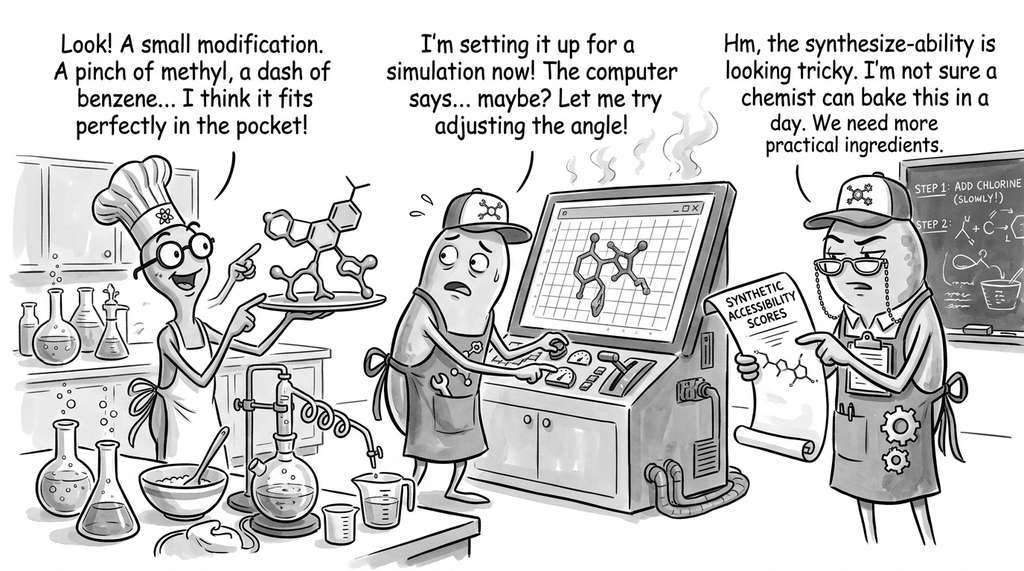
Genentech's ARIA system (2024) deploys a multi-agent team for small-molecule drug design where a proposer agent suggests molecular modifications, an implementer agent sets up docking simulations, and reviewer agents evaluate synthetic accessibility and predicted toxicity. The judge agent ranks candidates by a composite score and routes the top 5% to wet-lab synthesis. In internal benchmarks, the multi-agent pipeline surfaced viable leads at roughly four times the throughput of their prior single-model screening workflow.
Research Frontier
Sakana AI's "The AI Scientist" system (Lu et al., 2024) demonstrated a fully autonomous multi-agent research pipeline that generates hypotheses, writes experimental code, executes experiments, and produces complete scientific manuscripts with automated peer review. The system uses separate LLM agents for ideation, implementation, experimentation, and reviewing, closely mirroring the five-role architecture described in this section. In controlled evaluations, the automated reviewer agent achieved near-human accuracy in scoring generated papers. More recent work, including MLR-Copilot (Li et al., 2024) and the open-source OpenResearcher framework (2024), extends this pattern with retrieval-augmented literature grounding and iterative refinement loops that allow agent teams to revise hypotheses across multiple cycles. These systems push beyond what this section covers by closing the loop entirely: the judge's output feeds directly back to the proposer with specific revision guidance, enabling multi-round autonomous research campaigns that run for days without human intervention.
Try It: Build a Three-Agent Hypothesis Review Pipeline
Build a minimal multi-agent team that proposes and reviews scientific hypotheses using any LLM API you have access to. Step 1: Define three agent roles (proposer, reviewer, judge) as Python dictionaries, each with a system prompt and temperature setting. Use the prompts from this section as starting points. Step 2: Write a call_agent(role, user_message) function that sends a request to your LLM API with the role's system prompt and temperature, returning the response text. Step 3: Implement the pipeline: call the proposer with the research question "What factors most strongly predict urban heat island intensity?", parse its hypothesis, then send the hypothesis to two reviewer instances (one focused on methodology, one on statistical rigor) with different system prompts. Step 4: Feed both reviews to the judge agent, whose prompt instructs it to weigh the reviews and output a final accept/revise/reject decision with reasoning. Step 5: Run the pipeline three times and compare outcomes. Measure inter-run agreement: do the reviewers flag the same weaknesses each time? Does the judge reach the same decision? Log token counts per run to calculate cost per hypothesis. This exercise requires only the openai or anthropic Python package and roughly 20,000 tokens per run.
Exercises
- Conceptual: The Condorcet jury theorem assumes binary decisions (correct/incorrect). Scientific review uses three options (accept/revise/reject). Extend the theorem to three options by treating it as a multinomial problem. Under what conditions does majority voting still converge to the correct answer? What happens when "revise" is the correct answer but no option achieves a strict majority?
-
Coding: Implement a
ModelDiversitySchedulerthat assigns different LLM providers to different agent roles. The scheduler should accept a list of available models with their costs and capabilities, and assign them to roles to maximize error decorrelation while staying within a per-hypothesis budget of \$2.00. Test with at least three model providers and five roles. - Analysis: A discovery team with 5 agents and 2 review rounds costs approximately \$1.50 per hypothesis in API calls. A single-agent baseline costs \$0.20 per hypothesis. The team produces accepted hypotheses at a rate of 35% (35 out of 100 pass review), while the single agent produces hypotheses at 100% rate (no filter). If 40% of team-accepted hypotheses are genuinely correct and only 12% of single-agent hypotheses are correct, compute the cost per correct hypothesis for each approach. Which is more cost-effective?
Exercise 54.1.1
You have three reviewer agents with individual accuracies \(p_1 = 0.75\), \(p_2 = 0.65\), and \(p_3 = 0.70\). However, reviewers 1 and 2 share the same base model (error correlation approximately 0.5), while reviewer 3 uses a different provider (correlation with the others approximately 0.15). Is majority voting still guaranteed to outperform the best individual reviewer (\(p_1 = 0.75\))? Compute the naive Condorcet majority accuracy assuming independence (use the average \(p = 0.7\)), then reason qualitatively about how the correlated pair affects the true collective accuracy. Under what correlation threshold does the team reliably beat the solo best?
Hint
When two reviewers are correlated, treat them as providing roughly 1.5 independent votes rather than 2. The effective number of independent voters \(n_{\text{eff}}\) is smaller than the raw count. Compute the Condorcet accuracy for \(n_{\text{eff}} \approx 2\) (using the formula for \(n = 3\) but discounting the correlated pair) and compare to \(p_1 = 0.75\). You will find a crossover point where correlation is high enough that the team underperforms the best solo agent.
Lab: Measuring Error Correlation Across LLM Reviewers
Goal: Empirically measure how much error correlation drops when you use different models versus different prompts with the same model, and verify that lower correlation yields higher collective accuracy.
Tools needed: Python 3.10+, the openai and anthropic
SDKs (or any two LLM providers), and a set of 30 factual science questions with known
correct answers (use a quiz dataset like SciQ from HuggingFace).
Procedure: (1) Run each question through three "reviewer" configurations: Config A uses the same model with three different system prompts; Config B uses three different models (e.g., Claude Haiku, GPT-4o-mini, Gemini Flash) with identical prompts. Record each reviewer's binary correct/incorrect verdict. (2) For each config, compute the pairwise error correlation (Pearson correlation of binary error vectors) and the majority-vote accuracy across the 30 questions.
What to vary: Try prompt diversity levels (minimal wording changes vs. radically different personas) and model diversity levels (same family vs. cross-provider). What to observe: Does cross-model diversity consistently produce lower error correlation than cross-prompt diversity? Does lower correlation translate to higher majority-vote accuracy, as Condorcet predicts? Plot correlation vs. collective accuracy for all configurations.
What's Next
With roles defined and coordination architectures established, Section 54.2: Debate and Peer Review Protocols develops the adversarial interaction patterns that make multi-agent teams valuable. That section covers structured debate protocols, peer review with calibrated reviewers, and methods for measuring when critique improves discovery quality versus when it degrades it. The reviewer and judge roles defined here are central to Section 54.2.